"And what's the good of it?" I said, "What reasons made you call from formless void this earth we tread . . . Yea, Sire, why shaped you us, 'who in this tabernacle groan'--if ever a joy be found herein, such joy no man had wished to win if he had never known!"
So said an imaginary person, perhaps one through Thomas Hardy himself was voicing his thoughts, to God, in his poem "New Years Eve." Why did God make and "shape" us? Why do we need to be, to live?
Because God loves us, is the oft used Christian response. Though I do not dispute the fact of God's love, the sentiments of Hardy's poem do cause one to wonder why, even if at the end of all space and time God will redeem all things and restore all that has been lost, humanity must endure such pain and tragedy to experience such bliss?
Because of humanity's sin, is the oft used Christian response. Again, I do not dispute the fact of sin, but to an outsider looking in, one might wonder why it happened, why Adam and Eve made the fateful decision, why the world was plunged into moral darkness.
The fact of human choice is a frightfully difficult one to grasp, a notion I do not pretend to understand fully. But I will offer that without choice people are deterministic robots, bereft of any point, captives of a nothingness of destiny. Why do we live? Why do we choose? Frustratingly, we cannot meaningfully do one without the other.
In this is the puzzle and conundrum of humanness.
Wednesday, October 12, 2016

Monday, October 10, 2016
1492. It's one of the most pivotal years in human history. "In 1492," as the school kids' song goes, "Columbus sailed the blue." As almost everyone knows, what Columbus found on the other side of the "blue" changed the world. Humans of two hemispheres, neither of whom had been aware of the other, suddenly were, almost overnight, finding themselves confronting worlds that literally blew their collective minds. No one would ever be the same.
Sadly, however, as anyone who has read the late historian Howard Zinn's A People's History of the United States (and similar works) knows, although 1492 may have been a momentuous and lucrative year for many Europeans, it was a terrible one for the natives of the Americas. 1492 marked the beginning of a lengthy European oppression and exploitation of the peoples of the Americas, a run of centuries of difficulty and pain, pain which, in some cases, continues, in multiple forms, to this day.
The worst of it is that in too many instances this exploitation was justified in the name of Christianity. It was an awful stain on the love of God.
Historian Erna Paris once observed that, "Attaching God to history is the most powerful nationalism of all." Whenever we try to juxtapose God and the history we are trying to create, we blur a line we cannot possibly cross: the boundary between what is here and what is not, the difference between the visible speculations of finitude and the hidden certitudes of infinity. We think we speak for God.
And God, it seems, whether he is talking about politics, economics, religion, or inculturation, does not need us to speak for him. He doesn't need our societal connections and associations to give the planet purpose or meaning. But we need God. We need God to speak to us. And as long as we unilaterally construct our sense of greatness and purpose on our limited and necessarily incomplete perceptions of divine will and judgment, we will never hear him.
Ah, Christopher Columbus. What a puzzle, what a glorious and messy puzzle, you bequeathed us!
Sadly, however, as anyone who has read the late historian Howard Zinn's A People's History of the United States (and similar works) knows, although 1492 may have been a momentuous and lucrative year for many Europeans, it was a terrible one for the natives of the Americas. 1492 marked the beginning of a lengthy European oppression and exploitation of the peoples of the Americas, a run of centuries of difficulty and pain, pain which, in some cases, continues, in multiple forms, to this day.
The worst of it is that in too many instances this exploitation was justified in the name of Christianity. It was an awful stain on the love of God.
Historian Erna Paris once observed that, "Attaching God to history is the most powerful nationalism of all." Whenever we try to juxtapose God and the history we are trying to create, we blur a line we cannot possibly cross: the boundary between what is here and what is not, the difference between the visible speculations of finitude and the hidden certitudes of infinity. We think we speak for God.
And God, it seems, whether he is talking about politics, economics, religion, or inculturation, does not need us to speak for him. He doesn't need our societal connections and associations to give the planet purpose or meaning. But we need God. We need God to speak to us. And as long as we unilaterally construct our sense of greatness and purpose on our limited and necessarily incomplete perceptions of divine will and judgment, we will never hear him.
Ah, Christopher Columbus. What a puzzle, what a glorious and messy puzzle, you bequeathed us!
Friday, October 7, 2016
Desert Trip? If you're a baby boomer or if you enjoy classic rock and roll, you are surely aware of what is being called the "rock event of the decade" coming up this weekend. For three nights in the desert community of Indio, California (set below the San Gorgornio Mountains, near Palm Springs), this concert will feature performances by the Rolling Stones, Paul McCartney, the Who, Neil Young, Bob Dylan, and Roger Waters (formerly of Pink Floyd). It's a classic rock aficionado's dream come true.
In preparation, many rock stations around the U.S. are playing songs from the massive music catalogs these bands/individuals have accumulated over the decades they have been doing music So it was that this morning I heard a song I had not heard in a long time, Neil Young's "After the Gold Rush." "I dreamed," he sings, "I saw the silver space ships flying in the yellow haze of the sun, there were children crying and colors flying all around the chosen ones . . . they were flying Mother Nature's silver seed to a new home."
It's an idyllic vision, a call for destiny and restoration, a summons to look for the greater picture beyond the political compromise and environmental destruction, driven by the West's immense thirst for oil, of the early Seventies. It's a paean to hope. Listening to the words, I recalled where I was when I first heard them, and where I am today, on the other side of faith.
And that has made all the difference. For it is faith which enables us to see that genuine hope, though it is certainly rooted in our human abilities, must have a framework grounded in transcendence, a God made human being in whom all things come together, to really ring true.
We will not likely make a fully restored world on our own.
Enjoy the show.
In preparation, many rock stations around the U.S. are playing songs from the massive music catalogs these bands/individuals have accumulated over the decades they have been doing music So it was that this morning I heard a song I had not heard in a long time, Neil Young's "After the Gold Rush." "I dreamed," he sings, "I saw the silver space ships flying in the yellow haze of the sun, there were children crying and colors flying all around the chosen ones . . . they were flying Mother Nature's silver seed to a new home."
It's an idyllic vision, a call for destiny and restoration, a summons to look for the greater picture beyond the political compromise and environmental destruction, driven by the West's immense thirst for oil, of the early Seventies. It's a paean to hope. Listening to the words, I recalled where I was when I first heard them, and where I am today, on the other side of faith.
And that has made all the difference. For it is faith which enables us to see that genuine hope, though it is certainly rooted in our human abilities, must have a framework grounded in transcendence, a God made human being in whom all things come together, to really ring true.
We will not likely make a fully restored world on our own.
Enjoy the show.
Thursday, October 6, 2016
Security or compassion? That seems to be the locus by which many Western nations are choosing how they will respond to the continuing refugee crises sweeping the planet. Comfortably affluent, secure in their laws and traditions, most of the wealthiest countries on earth appear to be astonishingly indifferent to the plight of the many millions of people who are not enjoying the fundamental comforts of human agency and form. The appear to be blithely cavalier about the desire of these waves of human beings for a safe place in which to raise their families and contribute to the world's adventure.
The people of the West of course desire safety, too. Don't we all? If I may, I offer a line from the seventh chapter of Ecclesiastes, which reads, "It is good that you grasp one thing and not let go of the other, for the one who trusts God will come forth with them both."
Turning this verse to the refugees and the West, I say that, all things considered, we can do both. We can harbor battered refugees while ensuring safety at home. We lack only the political will and, more importantly, the courage of faith, to do it. Though I do not claim intimate knowledge of the mind of God, I can note that, on the basis of numerous passages in the Hebrew and Christian bibles, God wants us to exercise love and compassion towards our fellow human beings. He longs for peace, he longs for care, he longs for unanimity on the planet. Yes, we must protect ourselves, and yes, we must look out for our families but, equally yes, we must love our neighbor. As did the Good Samaritan (Luke 10), we must go the "extra mile" for our human brethren.
And if we are to place any faith in the truth and validity of this verse from Ecclesiastes, we can conclude that if we do this wisely and rightly, yes, we can do both. We can look beyond ourselves. We can look to the love of God.
The people of the West of course desire safety, too. Don't we all? If I may, I offer a line from the seventh chapter of Ecclesiastes, which reads, "It is good that you grasp one thing and not let go of the other, for the one who trusts God will come forth with them both."
Turning this verse to the refugees and the West, I say that, all things considered, we can do both. We can harbor battered refugees while ensuring safety at home. We lack only the political will and, more importantly, the courage of faith, to do it. Though I do not claim intimate knowledge of the mind of God, I can note that, on the basis of numerous passages in the Hebrew and Christian bibles, God wants us to exercise love and compassion towards our fellow human beings. He longs for peace, he longs for care, he longs for unanimity on the planet. Yes, we must protect ourselves, and yes, we must look out for our families but, equally yes, we must love our neighbor. As did the Good Samaritan (Luke 10), we must go the "extra mile" for our human brethren.
And if we are to place any faith in the truth and validity of this verse from Ecclesiastes, we can conclude that if we do this wisely and rightly, yes, we can do both. We can look beyond ourselves. We can look to the love of God.
Wednesday, October 5, 2016
Although I gain much from the great art of the distant past, the sculptures of ancient Greece, the often misshapen yet devout depictions of the Middle Ages, the marvelous style of the Renaissance, the stirring colors of the Impressionists, and more, I often find its more contemporary successors more thought provoking. In particular, I think of American artist Jackson Pollock.
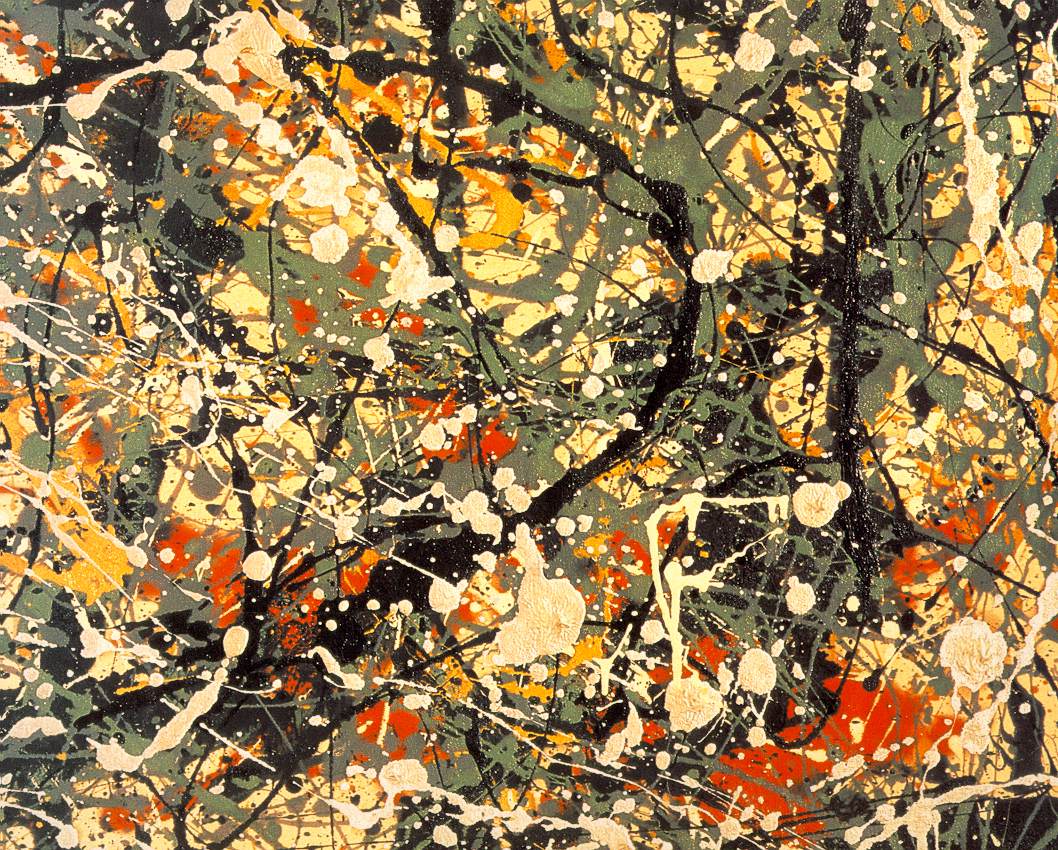
At first glance, one might wonder what is Pollock trying to convey in this painting. At first glance, it looks to be no more than a random mishmash of color. At first glance, it appears to reflect an absence of thought and rationality.
If we understand the pressures under which Pollock labored for most of his life, if we can grasp the angst that drove him to frequent bouts of turmoil and despair, if we can see how much his art reflects the heart of a troubled but highly visionary individual, we can perhaps comprehend. Though the art of the more bygone past certainly reflected the inner worlds of its creators, in Jackson Pollock we see art that endeavors to present an artist's inner world as it more deeply is, as the artist directly experiences it, as he meditates and responds to who he is in a bewildering world. It is life, it is death: it is existence.
Though Pollock died in 1956, his art endures. It's art as perhaps art, in the fractured planet on which we live today, most is. It's art that reminds us that life is more than what we imagine it to be. It's art that, rightly viewed, underscores the necessity of transcendence, and that, without transcendence, life is no more than what our personal angst makes it to be. It comes, it goes, and it is no more.
It's a hard way to go.
At first glance, one might wonder what is Pollock trying to convey in this painting. At first glance, it looks to be no more than a random mishmash of color. At first glance, it appears to reflect an absence of thought and rationality.
If we understand the pressures under which Pollock labored for most of his life, if we can grasp the angst that drove him to frequent bouts of turmoil and despair, if we can see how much his art reflects the heart of a troubled but highly visionary individual, we can perhaps comprehend. Though the art of the more bygone past certainly reflected the inner worlds of its creators, in Jackson Pollock we see art that endeavors to present an artist's inner world as it more deeply is, as the artist directly experiences it, as he meditates and responds to who he is in a bewildering world. It is life, it is death: it is existence.
Though Pollock died in 1956, his art endures. It's art as perhaps art, in the fractured planet on which we live today, most is. It's art that reminds us that life is more than what we imagine it to be. It's art that, rightly viewed, underscores the necessity of transcendence, and that, without transcendence, life is no more than what our personal angst makes it to be. It comes, it goes, and it is no more.
It's a hard way to go.
Tuesday, October 4, 2016
Amidst the turmoil sweeping across the globe, the wars, disputed elections, famines, contentious migrations and abandoned refugees, and more, one often wonders why, in the sated affluence of the West, millions of people devote hour upon hour to . . . college football.
For those who play, college football is a way of life. For those who follow it, it is, in many cases, likewise. For those who earn their living from it, and there are many, ranging from the coaches to the commentators to the people who serve food at the stadiums, it is, for some, highly lucrative.
Numerous pundits have commented on what they term the sorry state of college football, citing the enormous amounts of money spent on it, the inordinate attention paid to it, the way in which it seems to eclipse all other functions of a college, and more. I cannot disagree. The money is excessive, the exploitation deplorable, the myopic focus befuddling.
It's a tough call. The sport entertains millions, keeps millions more employed, and provides a way for many people to attend college, after a fashion, they would not have otherwise. If we measure all things with a financial yardstick, this is fine. If we make our measure transcendence and larger meaning, however, we will view the sport more circumspectly. We will remember that meaning is bigger than present joy and glory, more profound than temporal achievement, that genuine meaning is found in the degree to which we align our finitude with eternity, in the extent to which we ground our moment with the eternal fact and truth of God.
Only then will it really matter.
For those who play, college football is a way of life. For those who follow it, it is, in many cases, likewise. For those who earn their living from it, and there are many, ranging from the coaches to the commentators to the people who serve food at the stadiums, it is, for some, highly lucrative.
Numerous pundits have commented on what they term the sorry state of college football, citing the enormous amounts of money spent on it, the inordinate attention paid to it, the way in which it seems to eclipse all other functions of a college, and more. I cannot disagree. The money is excessive, the exploitation deplorable, the myopic focus befuddling.
It's a tough call. The sport entertains millions, keeps millions more employed, and provides a way for many people to attend college, after a fashion, they would not have otherwise. If we measure all things with a financial yardstick, this is fine. If we make our measure transcendence and larger meaning, however, we will view the sport more circumspectly. We will remember that meaning is bigger than present joy and glory, more profound than temporal achievement, that genuine meaning is found in the degree to which we align our finitude with eternity, in the extent to which we ground our moment with the eternal fact and truth of God.
Only then will it really matter.
Monday, October 3, 2016
Think about our Jewish brothers and sisters today. At sundown last night, Jews around the world entered into the holiest time of their year: the high holy days, the Days of Awe. Beginning with Rosh Hashana (the New Year) and culminating in Yom Kippur (Day of Atonement), these days give every Jew opportunity to reflect on the past and prepare for the future. These days are marked by repentance, discipline, singing, gathering, reading, and meditation, days of intense inwardness--always in community--regarding one's relationship with his/her fellow human beings and God.
All of us can learn from the Days of Awe. All of us can profit from taking time to think, to really think about what and how we are doing with our life, about where we have been, spiritually, vocationally, and personally, and where we want to go, come tomorrow. In this highly charged and media driven age, we all can benefit from setting ourselves apart to ponder deeper things, to contemplating the greater meaning and realities in which we inevitably move.
Although we may not believe we move in a bigger picture, we fool ourselves if we think we can live meaningfully without accepting the fact of its presence. We are born for transcendence, we are made to look beyond the immediate and present. In these Days of Awe, our Jewish brethren remind us that we are more than material concoctions, more than nexuses of chemical exchange. They tell us that we are creatures of this earth, yes, but simultaneously, to borrow the name of an REM song, creatures of the "Great Beyond."
Enjoy your pondering.
All of us can learn from the Days of Awe. All of us can profit from taking time to think, to really think about what and how we are doing with our life, about where we have been, spiritually, vocationally, and personally, and where we want to go, come tomorrow. In this highly charged and media driven age, we all can benefit from setting ourselves apart to ponder deeper things, to contemplating the greater meaning and realities in which we inevitably move.
Although we may not believe we move in a bigger picture, we fool ourselves if we think we can live meaningfully without accepting the fact of its presence. We are born for transcendence, we are made to look beyond the immediate and present. In these Days of Awe, our Jewish brethren remind us that we are more than material concoctions, more than nexuses of chemical exchange. They tell us that we are creatures of this earth, yes, but simultaneously, to borrow the name of an REM song, creatures of the "Great Beyond."
Enjoy your pondering.
Subscribe to:
Posts (Atom)