Tuesday, June 18, 2024

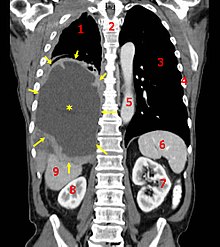
     Pancreatic cancer?  In too many cases these days, such a diagnosis is a death sentence.  Rarely does anyone who is diagnosed escape its clutches.

    When one of my oldest and best friends shared with me recently that he had been given a diagnosis of pancreatic cancer, I cratered.  Why him?  Why now?

    There are no reasons, there are no explanations.  The timing and meaning is beyond anyone's ability to fathom.  So when he asked me to pray for him, I of course said I would, fervently and often.  And I told him that although I believed that God loved him, I had to be honest:  I do not always know what such love means, for anyone.  God's love, I said, is often difficult to penetrate and understand.

    But it's there.  When nothing else is there, God's love is there.  Claiming this in the face of a diagnosis of pancreatic cancer is, however, perhaps the supreme act of faith.

    Yet what else ought faith to be?

Monday, June 17, 2024

        It's a day worth thinking about:  Father's Day.  Some of us have poor memories of our fathers; some of us never knew our fathers.  Many more of us have really good memories of our fathers; indeed, our fathers may still be part of our lives.  

100,000+ Best Sky Background Photos · 100% Free Download · Pexels Stock  Photos

     I lost my father, very unexpectedly, many decades ago, to a heart attack.  It was shocking then, and it still is today.  Why did Dad have to go so soon?  Happily, however, I have many, many wonderful memories of my father.  I owe so much to him, not just for taking care of me materially, which he did graciously, but even more for being such a splendid picture of what life could be.  Dad embodied for me life's beautiful potential, always encouraging me to consider the nearly endless possibilities of existence.  With Dad behind me, I felt as if I could do anything.  His simple words, "Do your best," still resonate with me today.  He was a father, yes, but he was also a friend, a friend whom I miss every single day.

     I am so thankful for Dad, so grateful that he and Mom had me, so overwhelmed that God's loving vision bequeathed such a wonderful human being.  Having had Dad in my life underscores for me that although life can be thoroughly confusing, it is nonetheless a fountain of immeasurable joy.  The world is gloriously greater than itself.

     Indeed:  the remarkable beauty of an intentional and personal universe.

Friday, June 14, 2024

      It was my dear aunt Jeanne who introduced me to the art of Paul Gaugin.  Over twenty years ago, she and my mother traveled to Chicago to take in an exhibit of his work at the Art Institute.  I'm so happy she did.  Today, Gaugin is most well known for his depictions of the people of Tahiti, the island on which he spent his later years.  These paintings depict another world, a world very different from the frenetic world of the West, a world of rest and leisure, openness and unconstructed possibility, a world which people do not try to shape for their own ends, but a world they allow to speak to them.  And from which they learn.

Image result for day of the god gauguin

     
     Many Christians point to God's commands, as they are recorded in Genesis, to Adam and Eve to "rule and subdue" the world as justifying anything people might do to survive on this planet.  This is risky exegesis.  To rule well is to care and steward that which one rules, to let the world be as it should be.
     
    And not to twist it into what we think it should be.  The freneticism of the West often blinds it to what life really is:  a gift from God.  A gift, moreover, not to be taken lightly.
    
     Thanks, Monsieur Gaugin.  Happy trails.

Wednesday, June 12, 2024

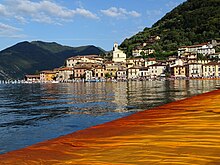
      Perhaps you've seen photos, perhaps you've seen his actual art.  Either way, I doubt you have forgotten it.  I speak of the Bulgarian born artist Christo (his full name was Christo Vladimirov Javacheff), most famous for the gargantuan sized art projects which he and his wife Jeanne Claude staged around the world.

    Christo and Jeanne Claude focused on covering buildings, bridges, parks, even islands with enormous swathes of brightly colored cloth.  Buildings include the Reichstag in Berlin, bridges the Point Neuf in Paris, parks Central Park in New York City, and islands Monte Isola in Italy.  Some of his projects cost nearly thirty million dollars.  Christo and Jeanne Claude financed every one of them with their own money.

    Curiously, both said that, on balance, their projects contained no deeper meaning or transcendent truth.  They viewed their work as pure aesthetic expression, gifts to those who enjoy beauty and new ways of framing the obvious and familiar.  Steps beyond that are rooted in what is already there.

A large field with oversized blue umbrellas at regular intervals. Mountains are barely visible in the background as the fog descends.

    Some laughed at Christo; others lauded him.  But that, I think, bears out the point:  art is made to provoke, to provoke imagination, controversy, longing, and dream.  Be it covering islands in massive sheets of cloth or producing a wood carving of a dog that looks like Santa Claus, art expresses, expresses profoundly, the marvel of the human being.  Born to stay, born to roam:  born to always create a new home.

Tuesday, June 11, 2024

      Fear is a powerful thing, sometimes for good, sometimes for ill.  I think about this whenever I hear or read about a municipality or, worse, national government enacting measures or making decisions which have the net effect of denying adherents of religions other than those which they pursue the freedom to enjoy the various expressions of those beliefs.  We see this when France outlaws a so-called a  "burkini"; we notice it in America when municipal governments from Illinois to Georgia to Massachusetts deny Muslim groups permits to build a mosque or, oddly enough, a cemetery; we see it when assorted factions of a religious worldview seek to prevent members of other factions from exercising their propensities in worship or practice.

     Ultimately, these responses to expressions of religious belief are driven by fear, fear of physical harm, fear of ideological tarnish, fear of political upheaval, and more.  As I said earlier, fear can help, and fear can harm.  In these instances, I believe it to be harmful. Yes, differences, particularly religious ones, make many of us uncomfortable.  On the other hand, we should recognize that we will never agree on everything, nor will we ever live in a world in which everyone thinks exactly alike. Jesus was not born in a monotone world, nor did Mohammad or Buddha emerge in a homogeneous culture.  But their beliefs thrive to this day.

    It seems that the power of God, should we choose to trust it, is more than able to surmount and overcome and resolve the fears of human beings.

    We're not called to deny; we are called to believe.
    
    And we should--in every way.

Friday, June 7, 2024

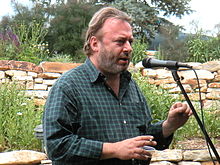
      Are you familiar with Christopher Hitchens?  Before he passed away in 2011 at the age of 62, Christopher Hitchens was one of the so-called "Four Horsemen" of the (equally) so-called "New Atheists."  In book, column, interview, and debate, he did everything he could to argue against the notion of God.  His most popular book was titled god is not Great.

     A book that appeared recently, The Faith of Christopher Hitchens, written by an evangelical Christian, seems at times to convince us otherwise.  It presents another side to Hitchens, a side that leads some to think that he was not so stridently anti-theistic after all.

     Larry Tatum, author of the book, states unequivocally that Hitchens didn't convert to Christianity before he died.  However, he cites a number of episodes in which Hitchens seemed struck by expressions of sacrificial love.  In these episodes Hitchens appears to be moved greatly by his observations of people who are acting totally selflessly on behalf of others.  He wonders out loud why anyone would do such a thing.

    Quite.  In the end, people will not believe in God because they are afraid of him.  They will believe in God because they believe he loves them.

    Doctrine is important, yes, but Jesus didn't preach doctrine.  He told stories about God's love.  For love, a simple yet at times bewildering love, is what God is most about.

Thursday, June 6, 2024

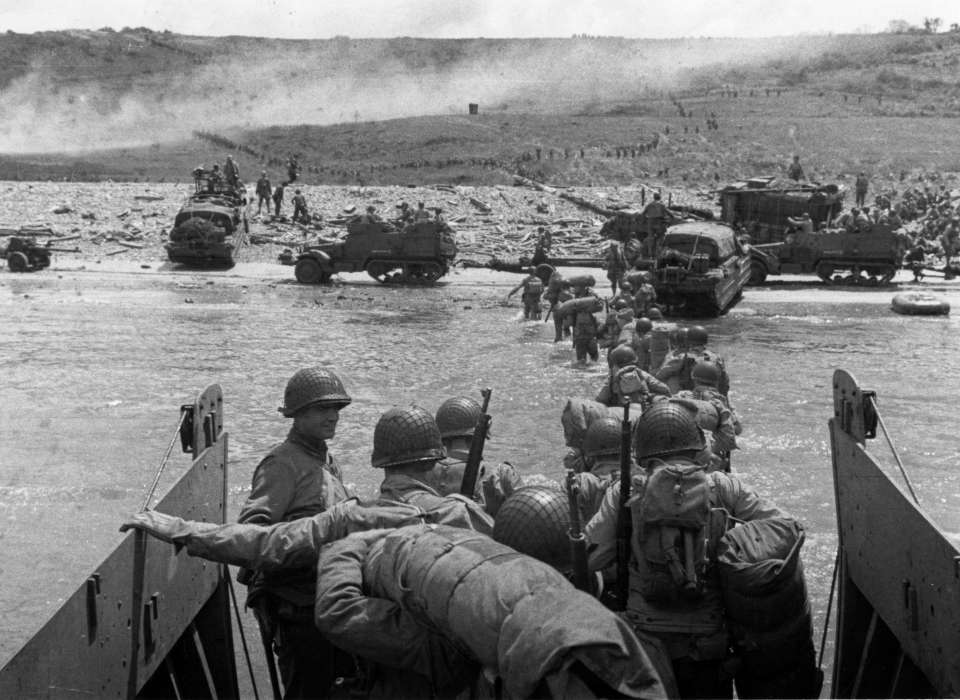
     As many people know, today is the 80th anniversary of D-Day.  For those who lived through it, D-Day was the day on which the Allies made their decisive assault on the Third Reich, a day of immense carnage and pain that led, after many more months of deadly and sustained warfare, to the fall and collapse of Adolf's Hitler's ambitions of a 1,000 year Aryan empire.  It is a day that the West should never forget.  We should never forget to honor and remember those who gave their lives, for they died without knowing the outcome.

    How difficult it is to measure the net worth and effect of our actions.  Likewise, how arrogant it is to assert what we do today means in the counsel of God.
     
    In the end, all we can be is thankful.  Thankful for many things, yes, but supremely thankful that however difficult it is to understand what such pain means, purpose remains.  Vision prevails.  Wisdom continues to reign.

    And how good it is that it is not our own.