Friday, July 25, 2025

       "Do not rejoice at your enemy's misfortunes," a Hebrew proverb says, "but want the best for him."  Or God will bless him anyway.

painting

    In this era of highly polarized political dialogue and disputation, avoiding what we might call Schadenfreude (taking pleasure in the misfortunes of those with whom we may disagree) is difficult.  However, it seems to be the only way forward.  We demean ourselves if we suppose our integrity to be ours, and ours alone.  There is always a bigger picture. 

    And we do not paint it.  Although it may be easy enough to say that, well, one day God will judge all things and hold everyone accountable for his or her deeds, I'm not sure this resolves the issue.  We do not live in the "later;" we live in the here and now.

    Yet unless there is a bigger picture--and a larger vision of newness--we have no business judging anyway.

Wednesday, July 23, 2025


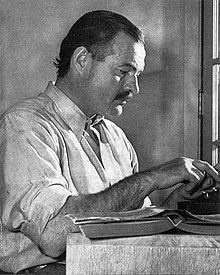
Dark-haired man in light colored short-sleeved shirt working on a typewriter at a table on which sits an open book
Ernest Hemingway

      Isn't truth a funny word?  Most of us appreciate it, most of us desire it. Very few of us, however, can define it.  Philosophers tell us there are essentially two ways of looking at truth.  The correspondence theory suggests that truth is simply that which corresponds to reality.  While this seems logical enough, it raises other questions:  how do we know what is real and how do we therefore know what corresponds to it? 

    Taking a different tack, the coherence theory holds that truth is the sum total of what seems apparent, logical, and right.  Truth is not fixed but is rather what appears to be most correct based on the prevailing evidence.  Yet how do we decide what is most correct and right?

     Though I see virtue in both perspectives, I won't try to reconcile them now.  I merely wish to make an observation about the necessity of truth.  When we insist that truth is relative or a creation of the moment, we are essentially saying that truth does not exist.  If so, we have no good reason to hold that even we exist.  If nothing holds, if nothing is sure, then neither are we.

     We need truth to be truth.  Otherwise, we became like the protagonist of Ernest Hemingway's Farewell to Arms, who, in the final scene of the novel, when he has just watched his wife die giving birth to his child, and then stood by as the child died, too, "put on his hat and walked into the rain."

    The end.

Monday, July 21, 2025

     He's most famous for his painting "The Scream," his portrayal of, as his biographer Sue Prideaux puts it, "the loss of meaning inflicted by the death of God."  But the Norwegian painter Edvard Munch had some insightful things to say about suffering.  

    "I must retain my physical weaknesses; they are an integral part of me.  I don't want to get rid of illness, however unsympathetically I may depict it in my art . . . My fear of life is necessary to me, as is my illness.  Without anxiety and illness, I am a ship without a rudder.  My art is grounded in reflections over being different to others.  My sufferings are part of my self and my art.  They are indistinguishable from me, and their destruction would destroy my art.  I want to keep those sufferings."

    And, "What is art, really?  The outcome of dissatisfaction with life, the point of impact for the creative force, the continual movement of life . . . in my area I attempt to explain life and its meaning to myself."

    However tragic we may consider "The Scream" to be, we can certainly thank Munch for his erudite perception of the importance of malaise and hardship in the formation of a wise human being.

    God is working even when we may not believe he's there.