How sad I was to read a few days ago of the discovery of the body of Tom Ballard on the slopes of Nanga Parbat, the tenth highest mountain in the world. Once anointed the "King of the Alps" for his immense prowess on the peaks of that range, he had, with fellow climber Daniele Nardi, set out to climb Nanga Parbat by the most difficult route possible in the most arduous season possible: winter. Everyone had high hopes.
 |
| Alison Climbing |
 |
| Tom at Four Years |
Ballard's death was particularly tragic because he was the son of British climber Alison Hargreaves, the first British woman to summit Mt. Everest and, a mere month or so later, the first British woman to climb K2, the second highest (and considerably more dangerous than Everest), in the world. She perished in a storm as she was descending from the summit. Tom was six years old.
Now Tom is gone, too, his life snuffed out at the age of thirty (his mother was thirty-three when she died). Oh, life! We love it, we live it. But we can never master it.
 |
| Tom Daniele |
We can only love God.
Although she has been gone for nearly nine years now, I could not help but think of my mother on Saturday of last week. It was her birthday. I recently heard John Lennon's "Mother." For those who have not heard the song, Lennon sings of the mother and father whom he always wanted but, as he puts it in the song, were never there for him. They didn't "have" him.
Would we all wish for parents who are there for us, who "have" us, who love us as we wish them to love us. In contrast to Lennon, I experienced this love in full, and more, in the love of my parents, my mother and father. I really needed nothing more from them, for in their love they gave me everything I could possibly want and need. I left home believing that the world was a good place, that people were decent beings, that love reigned in the universe.
I hope that you find this kind of love, too. Whether it's from your parents or others, I hope that, through it, you come to see the fullness and presence of love in the cosmos, and enjoy and appreciate its every expression on our behalf. That you see love as something that always wants you.
A love like the love of God. Thank goodness for a loving God.
Calling all men and women: today is International Women's Day! Why should set aside a day to celebrate women? Do we not celebrate women every day of the year? Absolutely. Historically, however, women have faced oppression on scales to which most men simply cannot relate. A complex web of tradition, sexism, condescension, and patriarchy has created a world in which, even today, many women are considered to be second-class citizens, and in some cases, tragically, less than human.

Politics and culture aside, however, I believe we do well to consider why the human race is composed of men and women. The reason is far more than mere procreation. The most profound reason for two human genders is that, bottom line, men and women need each other, need each other in more ways than they can individually or corporately imagine. Humanity cannot be fully human unless male and female are flourishing, unless both genders are able to be all that they can, before God, be. As Genesis makes clear, humanness is male and female, and we are duty bound to achieve its fullness. Do we have a long way to go? Sure. But we are not mere dollops of masculinity and femininity tossed into an accidental cosmos, nor are we male and female, complementary in gender, without reason. We are as we are because of God. And God wants nothing more than our human completeness.
Yesterday, we remembered Michelangelo, the famous artist of the Italian Renaissance. We talked about how by fusing his belief in God with his immense creative ability, Michelangelo produced art that, from a number of standpoints, affirms the near limitless possibilities of the human imagination.
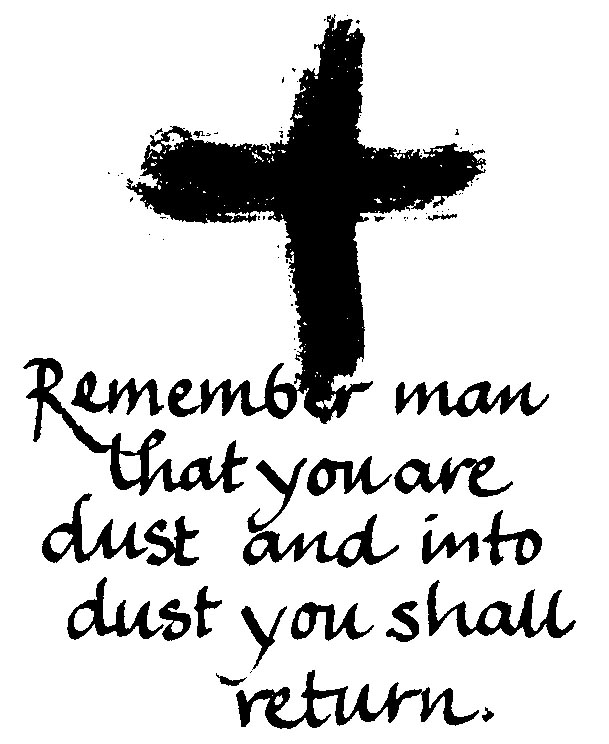
In contrast, today, we remember our limits. As we think about Ash Wednesday, the first day of Lent, we are reminded that whether we believe in an afterlife or not, we are ultimately no more than dust. When we die and pass out of this life, what remains of us will soon be no more, too, returned to the earth from which it has come. Before my siblings and I scattered my mother's ashes atop her favorite mountain in the San Gabriel Mountains of California in October of 2011, we opened the box that contained "her." All that Mom ever was had been reduced to a small pile of ashes. All her years, all her love, all her joy, all her meaning, all her hopes and dreams now no more than a bag of ashes. It was sobering.
 Even more sobering is that one day, every one of us will be exactly the same. Yet Michelangelo's vision remains with us still. True, as Ash Wednesday reminds us, we are thoroughly material beings. But we are spiritual beings, too, physical creatures with spiritual form and transcendent vision, created by a present and always God.
Our life is ending, yet our possibilities are endless: death is only the beginning.
Even more sobering is that one day, every one of us will be exactly the same. Yet Michelangelo's vision remains with us still. True, as Ash Wednesday reminds us, we are thoroughly material beings. But we are spiritual beings, too, physical creatures with spiritual form and transcendent vision, created by a present and always God.
Our life is ending, yet our possibilities are endless: death is only the beginning.
 Today marks the birthday of one of history's most remarkable artists: Michelangelo di Lodovica Buonarroti Simoni, otherwise known as, simply, Michelangelo. Why do we find Michelangelo so significant?
Like all of us, Michelangelo was a creature of his time, a person working in one of the most fascinating eras in the history of the West: the Renaissance. As I have said elsewhere in this blog, the Renaissance was a singular point in the evolution of European thought. It was a time, a very brief time, when the secular and sacred seemed to fuse together, blending in the most amazing way in all areas of human endeavor.
Today marks the birthday of one of history's most remarkable artists: Michelangelo di Lodovica Buonarroti Simoni, otherwise known as, simply, Michelangelo. Why do we find Michelangelo so significant?
Like all of us, Michelangelo was a creature of his time, a person working in one of the most fascinating eras in the history of the West: the Renaissance. As I have said elsewhere in this blog, the Renaissance was a singular point in the evolution of European thought. It was a time, a very brief time, when the secular and sacred seemed to fuse together, blending in the most amazing way in all areas of human endeavor.
 This was perhaps most notable in the art of the period. Across the board, people sought to do art as a fusion of unwavering belief in the goodness and creative power of God and their comcommitant belief in their innate creative abilities, abilities given to them, they constantly affirmed, by God. Deeply committed to the joy of art, profoundly dedicated to the presence and love of God, Michelangelo's astonishingly fertile mind produced some of the most memorable artworks in human history.
Although much of today's art is very different from the of the Renaissance, the essential truth about its origins remains: the human heart and mind cannot help but create, be it to the wonder of humanity and its world, the glory of God or, ideally, both. Michelangelo demonstrates to us that we are awesome beings, beings capable of creating things beyond our imagination. We are creatures of immense possibility, possibility inherent in a universe created by an infinite God.
There are no limits to whom we can be.
This was perhaps most notable in the art of the period. Across the board, people sought to do art as a fusion of unwavering belief in the goodness and creative power of God and their comcommitant belief in their innate creative abilities, abilities given to them, they constantly affirmed, by God. Deeply committed to the joy of art, profoundly dedicated to the presence and love of God, Michelangelo's astonishingly fertile mind produced some of the most memorable artworks in human history.
Although much of today's art is very different from the of the Renaissance, the essential truth about its origins remains: the human heart and mind cannot help but create, be it to the wonder of humanity and its world, the glory of God or, ideally, both. Michelangelo demonstrates to us that we are awesome beings, beings capable of creating things beyond our imagination. We are creatures of immense possibility, possibility inherent in a universe created by an infinite God.
There are no limits to whom we can be.
Paradise? As I, along with millions of others, contemplate the surge of cold that is currently sweeping across the midsection of the United States, I think once again of Joshua Tree, that oasis of cactus and rock in the remote California desert where I was last week. I think also of a novel I read many years ago called Islandia. It is a tale of a utopia set in a series of idyllic and pastoral islands in a distant ocean. Far away from the turmoil of war and the ravages, as it saw it, of capitalism, Islandia offered its inhabitants a life without worry or care. It was a life shaped by mutual exchange, cultural openness, and community, a land in which all people are at peace with each other.
Although Joshua Tree and Islandia are very different places, they both offer havens, respites, places of solace and rest. Just as it's not surprising that historical visions of the afterlife pictured a land of glory and peace, so it is no accident that some of the most intrepid monastics, regardless of religion or creed, found their richest insights in the desert.
Oddly enough, while places like Islandia and Joshua Tree provide comfort in very different ways, we need both of them to find our meaning. In bucolic bliss we find joy through leisure and ease; in the rugged landscapes of the desert we find joy through abnegation and sacrifice.
Would his mission really have changed the world if God, in Jesus, had come to Islandia?
Joshua Tree. It's a beautiful place, an idyll of sand, sagebrush, rocks, and cacti in the Southern California desert. Spreading across thousands of acres that ebb and flow into the vast and arid lands of the remotest areas of the Southwest, Joshua Tree is home to one of the most remarkable trees on the planet: the Joshua Tree. Looking partly like a child's rendering, partly like a Dr. Seuss drawing, and partly like a dream of Carlos Casteneda (he of peyote adventure and journey with the sage Don Juan), the Joshua Tree speaks volumes about the amazing diversity--and seeming silliness--of the creation. Why do we need such an unusual looking tree to round out our ecological vision?
That, however, is the point. The Joshua Tree reminds us that we cannot measure worth by ourselves, that we stumble when we suppose that we are the standard by which all things find value. Who needs the Joshua Tree? On the one hand, no one. On the other hand, everyone.
Without the Joshua Tree, we are stumbling in the dark.
And so is God.
 Even more sobering is that one day, every one of us will be exactly the same. Yet Michelangelo's vision remains with us still. True, as Ash Wednesday reminds us, we are thoroughly material beings. But we are spiritual beings, too, physical creatures with spiritual form and transcendent vision, created by a present and always God.
