Wednesday, April 14, 2021

      This week marks the birthday of the American playwright Samuel Beckett.  Known for his bleak portrayals of human existence, Beckett wrote some plays intended to cause us to question why we even exist.  They present worlds singularly devoid of meaning.  But that's Beckett's point:  there is no meaning.  It's a dark, cold, and impersonal world.
     Is this true?  Emotionally, it can certainly seem that way at times.  If there is no reason for this world to exist, if there is no reason why we are here, then however grand our life might be, it ultimately means very little.

Samuel Beckett - Wikipedia

     For Beckett, this didn't seem to matter.  In his "Happy Days," Beckett presents only two characters, Winnie and Willie.  Winnie is buried in dirt up to her waist; Willie crawls around on all fours.  As the play proceeds, Winnie talks, talks nearly constantly, to Willie.  She talks of everyday things and how blessed she feels to be alive:  she has Willie.  Willie rarely responds.
     By the end of the play, Winnie is buried in dirt up to her neck.  Willie is still only able to crawl.  Yet she continues to insist that these are happy days.  And we, the reader, are left to wonder why.
     Similarly, in his far more well known "Waiting for Godot," Beckett presents two men sitting on a bench at a bus stop waiting for someone they know only as Godot. As the play moves on, the men continue to talk.  But Godot never comes.  As they take leave of each other, they suppose that perhaps Godot will come tomorrow.  But will it really matter?  They're probably waiting, they finally admit, for something that will never happen.  But that's just life:  we live for nothing that ever comes.
     Besides, in a world absent of point, what else is there to do?
     Herein is Beckett's central admission:  when transcendence is gone, we are, too.

Monday, April 12, 2021

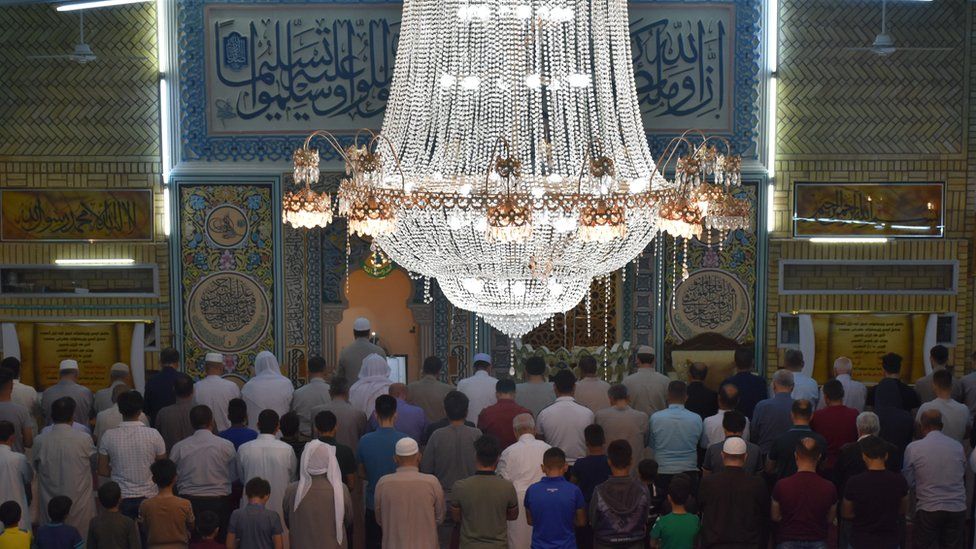
     Ramadan, one of the greatest events in the Muslim calendar, begins this week.  Thirty days of fasting, culminating in the feast of Eid al Fitr, Ramadan is a time for every Muslim to take time to celebrate and reflect on his or her relationship with Allah and the world.  It's a season of hope, wonder, mourning, and contemplation, a slice of the year in which Muslims, like most people of faith, take time to focus more intensely on why they live as they do.

Muslims perform the first 'Tarawih' prayer on the beginning of the Islamic Holy month of Ramadan in Iraq
     You may not agree with the tenets of Islam; you may not like the beliefs most Muslims hold; you may be uncomfortable with Islam in general; you may even be frightened of Islam.
     Nonetheless, use the fact of Ramadan to remind yourself that we live this life as a gift, that we spend our days in the aegis of a personal transcendence.  We live in the umbra of a beautiful (and often exasperating) wave of experience, balancing what we see and what we cannot.  Ramadan tells us that we are not alone. It says to us that we live in a vision, an intensely personal vision in which all things find purpose and meaning, the full truth of what is.
     There's much more to believe than what we see.

Friday, April 9, 2021

           What's a muon?  A muon is one of many subatomic particles that physicists have found "running" through the quantum spaces we occupy.  Though a muon behaves in ways similar to an electron, it is many times heavier than they and thus functions differently in the quantum fields that, it seems, comprise the innards of our reality.

     Recently, particle physicists working a the "super collider" at the Fermi Laboratory in Batavia, Illinois, made what they consider to be a potentially earth shattering discovery.  After much experimentation, they concluded that a muon "wobbles."  Why is this important?  It is important because, in the view of these physicists, this means that there are other subatomic particles which we have yet to find, particles that affect the movement of muons and, consequently, the workings of the universe.

     Put another way, per these physicists, we may not fully understand the essential structures and governing forces of the universe after all.  We may need to revise our understanding of how the cosmos holds together.

     Once more, we come face to face with our human inadequacy and inexorably finite and limited grasp of what exists--and why it does.  This is in fact a cause for celebration.  We are reminded anew that for all our intelligence, insight, and drive, we may never really comprehend, outside of acknowledging a presence of transcendence, not so much how we got here but, more importantly, why we are even here at all.

Thursday, April 8, 2021

      Have you heard of the Golem?  A frequent visitor to much Jewish legend and folklore, the Golem was a figure made entirely of inanimate matter.  But it was inanimate matter that came to life, came to life to engage in any number of activities, some to the material good of those around it, some to their spiritual betterment.  The Golem was a mysterious figure indeed, one whom, in most of the stories in which it appears, constantly eluded any attempts to grasp or understand it.

     Which was the point.  Sitting in a playground on Jerusalem today is a large sculpture of the Golem.  Designed by artist Niki de Saint Phalle, a French artist who passed away earlier this century, it features a Golem with three red tongues protruding from its mouth.  Each protruding tongue is a slide.  Although some have called this a frightening visage, others have remarked that it does, in true Golem fashion, teach lessons about confronting one's fears and trepidations.

     Again, that's the point.  We cannot learn about existence without confronting those things about it that we may never overcome or understand fully.  The Golem reminds us that, in the end, we are only as secure in existence as the extent to which we acknowledge that we will never completely understand it.

     Mysteries bigger than us always remain.

Wednesday, April 7, 2021

      Born in France in 1902, Alexandre Kojeve, a philosopher of relative obscurity, once made an intriguing point.  History, he said, is over.  It's over because no longer will people see themselves as the "other," but rather as another individual equal to them.  Previously, as Kojeve saw it, history was the story of Masters and Slaves, the former continuously dominating the latter ad infinitum.  No more:  individuality now reigned supreme.  Each person would see every other person in the exactly the same way:  a fellow human being.

     This insight was of course not extraordinarily new:  most religions and even some political philosophies had long insisted on the value of the same thing.  What makes Kojeve's point somewhat unique is that he did not frame it in the context of any religious perspective.  He was in fact an atheist.  However, he insisted that a spiritual drive was innate in every human being:  we daily tangle, he said, with death.  We are constantly balancing life with its end.  We do so not because we are spiritual beings, but because we seek something greater than who we, at the moment, are.

     In other words, the present is not enough.  On this, I believe almost everyone can agree:  we humans are bent to seek more than what is before us.  Even if it is something as mundane as desiring to eat a meal.  As Kojeve's critics have pointed out, however, if humans are seeking more in themselves and themselves only, they miss a crucial point:  we did not make ourselves to be human beings.

     Above all, we remain the recipients of a life we will never understand apart from acknowledging that which gives life its ultimate point.

     Put another way:  God.


Friday, April 2, 2021

      As we prepare for the descent into the nothingness of Good Friday, the day on which darkness overwhelmed even the creator himself, we cannot help but think about light:  when will it come?  So it is that we anticipate Easter, the day on which we see light as it was most meant to be:  the total and absolute witness of God's love for what he made.

"Resurrection" by El Greco

     In the absolute darkness and nothingness of Jesus' death, the Son of God abandoned by his Father, all light is gone.  Yet out of this abject blackness, the greatest of all light arose.  A light that eclipses and encompasses all others, it is a light that changed history, bent space and gravity, and permanently altered all our notions of meaning and time.
     The resurrection is the greatest of light because it brought, from the fiercest and vilest nothingness of all deaths, a life that will never end.  It's nonsensical, its unbelievable, it's unfathomable, but it is entirely true.
The resurrection tells us that life has meaning, meaning that exceeds our greatest imagination.  It tells us that though we die, we will live again, forever.
     Indeed:  there is no darkness without light.
     How can life ever be the same?

Thursday, April 1, 2021


     Today is Maundy Thursday, the remembrance of the Last Supper, the final Passover Jesus celebrated before he died.  Imagine his state of mind:  he knew that before another night had passed, he'd be dead, gone from this world.  Yet he rejoiced the beauty of the Passover moment.
     Today is also April 1:  April Fools Day.
     But it's more.  Today is the birthday of one of the greatest of the Romantic pianists:  Sergei Rachmaninoff.  Born in Russia, eventually emigrating to America and, shortly before his death in 1943, becoming an American citizen, Rachmaninoff (my wife's favorite musician) composed some of the richest music ever written for the piano. His work blends intense and mournful melody with powerful and intricate chords and keyboard movements, beautifully capturing the deepest spirit of the Romantics.  Rachmaninoff's musician gives us a poignant window into our perennial struggle with the vast and unyielding import of sentient existence.  It shows us that however intellectual we may suppose ourselves to be, we are, in the end, creatures of heart and imagination.
     Rachmaninoff's music is therefore more than appropriate for Maundy Thursday:  it speaks to the center of who we are.  In his music, we realize, again, that although reason is an essential part of who we are, we make our biggest decisions with our heart.  We are also reminded that while we may well live for the moment, we flourish ultimately when we accede to the presence of the eternal.
     For as Maundy Thursday and Rachmaninoff's music remind us, in the end, we find our true self when we submit to the fact of things we cannot see--but things whose power over us we cannot deny.
     After all, we are only who we are.