Monday, May 17, 2021

     Over the weekend I traveled to Seattle to attend the gallery opening of an art/writing exhibit on which I've been working with four artists for roughly a year and a half.  It had to do with the idea of Lost and Found.  It was a joy to work with the artists, to see their creative juices flowing in response to my essays, and to see the project come together.  Following is the introduction which I wrote to a book we published with some of the artwork and all of my essays.  I also enclose a link to the gallery website so that, for those so inclined, they may read the essays in full.

     "All that we are, all that we do:  this is lost and found.  Woven deeply, rippling steadily, flowing freely, remembering past, affirming present, and casting future, lost and found is the story of existence.  In it we find door and window, structure and form, and frame and foundation, all which shapes and comprises the realities we inhabit, the paths and realities we seek and pursue:  what we see and what we do not.  And life becomes.
     So do these essays endeavor to do:  to speak of lost, to ruminate on found.  To contemplate the point of losing, to meditate on the wonder of finding.  To take meaning apart.  And see it again.
     It is perhaps too simplistic to suppose, and to suppose nothing else, that in losing we gain or that in gaining we lose.  Although to an extent this is true, buried beneath this scaffolding is a bigger point:  life responds to us as much we respond to it.  Embedded in the countless patterns and rhythms of this cosmos we humans are, as dependent on it as much as it is dependent on us.  We lose and find as a reflection, and manifestation, of the possibilities of existence, as an expression of the near infinite compass of circles that comprise and impel this adventure we call life.
     To lose and find is to live as choice making beings in a freely roaming universe.
     It is also to move ever closer to resolving, though never fully, the tension that drives us all, the ever looming, and patently inescapable, juncture of mortal and eternity.  To tap into the transcendence that undergirds the immanent even as we wonder what either means, to step into our beyond even as we ponder how it can, in fact, be.
     To look even when we cannot see."
     Here's the link:

https://shiftgallery.org/2021/04/13/karey-kessler-anna-macrae-miha-sarani-and-david-traylor-with-william-marsh-lost-and-found/


Wednesday, May 12, 2021

      It's a lonely image, that of the "Wandering Jew," and the one below in particular.  You may notice that the person in this painting is wandering past the crucified Jesus, past the one who proclaimed that he had come to deliver the Jewish people--his people--from sin. As the wind blows and the storm rages, however, this person is moving determinedly ahead, resolved to keep going another way.
     In many ways, however, all of us walk the path of this "Wandering Jew."  Whether we believe in Jesus, Allah, Krishna, or some other expression of the divine, we frequently forget about him in the course of our daily life.  Perhaps more than we think, we live and breath with nary a thought of him.  We wander through the storms of our lives, our hearts hardened and chin held high:  we will survive, regardless.
     The painting before us captures existence aptly.  Life can indeed be like hiking through a cold and forsaken wilderness.  Small wonder that we try so hard to control it; little surprise that we do whatever we can to contain it.  We want to keep afloat.
The Wandering Jew
    And in most instances, we will.  Yet we all have a choice.  We can navigate life declining belief in anything bigger than what it is, or we can live life believing in the full range of its possibilities.  Only in the latter way, however, will we see the larger point. Otherwise, though we wander determinedly, we will wander from dust to dust, one day coming into being, another day vanishing forever.  It's over.
     If we are personal, and we are, there's more.

Monday, May 10, 2021


     Sure, it's a Hallmark holiday, and sure, it's an opportunity for the retailers of the world to lure people, particularly men, into their stores and showrooms, and sure, it's exploited by clergy and politician alike, but Mother's Day, which the West remembered yesterday, remains a good day.  Whether we have good or bad memories of our mothers (or perhaps a mix), we must admit that without our mothers, we would not be here, would not have found life, would not have tasted the marvels of existence.  If our mother genuinely loved us, so much the better, for we learned early on that the world is indeed a good place, and that life is indeed an adventure worth pursuing.  For those for whom the opposite was true, I'm sorry, deeply sorry.  Life was likely not as pretty.  In fact, it may have been inordinately cruel.  And I hope and trust that as you have spun out your life, you have found healing and remedy, that you have found that even if your mother did not seem to love you, other people do.
     The sacrifices a mother makes for her children mirror the sacrifices that our creator makes for us every day, the endless effort he makes to ensure that despite the brokenness of the world, we, humanity, endure.  Good or evil, sinner or saint, God loves us all, blessing us with everything we need to flourish on this remarkable planet.  Like a mother, God never forgets those whom he made.
     I loved my mother (she died in 2010), and miss her much.  I'm so thankful God gave her to me, and me to her.  And my memories of her love makes me realize, over and over, every day, the enduring reality of God.
     Thanks, God, for my mother.

Friday, May 7, 2021


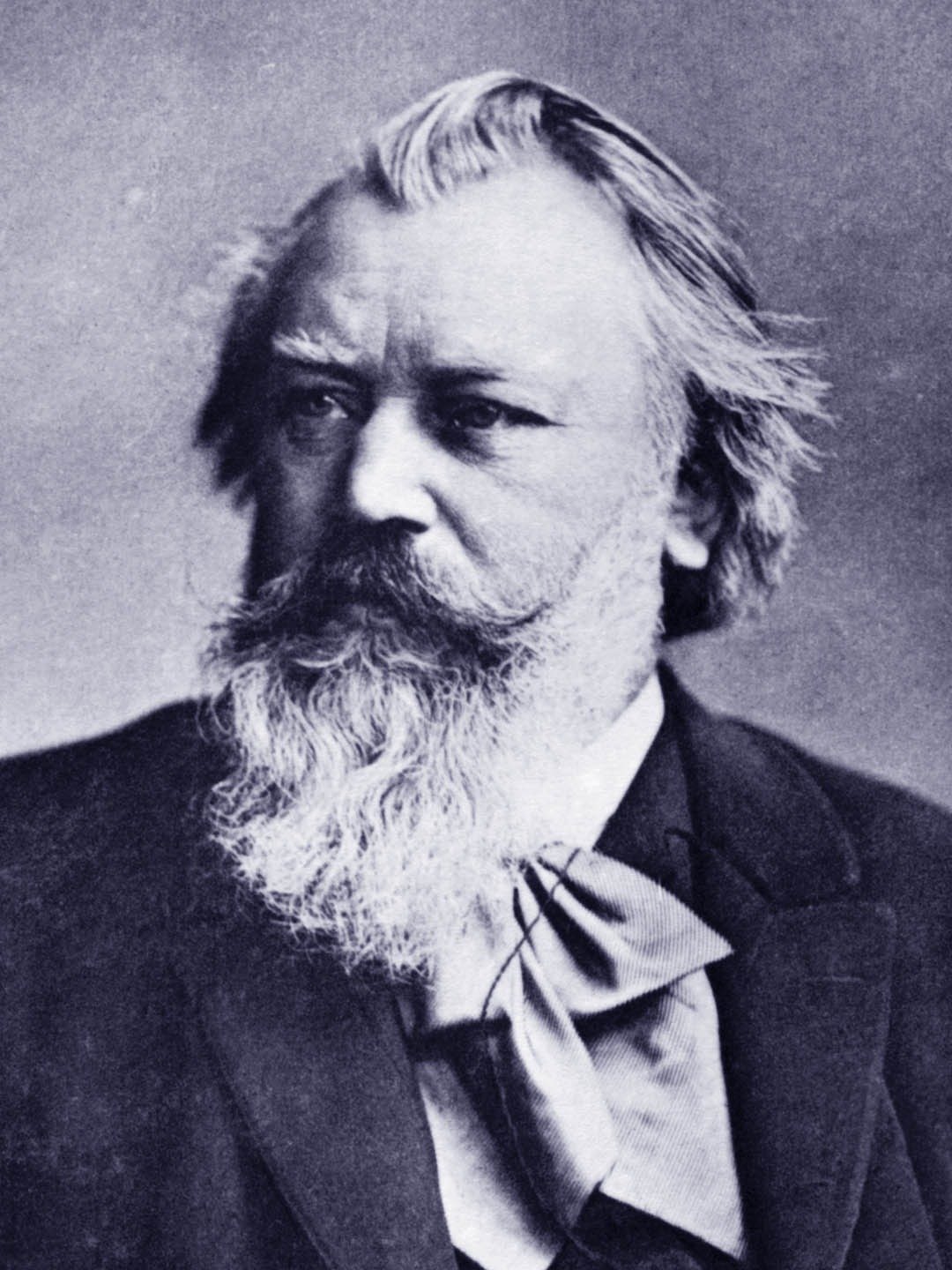
www.gstatic.com/tv/thumb/persons/188752/188752_...     Have you heard Johannes Brahms's Requiem?  Based on words from Psalm 90, Requiem is surely one of the most powerful pieces of music Brahms (whose birthday we remember this month) composed.  It is a profound reminder of our humanness, our fragility, our mortality.  "Teach us, Lord," it says, "to number our days so that we will develop a heart of wisdom."
     We are not forever on this planet.
     The Requiem also uses a line from Isaiah 40, "All flesh is grass."  How can we not agree?  Magnificent though we be, we are in truth "grass," here today, gone tomorrow:  we are so frightfully evanescent.  Who will ever know that we were born?
     Reams have been written about whether  Brahms believed in the worldview behind these words, but that's not the point.  Our lives are gifts, gifts which we have for a very short time.  If the universe is unconscious and impersonal, our lives are gifts in the darkness of a purposeless cosmos, a shout into nothingness.  If on the other hand the universe is personal, the conscious expression of a conscious God, our life is a gift of profound purpose.  Brief though it still may be, its brevity happens in a wider umbra of time and destiny.  We are grass, yes, but we are grass that, even if it fades and dies, will eventually burst forth again.

Thursday, May 6, 2021

     A longing for freedom is one of our most fundamental passions.  We long for freedom, to be liberated from the constraints of finitude—spiritual, mental, physical—and break into a higher understanding of what is real.  We long to make our will, our free will (at least as we see it), the sole and unchallenged arbiter of our truth and reality.  We want to be, as many writers have noted, and exist in a way that releases us from all constraint. 
   
1,813,354 Freedom Photos - Free & Royalty-Free Stock Photos from Dreamstime 

So did Nietzsche set forth his Ubermensch, and so did Tom Wolfe, in Bonfire of Vanities, call his Wall Street protagonists "masters of the universe," people in total control of their worlds, their freedom limited only by their willingness to realize, guide, and further it.  There is nothing greater than them.  As Titanic director James Cameron remarked upon receiving the 1997 Academy Award for Best Picture, “I’m king of the world.”
But there is a problem.  It is the problem of God.  If God exists as a sentient and active and omnipotent being, acknowledging him as such means that we no longer have absolute freedom.  Sure, we can still do whatever we choose to do, but we now do so aware that we do so under the aegis of someone who will one day judge how we have used what has been given us.  Our entire life equation changes.
In addition, even if we do not believe that God exists, we must nonetheless understand that no one has unlimited freedom in a finite universe, much less a universe whose ultimate parameters are beyond her control.  Our freedom is merely the degree to which we believe ourselves to be free.  It has no genuine substance.
We therefore remain like the person in the Smashing Pumpkins song, “Even after I finished venting my rage, I’m still a rat yelling in a cage.”
So are we free?  Yes.  Are we free to be free?  Yes.  Are we free to be free to be free?  No.  Were we totally free to be free, we would never struggle with limits, never struggle with meaning, never struggle with the conundrum of evil.  To be free is to know and successfully wrestle (for we will always struggle) with what constrains it.  Only this is a freedom that makes itself free.  Any other freedom means nothing.

Wednesday, May 5, 2021

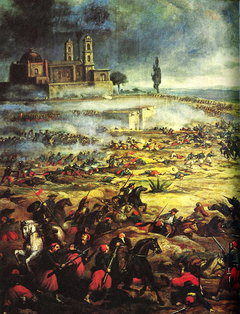
      Today, May 5th, is Cinco de Mayo.  Although it is not Mexican Independence Day (traditionally celebrated on September 16), it is nonetheless a day to remember:  Mexico's 1862 liberation from the oppressive machinations of French occupation.  A stronghold of economic and political might before Europeans arrived on its shores, Mexico spent several subsequent centuries toiling under the weight of various foreign nations who, unfortunately, viewed Mexico primarily as a land to be exploited for their own use.

Batalla de Puebla.png

     It's an all too familiar story:  imperialistic Westerners marginalizing and abusing the rest of the world.  Thankfully, much of this is over.  Many issues, however, remain.  Much of Mexico, as well as many of its southern neighbors, continue to look to establish their way and place in the world.  Happily, they are now free to do so.
     Though freedom can be messy and complicated, we must always remind ourselves that despite its complexities, freedom to be, whatever we become, is preferable to never finding freedom at all.  God wants all of us to be free.  He wants us to find economic freedom, he wants us to find political freedom.
     Most of all, however, as Jesus tells us in the gospel of John, God most wants us to find the freedom of truth, the freedom of the truth that sets us truly free:  the freedom we find in trusting in his great love for us all.

Monday, May 3, 2021

     "The mountains are calling me," said the American naturalist John Muir, "and I must go."  As we little human beings wander about this planet, living out our lives, responding to circumstances, making choices, devising goals, and constructing visions, we all wonder:  where, really, are we going?  To what are we really being called?

Credit: Corbis/VCG via Getty Images/Library of Congress

     In the big picture, we may never know.  We live with what is before us.  We may feel called, we may feel compelled.  Or we may feel as if we have never had a choice in what happens in our lives.  To an extent, none of us really does.  As philosopher Martin Heidegger was fond of saying, we are "thrown" into this world:  not a single one of us could have made ourselves be here.
     So yes, listen to your call.  In an empty world, it's all you have.  Or better, listen to the rhythms out of which this call, if it is to hold any meaning, any meaning at all, must inevitably come:  the presence of God.