Artist and poet, Bruce Baillie has turned many eyes with his creative takes on life and its landscapes. One of his most famous works is "To Parsifal." In it, he moves rapidly from one image to another of the American West, turning sensibilities over and over again until we are not sure on which image we ought most to ponder. But this is his point. Life is anything but static, and existence is anything but predictable. We live in a sort of illumined darkness, suffused with joy yet caught in mortality.
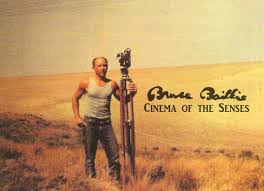
As we do, as we balance these contradicting points, we find ourselves blending, Baillie observes, our interior thoughts and the external space in which we have them. We mix our inner with our outer, weaving them together, day after day, year after year, in a continuous attempt to come to grips with the facts of our finite existence.
If I may, I will expand on Baillie's point to say that, yes, all of us need to be aware of the relationship between what is within and outside us, that we all must attend to our form while not overlooking our content. I will add, however, that unless we ground our quest in something other than ourselves and our world, we are really not going anywhere.
We go around and around only to return to where we began. Materially, maybe this is enough. Existentially, it will never be sufficient: how can we explain that which we have no inkling of why it is here?
If you are Irish (I'm one quarter), you know. This year marks one hundred years since that Easter Day on which the Irish people took up arms against their British overlords to assert their independence. It is a sacrosanct day in Ireland, and a revered moment in the lives of many Irish in other parts of the world. In recognition of this centennial year, many books have appeared about the particulars of the revolt.
One of these books, which I came across recently, has to do with the legendary Irish warrior Cuchulainn. In a pensive moment, Cuchulainn is said to have remarked, "I care not though I were to live but one day and one night if only my fame and deeds live after me." Do not all of us, to an extent, identify? Cuchulainn wished for the Irish people to remember his deeds, to always find inspiration and glory in what he had done.
Cuchulainn's sentiments find parallel in Gabriel Conroy's poem, "The Dead." As he writes, "Better pass boldly into that other world, in the full glory of some passion, than fade and wither dismally with age." Catholic to the core, these Irish revolutionaries wedded their challenge of British rule to the wonder of the life to come, fusing present ardor with certitude of coming celestial bliss.
To a point, shouldn't we all? Perhaps we do not want to be revolutionaries, and perhaps we do not want to be famous. Yet we can certainly agree that if this life is lived in the compass of another, we do well to live it with vim and zest. Just as we only live once, so do we only enter eternity once, and for all time.
Every day, everything, absolutely everything we do, matters, not once, but twice: eternity is that big.
Long live present--and future--revolution. In particular, the revolution that overturns everything we ever thought we knew.
Anderson Cooper, known to many of us as an intrepid reporter of several decisive national and international events as well as a correspondent for the CBS news program Sixty Minutes, recently published a joint memoir with his equally famous mother, Gloria Vanderbilt. In a documentary made to accompany the memoir, Anderson offers a telling observation of his mom. She is, he said, "an emissary from a distant star, marooned on this planet and trying to make sense of it all."
In the public eye since birth, Gloria Vanderbilt, heiress to a vast fortune and whose name was later attached to a pair of blue jeans, has never led a "normal" life like most of the rest of us. How could she? If we are not "celebrities," we cannot really know what fame is like. While it seems glamorous and dashing, it is often laced with immense angst and loneliness. "Who am I?," has many a "famous" person asked. "Am I really marooned on planet Earth?"
Unlikely, of course. Perhaps Cooper's point is that although all of us are trying to make sense of this existence, it is the famous who maybe feel the most unequipped to do so: are they only here for others' pleasure? For that matter, what do any of us mean? Are we all marooned in this existence? After all, none of us made a choice to be here.
Planets near, planets far: unless the cosmos has a larger and transcendent purpose, regardless of who we are and where we are from, we are nothing more than vacuous wisps of materiality in a vast, impenetrable, and unexplainable sense of being.
Growing up in California, I had many opportunities to camp in the desert. At any given moment, I was only a couple of hours from thousands of acres of expansive stretches of cacti, sagebrush, empty rivers, and vast mountains of sand. Over the years, I grew to love desert camping. Though I still loved the mountains foremost, I found in the desert a starkness of beauty, a sublimity and equanimity of geological expression that I could find nowhere else. Pushing all the superfluous and extraneous away, the desert reduced life to its raw essentials: there was little else beyond its presence.
The early fathers of the Christian church (and the elders of countless other religious traditions as well) enjoyed the desert, too. They found its emptiness ideal for spiritual reflection and existential contemplation. Reveling in the silence of the voiceless landscape, they found themselves drawn ever more deeply into meditating on anything but the ordinary and mundane.
You may never come to appreciate the desert. Yet you can perhaps come to accept that we will never find what is most important without letting go of everything else that we think is. Though God is everywhere present, he remains apophatic. In this world, he is a hidden God.
Ironically, more often than not, we're the ones who hide him.
As we do not see the surreal majesty of a nighttime desert sky, its black darkness sprinkled with innumerable stars, without leaving our urban lives far behind, so we will not see God unless we set aside the busyness of the present for the greater and illuminating presence that lies within and beyond it.
It's hard to see in the quotidian dark.
Lost civilizations? In his House of Rain, author Craig Childs tells a fascinating story of the years he has spent tracking down the remains of the Anasazi Indian tribe that occupied many parts of the American Southwest in the first and second millennium A.D. The fascination is that although we have copious evidences of the Anasazis, we do not know why they disappeared. While we can document the causes of the disappearances of other Indian tribes, we cannot do so for the Anasazis. Their demise, like that of the Mayan civilization of Central America, remains a profound historical mystery.
As I have been wrapping up my writing of a book about memory, I have thought often about the Anasazis. We know of them, and we know about them. But what we do not know is them. Our memory of the Anasazis only extends as far as their artifacts; it does not encompass who they are.
So it is for countless other bygone civilizations. One after another, for thousands and thousands of years, they come, and they go, emerging, flourishing, and dying, often without any notice or clue. How will we know them? How will we remember them?
We will only remember them as memory itself. And memory will only remember if it is remembered in turn. Absent a starting point, memory has no form. Only as memory begins will it end. And memory cannot begin unless there is a beginning of remembrance, a remembering God.
Otherwise, one day, one day far into the future, no one will remember anything at all. And what will life have been all about, anyway?
Although seismologists can tell us where an earthquake is likely to occur, rarely can they predict when it will occur. Poor Ecuador. Pummeled by a devastating earthquake a few days ago, and hit once more with an aftershock yesterday, Ecuador is struggling, struggling immensely, to cope. So much loss, so much pain. For those caught in it, the suffering is unfathomable. Never had they before experienced such physical and spiritual deprivation.
If you have the means, consider sending money to the many relief organizations that are already on the ground, trying their best to reach those hurt in urban areas as well as those in some very remote rural regions. For the latter, help may be long in coming. It's tragic, as they are often the poorest people in the country.
A colleague of mine whose family still has many connections to people in the country, has talked me poignantly about the pain Ecuadorians are feeling. "Nothing," she says, "has happened like this in Ecuador before. No one was ready. Everyone is hurting."
Yes. We may know what to expect, but we do not as often known when to expect it. The world is highly capricious, its systems on the one hand highly predictable, yet on the other hand deeply prone to recondite surprises. So we ask: what is God doing in all of this? If he ordered the world, why would he order this?
Unfortunately, this is an unanswerable question. We end up either questioning God or ourselves. And neither God nor we will be able to answer satisfactorily. We're back to square one. I wish I had some answers. I wish I knew why.
Despite everything, however, I will continue to seek solace. Yet I will seek it not in the notion of a faceless and empty cosmos but, however difficult it may be, in the fact of an omniscient God. I would rather know, eventually, than not.
Pray for Ecuador.
I'll be traveling for the remainder of this week. See you on Monday: thanks for reading!
A couple of weeks ago, American author Jim Harrison died at the age of 78. A prolific and creative writer, Harrison penned dozens of books, articles, and poems about living lustily and fully. His plots are brazen, his characters singularly memorable; his poems intricately entangled in the puzzles of the present. I share here part of a poem Harrison wrote while thinking about the poet Sergei Yesenin, who committed suicide in 1925 at the age of 30.
"And what a dance you had kicking your legs from the rope--We all change our minds, Berryman said in Minnesota halfway down the river. Beauty takes my courage away this cold autumn evening. My year-old daughter's red robe hangs from the doorknob shouting Stop."
Such poignant words about about the beauty, the tarnished and difficult beauty, of earthly existence. Life is confusing, yes, yet it's lovely, its vertiginous ripples generously dappled with moments of adventure and discovery and profound personal joy. It's all good.
So it is. Harrison relished in stirring up the waters of our existential complacency, ever reminding us that finding life's goodness is in the living of it. I can't disagree. Nor do I disagree with Harrison's position that this life is the only mortal one we will have. Carpe diem. Yet I'm also persuaded that unless I want to live with the existentialists' ongoing contradiction of life's freedom and life's death, I need to know that life and death occur in a much larger ken. I need to be able to explain why both have to be.
And this is very difficult to do if we've living in a world that is its own sum. For this raises another question in turn: how do we know?
