I've always wondered about the penchant of those who ascribe a totally material origin to the universe and yet insist that purpose is to be found in it. Somehow, it doesn't add up.
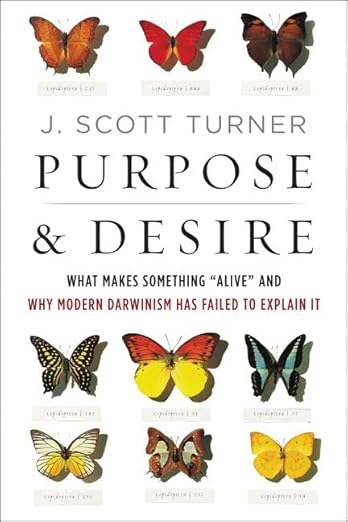
Making some of the same arguments that atheist philospher Thomas Nagel made in his 2012 Mind and Cosmos: Why the Materialist Neo-Darwinian Conception of Nature is Almost Certainly False, physiologist and biologist J. Scott Turner, in Purpose and Desire, a book he published about ten years ago, wonders why, too. Why do we believe we have purpose if we live in what Darwinian evolution decrees to be a meaningless world?It's tough. Clearly, every living thing behaves as if it has purpose, be it a purpose to eat, to seek safety, to reproduce, even to consider the nature of existence. Yet why would wholly material beings come to think of such things? Can chemicals desire? Can chemicals think?
A thoroughgoing Darwinian evolutionist, Turner does not see how. He does not see how mentally inert matter can exercise purpose. Yet he believes in the Darwinian picture of existence. And while, yes, he believes in God, he is careful in the course of the book not to use such belief as the way to answer his question.
And maybe that's his point. Unless a bigger purpose is afoot, unless a larger vision is working through the cosmos, we strive in vain to prove it has purpose. How can we? As essentially inert matter, we have no reason to wonder.
But we do. Everyday. We can therefore choose to live with the puzzle of God or we can choose to live without ever being able to explain why we really want to live in the first place.
It's the choice of a lifetime.
By the way, I'll be traveling for a few weeks and will not be posting. Thanks for reading: we'll talk soon!

No comments:
Post a Comment