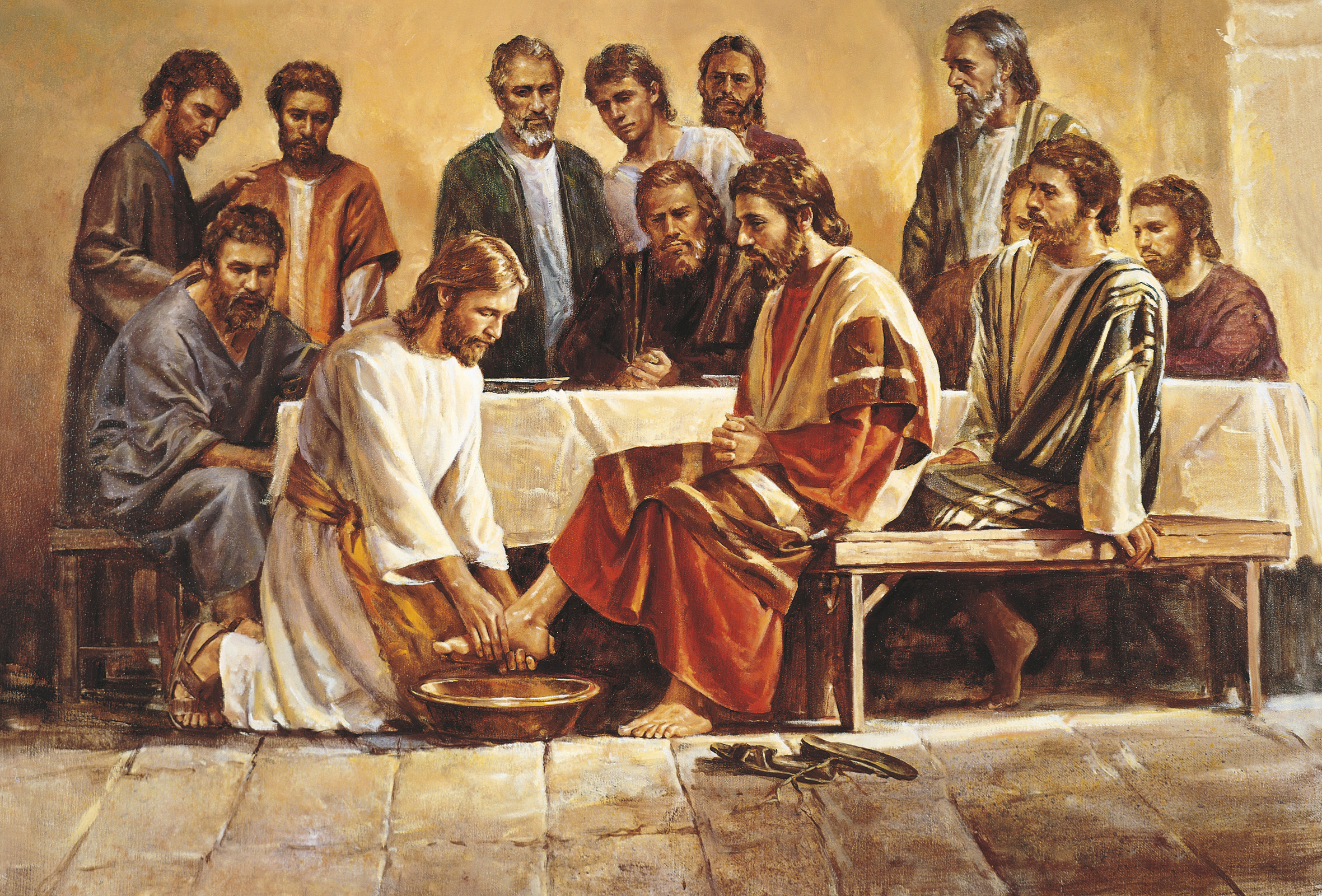
Today is Maundy Thursday. As we enter into the final days of Lent, the climatic days of Holy Week, we think about service. Throughot his earthly life, Jesus told people that he had come as a servant. He had not come to judge, he had not come to condemn; he had come to serve and save. Jesus had come to serve his creation. At the Last Supper (the event which Maundy Thursday commemorates), Jesus made clear that he was readying himself to give himself, to give his body, heart, and soul for the good of those whom he had made. Even as the final hours of his life loomed, Jesus emphasized that he had come to serve. His welfare was the last thing on his mind.
Whether we believe in Jesus or not, we can learn from his example. The world hardly needs more arrogant leaders. The planet will do just fine without its people constantly striving to dominate one another. When we, literally or metaphorically, wash one another's feet, as Jesus did at the Last Supper, we affirm our fellow human beings. We tell our fellow travelers that we regard them as more important than ourselves. We state to the world that working to sustain everyone is greater than working to sustain oneself only.
We let go of what we want for the good of others.
Consider what you have, ponder what you have been given. And sacrifice. Give up . your wonder, let go of your grace in order to create more of them for your neighbor. Make him/her more important than you.
And see how you--and the world--changes.
As Paul writes of Jesus to the church at Philippi, he "gave up his privileges" to become one of us, to live--and die--for creation.
Thursday, April 13, 2017
Wednesday, April 12, 2017
If you have read any of the biblical narratives about the trial and death of Jesus, you are likely familiar with the pericope (story) of the thief on the cross. As Luke tells it, both of the two men crucified with Jesus were hurling insults at him. After a time, however, one of them came to see things differently.
"This man," he tells the other thief, "has done nothing wrong. He is suffering unjustly. But we are not. We deserve our punishment."
Turning to Jesus, this thief then says, "Jesus, remember me when you come into your kingdom."
"Today," Jesus replies, "you shall be with me in Paradise."

It's a glorious promise. The thief's present pain, body as well as soul, will this day, this very day, be totally vanquished. He can look forward to a profoundly marvelous future.
Though the thief's destination is central to this passage, I want to think more about his faith. He knew about Jesus, he knew about Jesus' deeds. He knew that Jesus had told his audiences that he was bringing a kingdom to earth. It was not until the thief hung on the cross, however, that he came to realize, fully, the nature of this kingdom. He saw that Jesus' promised kingdom is not one of material gain, but one of spirit and soul. He knew that he would therefore need to trust in what he could not see in order to grasp what he knew he most needed: forgiveness and new life. He knew he needed internal change.
And that, as we move toward Good Friday, is the point. We trust in Jesus whom we cannot see because we know that in our deepest hearts, tangled as they are in the vexations of humanness and sin, we need more than ourselves to be eternally whole.
"This man," he tells the other thief, "has done nothing wrong. He is suffering unjustly. But we are not. We deserve our punishment."
Turning to Jesus, this thief then says, "Jesus, remember me when you come into your kingdom."
"Today," Jesus replies, "you shall be with me in Paradise."
It's a glorious promise. The thief's present pain, body as well as soul, will this day, this very day, be totally vanquished. He can look forward to a profoundly marvelous future.
Though the thief's destination is central to this passage, I want to think more about his faith. He knew about Jesus, he knew about Jesus' deeds. He knew that Jesus had told his audiences that he was bringing a kingdom to earth. It was not until the thief hung on the cross, however, that he came to realize, fully, the nature of this kingdom. He saw that Jesus' promised kingdom is not one of material gain, but one of spirit and soul. He knew that he would therefore need to trust in what he could not see in order to grasp what he knew he most needed: forgiveness and new life. He knew he needed internal change.
And that, as we move toward Good Friday, is the point. We trust in Jesus whom we cannot see because we know that in our deepest hearts, tangled as they are in the vexations of humanness and sin, we need more than ourselves to be eternally whole.
Tuesday, April 11, 2017
In similar fashion, Cormac McCarthy’s The Road tells the story of a boy and his father who wander through a land devastated by what appears to be some form of nuclear holocaust. It is a barbarous land, one torn by disorder and lawlessness, a world with no rules, structure, forgiveness, or commiseration. It is every person for him or herself. No one cares about anyone else. Vigilantes and gangs control the roads, dealing brutally and harshly with anyone who dares use them, and killing and abuse are reduced to triviality and banality. All human glory is gone. Any memory of the world which has been lost is gone, too. It’s no more than a nuance of the cortex. It is a world which God never knew.
So, apart from the person of Jesus and his life and death, is our world. Whether you believe in Jesus or not, consider that without his life--and the fact of God behind it--we have no way, absolutely no way, to claim, independently of our random and finite selves, that this world means anything. Should it?
Yet we all want it to. Otherwise, we are born, have fun and joy, then die. The moments were grand, the years wondrous. But now they're gone, forever.
The truth that God made and died for the world, however, means that it is loved by more than itself and those in it: it is loved by God. Its worth is forever.
Monday, April 10, 2017
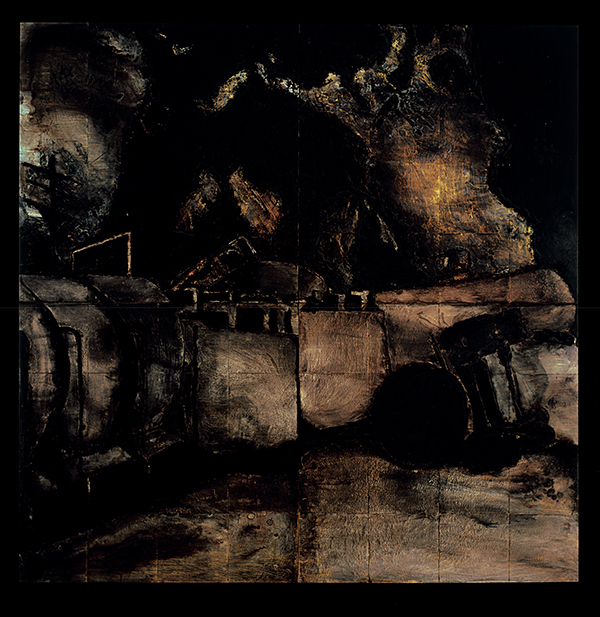
Don't look too closely: it's a disaster, a picture of suffering, helplessness, and pain. Part of a series of paintings by the American artist Donald Sutherland which he called, aptly enough, "Disaster Paintings," this painting represents the artist's view of how we respond to catastrophes in the experiences of our fellow human beings.
As the Modern Museum of Art's description of this series notes, "the Disaster Paintings eternalize the real-life modern events we are faced with daily in contemporary society yet quickly forget when the next catastrophe occurs."
Quite. Sure, life isn't all about disasters and pain, but most of us live as if it were. In every possible way, we try to arrange our affairs to avoid tragedy. We crave security; we cringe at the loss of control. And when we see our fellow humans in pain, we weep. We weep over the suffering, we weep over the events that led to it. Yet so prolific is the flow of "disasters" today that we rarely have time to ponder each in full.
We frequently forget that we live in a broken world. It's a glorious and wondrous world, yes, but it's a flawed system which, try as we might, we will never fully set right. Sadly, disaster is inevitable.
Nowhere is this more true as we consider the week before us: Holy Week. Many consider it a disaster. After all, Jesus, the Christ, the Messiah, the long awaited king, died. And he died the cruelest of deaths: crucifixion. In every way, Jesus' death represents the nature of a world oriented towards disaster.
Yet in every other way, Jesus' death presents a God who is bigger than disaster, a God who can redeem even the very horrific of disaster, even the very darkest of nights. Jesus died, yes, the Messiah slain, but God lives. And Jesus rose. God is God over even death.
Though disaster fills this world, God's power fills it even more.
Friday, April 7, 2017
Many years ago, Neil Young composed a song called "Only Love Can Break Your Heart." Anyone who has loved, or who has been loved, can relate. Not that love is the only thing that can break our heart, just that love, with its often overwhelming swirls of emotion and passion, tends to stir up feelings in us that nothing else can. Whether we love deeply, or are loved deeply, or both, we will eventually encounter heartbreak. Experienced and gained, love inflames with joy; lost and gone, love can torment horribly.
As we continue our Lenten journey, whether you believe in its foundations or not, consider the weight of love. We cannot live without love, yet in a ironic and even tragic sense, we cannot live with it, either. Love is one of the paradoxes of being human, part of being made in the image of a God who loves. It's wonderful, it's exasperating and confusing.
It is therefore good to remind ourselves that, love, God is no different. So much does God love us, his human creation, he indeed broke his heart: he watched his son Jesus die on a Roman cross. Because he loved us, God lost everything.
Yet it is in this horrific paradox, ours and God's, that we see what love, ours and God's, is most about: a heart that must break to find love's deepest part.
It is therefore good to remind ourselves that, love, God is no different. So much does God love us, his human creation, he indeed broke his heart: he watched his son Jesus die on a Roman cross. Because he loved us, God lost everything.
Yet it is in this horrific paradox, ours and God's, that we see what love, ours and God's, is most about: a heart that must break to find love's deepest part.
Thursday, April 6, 2017
A old Ukrainian folktale tells about two brothers, one rich, the other poor. Whenever the poor one is beset by misfortune, his brother never wants to help him. One day, however, the poor brother learns that his troubles are actually due to the actions of some "Imps of Misfortune." He proceeds to capture these Imps, buries them in a coffin and, subsequently, prospers.
But when his rich brother finds out about this, he seethes. He goes to the Imps and promises to set them free so as to bother his brother once more. The Imps, however, tell him something he didn't expect to hear.
Because you are offering to free us, they say, we conclude that you, unlike your brother, are good. So we will bother you instead.
Does not this seem backwards? Of course it does. Normally, we would think the meaner person would suffer more misfortune.
I tell this story to make a larger point. It's about grace. Grace confutes reality; it overturns what is normal and predictable, undermines what what we might think is true. Yet grace cannot be any other way. The way that an infinite personal God works in our reality will always be a surprise to us, we finite beings who know very little beyond our immediate perception.
It is God's unpredictability, his wild and, most important, loving, unpredictability, that makes him a God worth believing.
Ultimately, it's all about God's love, the most vexing and yet most wonderful mystery of all.
But when his rich brother finds out about this, he seethes. He goes to the Imps and promises to set them free so as to bother his brother once more. The Imps, however, tell him something he didn't expect to hear.
Because you are offering to free us, they say, we conclude that you, unlike your brother, are good. So we will bother you instead.
Does not this seem backwards? Of course it does. Normally, we would think the meaner person would suffer more misfortune.
I tell this story to make a larger point. It's about grace. Grace confutes reality; it overturns what is normal and predictable, undermines what what we might think is true. Yet grace cannot be any other way. The way that an infinite personal God works in our reality will always be a surprise to us, we finite beings who know very little beyond our immediate perception.
It is God's unpredictability, his wild and, most important, loving, unpredictability, that makes him a God worth believing.
Ultimately, it's all about God's love, the most vexing and yet most wonderful mystery of all.
Wednesday, April 5, 2017
What's grace? In its purest form, grace is something undeserved, something
freely given apart from the recipient’s standing, ability, or merit, something
the recipient often didn’t expect to receive. Anyone who has read Victor Hugo's Les Miserables knows one example of grace. Even though the priest in whose house Jean Valjean spent the previous night is aware that Valjean is taking the household silver, he lets him leave, anyway, without retribution. We don’t deserve grace, but without grace the world would not
be.
In its richest sense, grace connotes dependency, a dependency on beings with greater power than oneself. Though we independent human beings may loathe dependency, we really cannot live without it. We really cannot live with grace.
Charlie Fowler was a star mountaineer who put up numerous first ascents across the world, including Alaska, the Himalayas, and Antarctica. His power was monstrous. In November of 2006, however, while climbing a new route in the Pakistani Himalayas (with a fellow mountaineer), he was trapped in an avalanche and died. Some might have said that despite any personal failings Charlie may have had, the mountains had been good and gracious to him, that the mountains had shone upon him for many years, that he was blessed with constitution and circumstance to make astoundingly spectacular ascents.
All this was definitely true. In the bigger picture, however, Charlie was dependent upon grace. He was dependent on his genetic heritage, he was dependent on his abilities, he was dependent on the gracious "behavior" of the mountain.
In the bigger picture, grace must come from beyond this world, from beyond what we think or see, from beyond what we can know, from beyond what we might think. It must come from a personality greater than the present, for genuine grace must be able to overpower the present—and the future as well.
Only then can we, and Charlie Fowler, live in it.
Rest in peace, Charlie. We miss you.
In its richest sense, grace connotes dependency, a dependency on beings with greater power than oneself. Though we independent human beings may loathe dependency, we really cannot live without it. We really cannot live with grace.Charlie Fowler was a star mountaineer who put up numerous first ascents across the world, including Alaska, the Himalayas, and Antarctica. His power was monstrous. In November of 2006, however, while climbing a new route in the Pakistani Himalayas (with a fellow mountaineer), he was trapped in an avalanche and died. Some might have said that despite any personal failings Charlie may have had, the mountains had been good and gracious to him, that the mountains had shone upon him for many years, that he was blessed with constitution and circumstance to make astoundingly spectacular ascents.
All this was definitely true. In the bigger picture, however, Charlie was dependent upon grace. He was dependent on his genetic heritage, he was dependent on his abilities, he was dependent on the gracious "behavior" of the mountain.
In the bigger picture, grace must come from beyond this world, from beyond what we think or see, from beyond what we can know, from beyond what we might think. It must come from a personality greater than the present, for genuine grace must be able to overpower the present—and the future as well.
Only then can we, and Charlie Fowler, live in it.
Rest in peace, Charlie. We miss you.
Subscribe to:
Posts (Atom)