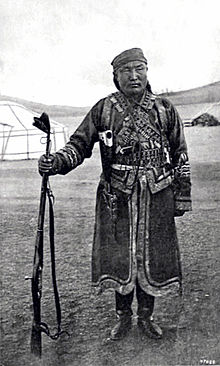
Ja Lama. Who was he? Ja Lama was a conqueror and adventurer who alternately terrorized and uplifted what is today southern Russia, northern China, and Mongolia. Many Mongolians believe he helped their nation gain its independence from China and Russia in the early twentieth century. On the other hand, Ja Lama was supremely cruel, inflicting unspeakable tortures on his enemies and those who disagreed with him, and ruled the lands he conquered with an iron hand. He brooked no dissent.
We might describe Ja Lama as a big fish in a small pond. Outside of the region in which he roamed, few were aware of him. Ambushed later in his life, alone and without help, he eventually endured the fate he imposed upon so many others: he was executed, shot by a firing squad at the age of sixty.
And where is Ja Lama today? I don't know for sure, but in an ironic twist, his skull is now on display at the Hermitage in St. Petersburg, Russia, labelled simply, "No. 3394, head of a Mongolian."
As the Bible often notes, though we are amazing and grand, ultimately we are dust--and one day to dust we shall return.
And it's over. Sic transit gloria.
Ah, how we need the fact of God.
As I was thinking about a class I'm currently teaching, I had occasion to re-read Plato's allegory of the Cave. Set into his monumental Republic, his voluminous study of the meaning of justice and the nature of the state, the Cave is a study in the folly of perception.
Perception is tricky. On the one hand, it is all we have to measure and evaluate the world. On the other hand, we do not perceive in a vacuum. We perceive in our social and cultural context.
Plato described a group of people who are living in a cave, a fire their only light. All they can see are shadows, semblances of reality. One day, however, some of these people venture into the daylight outside the cave. And they see without shadows. They see the world as it really it.
We all live in caves. We all live in caves of our own making. And we often do not know we are.
What can we do? Although we will never see reality apart from who we are, we can nonetheless understand that, despite it all, reality exists.
We can therefore pursue a much larger question: why does reality exist?
Outside of positing a reality out of which this reality has come, we will never know. We're all living in a cave.
"Freedom," the Who sang many years ago, "tastes of reality." As many of you may know, today the U.S. remembers he birthday of civil rights activist Martin Luther King, Jr. Central to the day is King's belief, a belief he shared with millions of others, that freedom, the ability to do what one chooses, when one chooses to do it is one of humanity's greatest privileges and blessings. We all deserve to be free.
Is freedom reality? If being free is the ability to find oneself as oneself is in this world, then freedom is indeed reality. It offers people opportunity to find what is most real and true about them, their lives, and the world in which they live them. It is a path to ultimate discovery.
Yet freedom is also, as many historians have pointed out, a release from bondage. In King's case, he was calling out for the end of the bondage of the American black, urging the nation to let go of its belief that black people did not deserve the same freedoms that the rest of the country enjoyed. That all people be free to pursue their dreams.
 For this is what God really wants. He made us to be free, to free to choose, to be free to do. To be free to live as we like.
Freedom is wonderful, and freedom is intoxicating. But freedom can be frightening. We often do not know what to do with it. We frequently do not know what its fullness really means.
Maybe that's why, as John records it in chapter eight of his gospel, Jesus told his audience that, "You shall know the truth, and the truth shall make you free." True freedom is to know the truth: the truth of the presence of God. King knew this well, and steadfastly centered his call for freedom in the greater fact of God. He knew that freedom is only meaningful if it is grounded in something bigger than itself. It's only real if it is centered in truth.
As we remember King's birthday, we also remember that the freedom he preached is ultimately, as Gandhi observed in his notion of satyagraha, self-discovery in truth. We are not free in an accidental universe without definition; we are free in a universe made real by truth itself.
For this is what God really wants. He made us to be free, to free to choose, to be free to do. To be free to live as we like.
Freedom is wonderful, and freedom is intoxicating. But freedom can be frightening. We often do not know what to do with it. We frequently do not know what its fullness really means.
Maybe that's why, as John records it in chapter eight of his gospel, Jesus told his audience that, "You shall know the truth, and the truth shall make you free." True freedom is to know the truth: the truth of the presence of God. King knew this well, and steadfastly centered his call for freedom in the greater fact of God. He knew that freedom is only meaningful if it is grounded in something bigger than itself. It's only real if it is centered in truth.
As we remember King's birthday, we also remember that the freedom he preached is ultimately, as Gandhi observed in his notion of satyagraha, self-discovery in truth. We are not free in an accidental universe without definition; we are free in a universe made real by truth itself.
Edvard Munch, about whose famous painting, "The Scream," I've written in the past, came to my mind recently. The impetus was an exhibit of Munch's work mounted by the Metropolitan Musuem of Art in New York City, "Between the Clock and the Bed." Although I didn't attend the show, I obtained the book the Museum published about it.
 Many paintings stood out to me, but I write about just one here. It is a portrait of German philosopher Friedrich Nietzsche. Perhaps most famous for his lauding of the "Ubermensch" (Overman or Superman), the person who breaks through the ordinary and mundane and rises above the "herd" to new heights of adventure, as well as his observation that, "God is dead," Nietzsche stirs a range of emotions in all who come across him. Some people hate him, some people love him, some people feel sorry for him.
Nonetheless, Nietzsche remains a compelling figure, and it is not surprising that Munch painted his portrait. What I found particularly intriguing was that Munch, the person who painted "The Scream," chose to paint the person whose ideas directly contributed to the ethos of emptiness "The Scream" embodies, as if one is to see, in Nietzsche, the lost human being, screaming into the world he made.
And make a world Nietzsche did: a world without God. It's a world of freedom yet a world of pain, an intense, joyful pain. And that's Nietzsche's point: better to step into the scary unknown than to lapse into the customary old.
Probably so. But sometimes the old, the world of God, is the most challenging world of all: a world of faith. Faith in the unseen, yes, but faith ultimately that in this unseen rests the worth and integrity of all that is.
As Nietzsche well knew, meaning is lost without it.
Many paintings stood out to me, but I write about just one here. It is a portrait of German philosopher Friedrich Nietzsche. Perhaps most famous for his lauding of the "Ubermensch" (Overman or Superman), the person who breaks through the ordinary and mundane and rises above the "herd" to new heights of adventure, as well as his observation that, "God is dead," Nietzsche stirs a range of emotions in all who come across him. Some people hate him, some people love him, some people feel sorry for him.
Nonetheless, Nietzsche remains a compelling figure, and it is not surprising that Munch painted his portrait. What I found particularly intriguing was that Munch, the person who painted "The Scream," chose to paint the person whose ideas directly contributed to the ethos of emptiness "The Scream" embodies, as if one is to see, in Nietzsche, the lost human being, screaming into the world he made.
And make a world Nietzsche did: a world without God. It's a world of freedom yet a world of pain, an intense, joyful pain. And that's Nietzsche's point: better to step into the scary unknown than to lapse into the customary old.
Probably so. But sometimes the old, the world of God, is the most challenging world of all: a world of faith. Faith in the unseen, yes, but faith ultimately that in this unseen rests the worth and integrity of all that is.
As Nietzsche well knew, meaning is lost without it.
A few weeks ago, some tobacco companies placed a full page notice in leading American newspapers that stated, basically, smoking cigarettes can lead to death. While this sounds highly considerate of the American consumer, the companies in fact only posted the notice because a court ordered them to do so.
It is well known that tobacco companies had been aware for decades that smoking was harmful and addictive. Yet they continued to market and sell cigarettes throughout the United States as well as all other corners of the world. Despite this most recent notice, they still do.
Although none of us is ethically consistent, I cannot help but wonder why these companies continued to sell a product which they knew was deadly to those who used it. These companies are run by people, humans like us, people with families, people with hopes, people with dreams, people who, in other circumstances, might go out of their way to help another person.
Ah, the human will and imagination: so marvelous, yet so deadly, even to itself.
Is this really how God wants us to be?
Art is a powerful thing. Besides moving us, our hearts, senses, and imaginations, it moves culture, potentially transforming a people, even a nation. I thought anew about this when the other day I realized that roughly ten years had passed since the passing of the Russian born artist Boris Lurie.
Lurie is most famous for developing what has come to be called NO!Art. What's NO!Art? It is art as social protest. And not just conventional social protest. As one who lost several family members to the Holcaust (Lurie was Jewish), Lurie used his art to express the utter horror of his wartime experiences. He wished to communicate, in particularly and graphic form, the profound pain and suffering that marked this dark chapter in humanity's history. Lurie didn't want people to forget. He wanted to ensure that the memory of this blackness would remain with humanity to the end of its days.
So we should remember. Lurie's art helps us to look outside our historical moment. It forces us to look beyond our frenetic pursuit of daily wants and needs. His art urges us to grapple with the emptiness at the core of the human soul. It causes us to ponder the darkness of a culture gone amuck.
We need Lurie's art. We need to remember. We need to recognize our fallenness. We cannot be fully human, human as magnificent, human as tragic, unless we do.
Tomorrow is Epiphany. Far, far away from Palestine, thousands of miles, culturally, from the world of ancient Israel, ensconced in the mountains of Persia, assorted people studied sacred scriptures, Jewish, Zoroastrian, and more. Day and night, they labored over the texts before them, looking for guidance from God as to what would come. And what would come? God. God would come to earth. And when God comes, he would be, these scholars realized, human and divine. Small wonder that they made the arduous journey over the Zagros Mountains, across the arid expanse of Arabia, and onto the international trade routes that coursed through the Levant. Who would have imagined such a thing? Ah, some might say, indeed: how is this possible? How can this be? It's nonsensical, illogical.
On the one hand, I suppose it is. Yet I do not know how else to explain why we are the way we are, why we are personal, why we have consciousness, why we have purpose and desire. We do not prove we are worthwhile because we insist we are worthwhile: a circular argument to be sure. We rather affirm our dignity by establishing the fact of a purposeful world.
And that we cannot do without God.
And what would come? God. God would come to earth. And when God comes, he would be, these scholars realized, human and divine. Small wonder that they made the arduous journey over the Zagros Mountains, across the arid expanse of Arabia, and onto the international trade routes that coursed through the Levant. Who would have imagined such a thing? Ah, some might say, indeed: how is this possible? How can this be? It's nonsensical, illogical.
On the one hand, I suppose it is. Yet I do not know how else to explain why we are the way we are, why we are personal, why we have consciousness, why we have purpose and desire. We do not prove we are worthwhile because we insist we are worthwhile: a circular argument to be sure. We rather affirm our dignity by establishing the fact of a purposeful world.
And that we cannot do without God.