Thursday, March 19, 2020

     Yes, we of the planet Earth are in the grip of a frightening pandemic that is causing tremendous social and economic upheaval around the globe, and yes, more and more people are dying each day from a virus presently immune to vaccination.  On the other hand, believe it or not, today is the vernal equinox, the first day of Spring.  The days are lengthening, the sun is shining, and privations of winter are winding down.  Spring has come.  It must.
      We rejoice in the newness, we rejoice in the verdancy, we rejoice in the appearance of new life.  We rejoice in the power of the earth to, once again, rejuvenate and revive itself for our joy and wonder.  It's like a resurrection.

Image result for spring photos
     
 The writer of Proverbs 27 observes that, "When the grass disappears, the new growth is seen."  Winter can be hard, winter can be harsh, and winter can be long, very long, rife with dissolution and vanishing, departure and hopelessness.  Even in the most tropical regions of the world, however, though spring, fall, and winter do not occur in the way they do in northern regions, "grass" nonetheless disappears.  Things die, things go away, things change.  And newness comes.  It's the rhythm of existence, the song of life.
     While we may not enjoy winter, personally, meteorologically, or otherwise, we walk in winters, small and large, every day, for in winters is the stuff of living, the glorious and aching mess of being alive, the raw material with which God fashions, in ways we rarely foresee, our springs.
     As the apostle Paul puts it in his first letter to the church at Corinth, the seed that falls to the ground cannot germinate unless it, now detached from its moorings, slips into the ground--no longer seen--and dies.  A seed's death is the winter that brings spring.
     Rejoice in the disappearance, rejoice in the newness.  Rejoice in a world that has both.
     And wash your hands . . . 

Wednesday, March 18, 2020

Image result for pi     Although the world remembered it a few days ago, it is worth remembering it again:  Pi Day.  If you have studied mathematics, you are likely aware of pi:  3.14 (and counting:  its decimal places are infinite), the standard, the framework, the number upon which so much else hinges.  Pi reminds us of the incredible order that is built into the world, how the universe is so remarkably tuned to what it is.  Even if the world is experiencing chaos which, many would say, in light of COVID-19, it currently is, it is, nonetheless, experiencing such disorder in the hands of an immensity of order.  While COVID-19 seems to evade all attempts to find it meaningful (religion notwithstanding), we can assure ourselves that if not for the orderliness of physical laws of the cosmos, we would not be 
able to begin to understand it as it is.  Though COVID-19 seems an aberration, and in many ways it undoubtedly is, it is an aberration occasioned and, in some respects, enabled by the immutable facts of physicality and physics upon which the universe functions.  Oddly, we wouldn't know it without knowing the essential intelligibility of the cosmos.
     Pi tells us that even if we do not believe in a creator or god, we cannot, indeed should not, avoid asking ourselves why, even if we understand its physical laws, we still do not know why we live in such a comprehensible, roughly, existence, such an irrefutably intelligible universe.
     How could such intelligence come to be?

Tuesday, March 17, 2020

     Although COVID-19 is dominating the news lately if you're Irish or have some Irish in you, you may well be thinking about another thing today:  St. Patrick's Day.  Patron saint of and missionary to the Irish nation, St. Patrick came into a remote and unsettled land dominated by various strands of Celtic religious thought and proceeded to teach and explain the Christian gospel.
Image result
     It seems that he did so rather successfully, too.  Despite what has historically been often very deep cultural rifts among the Irish populace, Christianity is still admired and celebrated throughout the land. God and Jesus remain very important.
     One of the beauties of St. Patrick's Day is that although it is a commemoration of the saint's supposed day of death, it is on the other hand a day of tremendous celebration.  Sure, some people celebrate to excess, but usually even this is done with every good intention:  life is beautiful!
     Amidst the revelry, however, we overlook the profundity of what Patrick had to say.  Consider one of his meditations on Psalm 46:

     "Be still and know that I am God.
      Be still and know that I am.
      Be still and know.
      Be still.
      Be."

     Amidst the "beingness" and celebration, Patrick is saying, remember from whom it all comes.  "Be" in your creator.

Friday, March 13, 2020

     Today is Friday the 13th.  It's not frequent, it's not often, but it happens.  As I think about the centuries of superstitions behind the meaning that we attach to this day, I also think about COVID-19 and the terror it is unleashing around the globe.  We may wonder how such things as this happen, we may wonder what these things mean.  If you are of a superstitious bent, you may sense an omen.  Or a portent.  Or nothing at all.
     Regardless, the virus is real.  As I look across the planet on this Friday the 13th, I see something close to mass hysteria as people and the nations they inhabit seek shelter from the storm, the storm of infection, the storm of potential death.  It can be frightening, genuinely frightening.  And it is.
     How easy it is to say that God loves us.  How easy it is to say that God cares.  These are fundamental bulwarks of Christian belief.  Yet we may not always see evidences of these truths in our lives, much less the lives of the countries to which we belong.  We may look for comfort elsewhere.  And we may well find it.
     To a point.  Though it isn't always easy to believe in the unseen, it is perhaps, in this case, the braver option.  We may not always understand the ways of "beyondness," but we understand even less the capricious contusions of a broken world:  why?  Why this?  Why that?
     The only reason we ask such things, however, is that we assume that the world has meaning, and that we who live and die in it therefore have meaning, too.  Yet how do we know this without knowing why we do?
     As a French writer pointed out a number of years ago, we cannot live without belief, a belief that, whatever we suppose or think, the world is bigger than we think.

Thursday, March 12, 2020

     In a broken world, a world in which things do not always go as we wish them to, a world marked by tremendous joy as well as profound tragedy, we humans seem to cultivate an innate longing for control.  Why can we not control the affairs of our lives? Why can we not ensure that we are not surprised by darkness?


Image result     In this week, the week of the second Sunday of Lent, we have opportunity to rethink our longing for control.  Lent is all about giving up.  We give up our time, we give up our pursuits, we give up our lives, we give up control.  We recognize that we live in a world beyond our control.  We acknowledge that if we try to control everything, we will inevitably end up creating a world of us and us alone, a world without any real point except poor little us.  We reduce ourselves to a collection of atoms spinning madly in a nexus of space and time, avoiding everything but ourselves.
     Lent is one of God's way of telling us that though we are remarkable creatures, seemingly capable of directing the course of our lives, we will never control it all.  Lent reminds us that we are finite, that we have limits, that our marvelous attributes can only take us so far.  Sooner or later, we encounter a bump:  we realize that we are not so remarkable that we in ourselves can decide what we are and what existence means.  How can we?  We are only us.
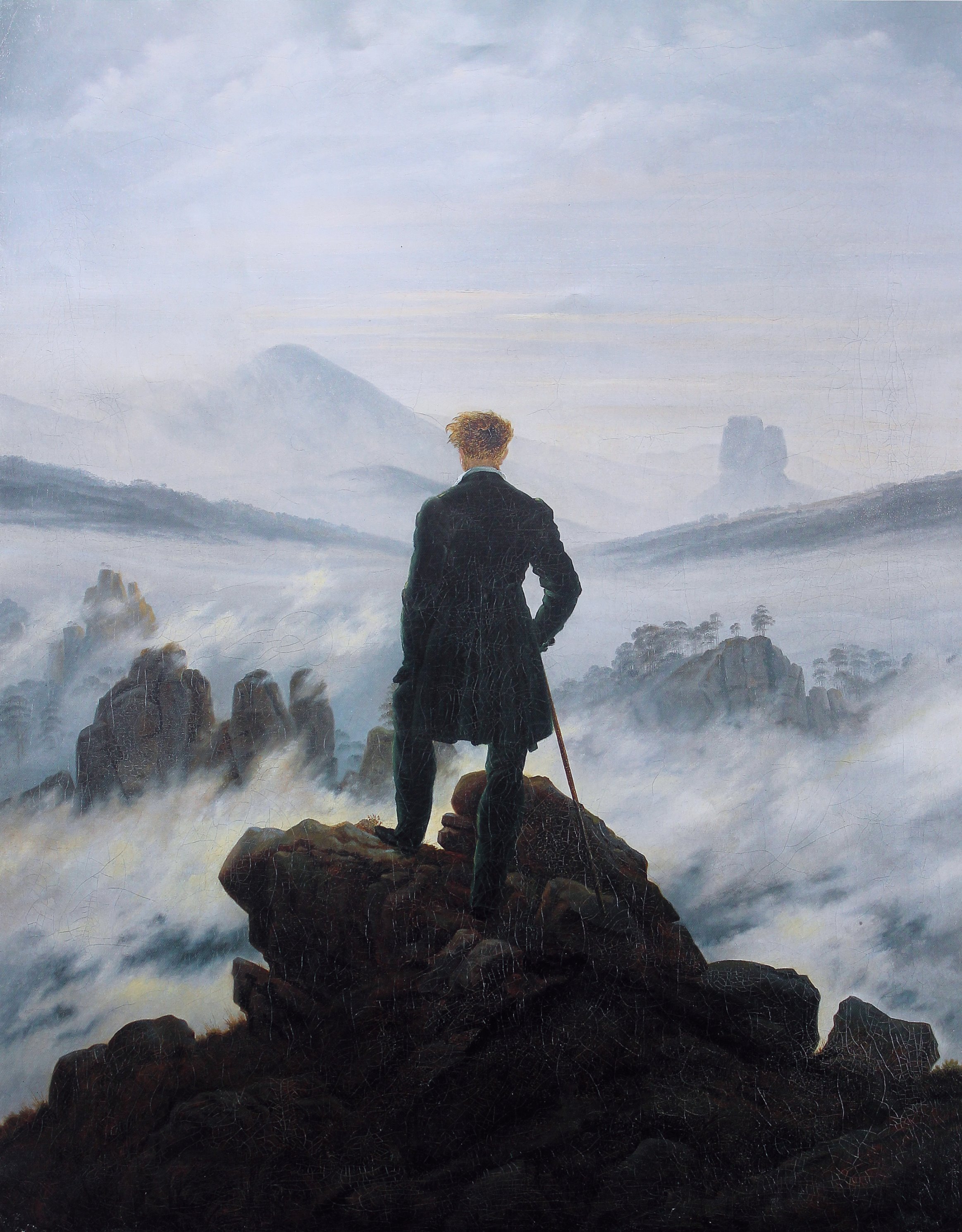
     We in Lent are like the "Wanderer above the Sea of Fog," standing before the world, watching, planning, waiting, bereft, however, of ultimate control over that which we see.
     And that's precisely God's point:  to live wisely, we must give up.  We must give up who we are now to find whom we are, in truth, destined to be.

Wednesday, March 11, 2020

     Purim!  Yesterday, our Jewish brethren completed their annual celebration of Purim.  Purim is a remembrance of liberation, a day to recall how God, once again, rescued the Jewish people from potential annihilation.  Like the Exodus, celebrated in about a month from today at Passover, Purim recognizes that despite all the machinery we have amassed to keep ourselves safe and secure, personally and internationally, it is ultimately transcendence that provides ultimate meaning and value to our efforts.  It is only the work of larger presences that ensure purpose in our dogged attempts to keep ourselves free.
     Purim tells the story of Queen Esther, a Jewish woman chosen by the Persian king Ahasuerus, probably Xerxes I, to be his latest bride.  As things go on, Esther's uncle, Mordecai, learns of a plot concocted by the courtier Haman to slaughter all the Jews in the Persian Empire.  In words that have resonated with believers for centuries, he goes to his niece and advises her that, "And who knows whether you have not attained royalty for such a time as this?"  It is you, Esther, and only you who can intervene with the king to save us.
     And Esther does, delivering her people from potential destruction.  Although we may not always see the passage of transcendence in our earthly reality, and while we may miss its intimations of its presence in the life of the world, Purim demonstrates to us that, as much as we might like to suppose that the cosmos is void of larger purpose, such purpose prevails.  Given our technologies, we may well be able to rescue ourselves from almost any situation of peril, yet we may overlook the greater point:  in a planet stripped of transcendent meaning, what does it really matter?
     "For such a time as this."  We really do have value.

Monday, March 9, 2020

     Yesterday, March 8th, was International Women's Day.  It's definitely an occasion to celebrate.  After all, it's no secret that, historically, women have frequently been relegated to second place status in almost every area of human existence and that, moreover, this continues to happen, too much, even today.
     It's time, indeed, way past time to remedy this malady.

International Women's Day
     And God would agree.  If we examine the verbs the writer of Genesis uses to describe the creation of man and woman, we see why.
     The verb used to describe God's creation of Adam is a fairly common one.  It connotes a general act of making or creating.  It presents the creative act as a rather casual one, as if God put together Adam from various parts he found as he wandered to and fro through the universe (although he really did not).
     The verb used to describe the creation of Eve is very different.  Used far less frequently, it is a verb that presents creation as a very systematic, thoughtful, and carefully constructed act, as if the creator--God--is working from a blueprint, a very complex activity.     
     What does this tell us?  That although God created man and woman, he did so in different ways.  While men and women are equally important, the woman is the most complex creature in all of creation.  Why?  Out of the two beings that comprise the human species, only she is able to give birth to human offspring, that is, living, viable beings made in the image of God.  Only woman can sustain the human race.
     And this is more than enough reason to laud and celebrate women.  Clearly, if not for our mothers, none of us would be here today.  If not for women, not one person would be able to enjoy this existence.
     Most importantly, if not for women, none of us would have opportunity to find God.