Wednesday, August 10, 2022

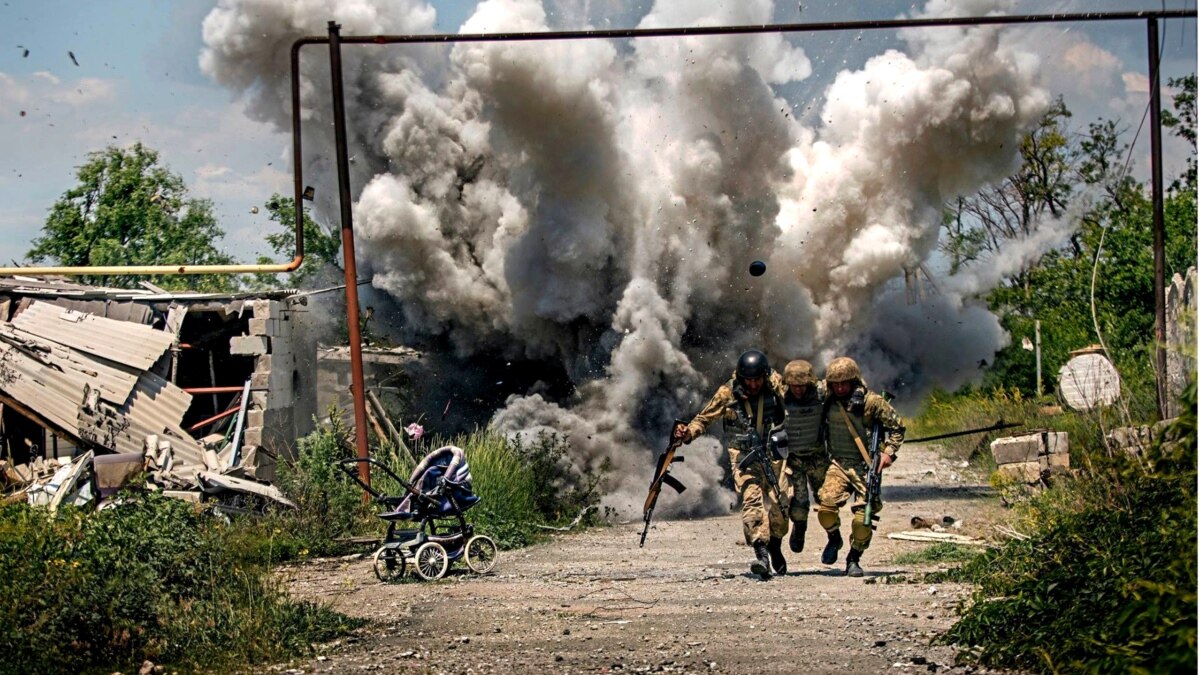
War Of Words Over Ukraine 'Combat' Photo

     Although I realize that war in Ukraine no longer dominates the newsfeeds in the way that it did at the moment of the Russian invasion in February of this year, this war, unfortunately, continues to create immense difficulties and hardships for the people of Ukraine.  Its human toll is singularly devastating:  thousands of lives lost, thousands of homes destroyed, hundreds of businesses gone forever.

    And for what?  In his mad obsession to restore Russian "greatness," Vladimir Putin seems willing to ruin the lives of millions of people, and not just in Ukraine.  If not for the recent agreement to allow Ukrainian grain to be shipped to other parts of the world, the Russian leader's war threatened to drag millions of people into starvation.  It's unconscionable.

    I struggle with the war's destruction, I struggle with the mind of a person bent on aggrandizing himself, and I struggle with the person and place of God.  Though for the first two of these I can find some material explanation, for the latter, I have no ready answers.  It is the dilemma that it poses that constitutes the ultimate challenge of faith.

    For it will not do to respond that, "Well, God has a plan."  For whom?

    No, it is these times that force those of us who believe in an infinite and loving God to make an extremely revolutionary stand:  will we affirm the fact of loving and transcendent purpose in worldly darkness or will we continue to believe that, in a random world, bad things happen and we will never know why?

    The choice is upon all of us.

Monday, August 8, 2022

      Tisha B'Av.  One of the most solemn days on the Jewish calendar, Tisha B'Av ("Ninth [day] of Av") (Av is the fifth month in the Jewish calendar) remembers the destruction of the Jewish temples in Jerusalem:  the first one, built by Solomon and destroyed by the Babylonians in the sixth century B.C., and the second, built after the Exile and destroyed by the Romans in 70 A.D.  Commemorated yesterday, Tisha B'Av is a day (and night) of intense summer mourning; in fact, many Jews see the entire summer as a time to remember and mourn the loss of the temples.

upload.wikimedia.org/wikipedia/commons/thumb/b/...

    In the "modern" age that most of us occupy, we may not readily identify with the destruction of temples built so many centuries ago.  Yet like most buildings of note, temples are repositories of memory.  People look to temples to remind themselves of what has been, what is, what could be, and what one day will be.  They find in temples conduits and expressions of the collective consciousness that sustains them, the corporate beliefs on which their spiritual sensibilities and inclinations are grounded:  the traditions that endure.

     People also look to temples to remind themselves of the fact and presence of hope.  Although the temples of Jerusalem were destroyed, the hope, the perduring hope in the love of a good God, continues:  remembering the destruction of a temple tells people that their hope does not lie solely in the structures of this present reality.  Their hope rather rests in something, in someone whose longevity and purview exceed that of all the world's empires combined.  It is a hope, indeed, an active conviction and belief, that regardless of the turns of earthly history, there is someone who will always be greater and more, a lasting foundation of point and meaning.

     And that life is therefore ever more than what we now see.

Friday, August 5, 2022


    Hieronymus Bosch, the late Renaissance Dutch painter, left us a curious legacy.  On the one hand, his art seems to reflect a wish for the traditional, the staid and religiously structured medieval past that the Renaissance left behind.  On the other hand, it evinces a desire for a breakage from tradition, a severing of ties to what had long been considered to be morally valid.  His "The Garden of Earthly Delights" is a prime example.

     In a way, we're all like Bosch.  Most of us appreciate tradition, most of us value the tried and true, and few of us entertain a wish to overthrow the existing order completely.  Conversely, however, not too many of us wish to maintain things exactly as they have always been.  We wouldn't be fully human if we did.

     Consider religion.  Repeatedly, the many religions which have emerged in the course of human history have advocated a new way, a fresh way of looking at the world.  That's their appeal:  a richer perspective on existence.  We may agree or disagree with any or all of the world's religions, but we cannot deny how they have opened new and, usually positive, avenues of thinking for billions and billions of people.

    It's tricky, this humanness of ours is.  We constantly balance a compelling desire for stability with an equally compelling desire to undo it, to undo it for a greater day.  As we should.  God didn't make us to stand still.

Thursday, August 4, 2022

     One book I read during my recent travels was Margaret Atwood's Handmaid's Tale. Perhaps you've read it, too.  If so, you likely have not forgotten it.  It's a harrowing portrait of cultural fervor gone too far.  America has collapsed, imploded over political excess and machination, and a tiny group of the elite is controlling the lives of thousands of people.  So controlling is this elite forces a group of fertile women, the Handmaids, to bear children for the Commanders, the rulers of the now truncated nation.  Pregnancy machines and nothing more.  Any dissent is punished severely, usually by torture and a horrible death.

    In a forward to a more recent edition of her novel, Margaret Atwood insists that she has no animus against religion.  Rather, she says, she does not wish to see religion used to exploit people.  Which, the careful reader will readily see, is what happens in Handmaid's Tale.

The Handmaid's Tale intertitle.png

    Excessive devotion to any religious or political creed or, even more, person--say, a demagogue--always creates more problems than it solves.  It never turns out well, and will lead inevitably to immense social carnage and destruction.  And no nation is immune to such things:  the world of Handmaid's Tale can happen anywhere.

    We're called to love our liberty to express ourselves, but not to use this liberty to make our liberty the sole definition of what freedom can be.

Wednesday, August 3, 2022

     Much criticism has been leveled at American president Joe Biden regarding his recent visit and exchange with Saudi Arabia ruler Mohammed bin Salman Al Saud, otherwise known as MBS.  Given that during his 2020 presidential campaign Biden vowed to make MBS an international pariah for his well established involvement in the assassination of Washington Post writer Jamal Khashoggi, many people accused Biden of hypocrisy.

    I suppose they have a point.  Why does the so-called leader of the free world freely consort, even seem to support, a person who apparently ordered the brutal murder of a prominent dissident?  MBS's conduct seems antithetical to everything for which an American president supposedly stands.  Moreover, the sheer immorality of a ruler who did that of which MBS is accused definitively challenges all boundaries of a reasonable political imagination.

    Unfortunately, it is America's dependence on oil that is ultimately driving Biden's actions.  With inflation and high gas prices pushing his approval rating to an all time low, Biden likely felt forced to reestablish relations with the Saudis and their oil reserved:  his presidency depended on it.  On the other hand, every one of Biden's predecessors did exactly the same thing:  they were willing to tolerate, even enable, the actions of dictatorial Saudi monarchs to ensure American access to Saudi Arabian oil.

A photograph of Mohammed bin Salman aged 34

    Other Western nations are no different, either.  In the end, it's all about the West getting what it believes it deserves:  continued affluence.

    Regardless of the compromises its people must make to get it.  While I appreciate my Western lifestyle as much as my next door neighbor, I do not believe we can pretend that it does not come without a tremendous cost, ecological, economic, and, most of all, moral.

    And who are we to think we can be the ultimate moral arbiter?

Tuesday, August 2, 2022

8,864 Sierra Nevada Mountains Snow Stock Photos, Pictures & Royalty-Free  Images - iStock

     Are the mountains our friends?  Many decades ago I was snowshoeing through the Sierra Nevada mountain range of California.  From the moment I started my backpack, snow began to fall.  It fell all through the day, and all night as well.  It fell most of the next day, too.  By the time the snow stopped falling, four feet of fresh powder blanketed the forest and surrounding peaks.  It was beautiful, but challenging.  Every landmark was obscured, every point that I might use to center my compass was impossible to see.  I had no clear idea where I was.

    It was scary.  Though I marveled at the magical way in which the snow had transformed the mountain landscape, I was also afraid.  Two days of storms had created a world beyond my control:  I didn’t know whether I’d ever make it home.  As I dug a snow cave, then crawled into it to cook my dinner that night, I reflected on my situation.  I’m so small, I thought, so very small.  And I’m at my wit’s end:  I have no idea where to turn.  Though I knew I loved these mountains dearly, I also realized that at this point they were not loving me in return.  No longer were they 

my friends.  Not at all.


But, I quickly caught myself, are these mountains really my enemies?  Maybe the deeper problem was that, like most of us, I did not like losing control.  I did not like having to admit that I had met part of the natural world which I could not conquer.  In previous years I had summitted dozens of mountains, winter, summer, and spring, always mastering obstacles, always overcoming every difficulty to reach the top.  I had always been supremely confident in my ability to find my way and succeed.


    Now I was not sure I could.  As I think about that night today, however, I realize that maybe, just maybe it was that very confidence that was my problem.  While by most standards we humans are more intelligent, capable, and moral than other animals, we err if we suppose that this means that we have a right to expect all other things to accede to our every whim and desire.  To assert otherwise is delusional.  This is a vast, vast universe, rippling with many, many events and phenomena that we may never master or understand completely.  And that is fine.


    After all, would we really want a world with no mystery or surprise, a world in which every natural system is totally predictable, a world that never exceeds our sense of awe and wonder?  Would we really want a world in which adventure could not happen, a world with no natural challenges to master or geological upheavals to overcome?  A world without any sense of the unknown?


    Unfortunately, in this life, we cannot have one without the other.  Yes, we rightly cower before expressions of nature’s potency with which we cannot deal or overcome.  And rightly do we weep when lives are lost in natural disasters.  Yet at the same time we enjoy being astonished at the glory that the natural world displays for us.  From the awe inspiring majesty of high mountains, the compelling emptiness of a distant desert, the verdant expanse of a boreal forest, or the enduring bliss of the open sea, we rejoice and delight in all that the planet has for us.  Its beauty is one of our greatest treasures.


    And it's no accident.

Monday, August 1, 2022

    In her fascinating and erudite book (Decay and Afterlife) about the meaning of ruins, author Aleksandra Prica makes a telling point about the cultural role of ruins. It is in ruins, she argues, that a society finds itself.  In ruins, a society sees both its past and its future, reminding itself that it did not emerge in an historical vacuum and that it will not end apart from the same.  A society's ruins are its successor's genesis:  one culture's demise is the birth of another.

    And life goes on.

    As I read through the book, I thought frequently of the closing scene in the original "Planet of the Apes."  Finally free to roam the planet with his newly acquired girlfriend, astronaut Charlton Heston (Taylor) comes upon what the most sinister of the apes knew all along he would see.  Half buried in the sand of the beach on which he is traveling, its once proud beacon now barely visible above the waves is the Statue of Liberty.

    A civilization that even now considers itself "exceptional" is, in the end, another ruin, gone, to use a common metaphor, the "way of all flesh":  dust for the ages.

    It's a humbling end.  Be thankful for ruins, for they are the lens through which we see ourselves as we are:  magnificent yet fragile creatures who are caught in a maelstrom of contingencies which we will never overcome.

    Even if there is a God.