Wednesday, February 14, 2024


    Today is Ash Wednesday, the first day of Lent.  It's a day that reminds us that, whether we believe in an afterlife or not, we are ultimately no more than dust.  When we die and pass out of this life, what remains of us will soon be no more, too, returned to the earth from which it has come.

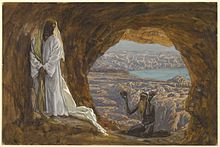
    The illustration on this page is of Jesus during his forty days in the deserts of Israel.  After his baptism but before he began his public ministry, Jesus spent forty days and nights in the desert.  While we do not know exactly what he did in that time (other than fending off the temptations of Satan), we can be sure that he meditated and prayed.  Of what he prayed we cannot be certain, but we can probably be safe on assuming that he, like many of the Jewish prophets before him, found profound solace and insight in the desert.  Being in the desert is an apt picture of journeying through Lent.  It's a constant reminder of who we, frail and fragile humans, really are:  ashes and dust.

    Before my siblings and I scattered my mother's ashes atop her favorite mountain in the San Gabriel Mountains of California in October of 2011, we opened the box that contained "her."  All that Mom ever was had been reduced to a small pile of ashes.  All her years, all her love, all her joy, all her meaning, all her hopes and dreams now no more than a bag of ashes.  It was sobering.

    Even more sobering is that one day, every one of us will be exactly the same.  Happily, however, even as it reminds us of our mortality, Ash Wednesday also reminds us to acknowledge that we are not dust and ashes only. We are spiritual beings, physical creatures with spiritual form and transcendent vision, created by a spiritual and eternal God.

    There is more to us, and existence, than what we see.

Tuesday, February 13, 2024

    A few days ago, I mentioned Irish writer James Joyce's Portrait of the Artist as a Young Man, in particular, some of its most famous lines, which read,

"He was alone.  He was unheeded, happy, and near to the wild heart of life.  He was alone and young and willful and wildhearted, alone amid a waste of wild air and brackish waters and the sea harvest of shells and tangle and veiled grey sunlight."

Photograph of Joyce in profile

    Words to stir any adventurer or wanderer.  In them, Joyce captures the heart of his literary project, his fervent efforts to break loose from the strictures of his Roman Catholic upbringing, his dogged work to bring himself into a new definition of what it means to be human.  To let go, to let go of what had restrained him, to freely embrace the fullness of the unknown.

    Put another way, the heart of adventure.  How we adventure will vary widely but at its heart is the quest, indeed, the desire, to step into what we do not know.  Ironically, however, wherever we go, we will eventually find that the real adventure is to see, in all its frightening enormity, the known that grounds all unknowns.

Monday, February 12, 2024

 Kansas City Chiefs' quarterback #15 Patrick Mahomes with his wife Brittany Mahomes and their children Patrick Bronze and Sterling Skye celebrate winning Super Bowl LVIII against the San Francisco 49ers at Allegiant Stadium in Las Vegas, Nevada, February 11, 2024.

     Did you watch the Super Bowl?  I watched the first half, Usher's half time show, and the closing moments of the game.  Millions of other people, however, watched the entire game, all four+ hours of it.

    I often wonder what our many animal friends think about the sight of that many people glued to their television sets for over four hours, eating, talking, laughing.  Whatever are those human beings doing?

    Simply being, I guess, human beings, magnificent, glorious, frail, intelligent, self-conscious and incomplete sentient beings availing themselves of the only existence they will ever have on this planet.

    Therein lies the puzzle.  Where else will we find such an intriguing combination of will, tenuousness, folly, and determination?  Is this God's intention or is this evolution's result?  Either way, it's nothing anyone could have predicted:  life's essence eludes us unless we understand why it is.

    And to deny that we need to know why life is, is, it seems to me, as big a crutch as an unbeliever might say about the nature of faith.  We will never escape our need to know.  So did British philosopher Iris Murdoch observe that, "It is a task to come to see the world as it is."

Wednesday, February 7, 2024

       Alone they were and, like the protagonist of James Joyce's Portrait of the Artist as a Young Man, free.  Quitting their corporate jobs and leaving everything to explore and experience the world, Lauren Geoghegan and Jay Austin traveled as they wished, stepping into cultures and times far from anything they had ever known.

     And along the way, they experienced the goodness of humanity.  Everywhere Lauren and Jay went, they were overwhelmed with outpourings of compassion and hospitality.  People, they wrote, are good.

     One day, however, they encountered a group of men who had sworn allegiance to ISIS. The fairy tale quickly came to a tragic end.  Lauren and Jay are gone forever.

     Nonetheless, Lauren and Jay were not mistaken.  People are good.  Every one of us, every last one of us, is made in the image of a good God.  We are all unique and special and loved by God.  But sin has fractured God's image in us; sin has cracked the mirror.  And horribly bad things happen.

     I don't despair, however.  As the Dutch missionary Corrie ten Boom, arrested and sent to Auschwitz for sheltering Jews during the Holocaust, once said, "There is no pit that God's love is not deeper still."

     Nothing can conquer transcendent love.

Tuesday, February 6, 2024

     In a world that begs to be experienced, those of us who set our sights on doing so fully frequently in what the Canadian poet and novelist Robert Service called wanderlust.  We set our sights on parts unknown, be they physical, mental, or emotional, and set forth, entirely open to what we find.  We're ready for anything.  Or as Service puts it, we respond to the "call of the wild."

     For Service, a poet of the Far North, this call entails nights of frigid cold and little fire, encounters with wild animals and wildness itself, a constant and steadfast sensation of entrapment, in a good way, in horizons of a peculiar blend of harshness and beauty.

    Yet ours does not need to be that of Service's.  Whatever it be, however, it in this "call of the wild" that we confront ourselves and our world most fully.  We bump against the dichotomy that governs all of existence, the grand balance between beginning and ending.  We step into what we cannot master or tame, the surreal and sightless edge of this enigmatic experience we call life.

     As we should.  We cannot find ourselves, and we certainly cannot find the world if we don't take both apart.  It is the call of the wild, whatever we understand it to be, that fractures what we know so as to show us what we do not.

    It's like God:  a wildness that undoes everything else.


Monday, February 5, 2024

         In the U.S., February is Black History Month.  In truth, one finds it rather odd that we must set aside a month to celebrate a history of a people whose lineage is considerably longer than that of the more dominant race in the world today, that is, white people.  In fact, as Nell Irvin Painter points out in her 2011 The History of White People, it is the white skin color that, from a genetic standpoint, is the more "aberrant" of human skin colors.  Moreover, whether we believe that humanity began in southern Iraq vis a vis the Garden of Eden, the savannah and gorges of central and southern Africa, or some combination of the two (which, given geological shifts many eons ago, seems likely), we must admit that our earliest ancestors were anything but lily white.

Image result for black history

     Due to racist behavior perpetrated by other races and ethnicities in the course of human history, the virtues of Black culture have often been ignored, suppressed or, worse, abused and destroyed.  This has been at our peril.  We can only enjoy and appreciate humanity when we can explore and experience all of its manifestations.  That we realize that, over and above us all, is a God who has created us to be, in the world he has made, together.

     This month, and every month, celebrate the marvel of our amazingly manifold humanness.

Friday, February 2, 2024

      Today, Groundhog Day, is a day buried deep in ancient European belief and lore, a day of reckoning, a day that marks the approximate midway point (otherwise known as Beltane or, from a Celtic standpoint, Imbolc) between Winter Solstice and Spring Equinox.  It is, as those who live through cold and snowy winters, the point at which, maybe, just maybe, things are on the upswing, and that, going forward, the earth is closer to spring than winter.


Image result for groundhog day images     Today, we know much more about the weather than our ancestors.  We can predict its trends far more effectively.  Most of the time, this is good.  On the other hand, with each new statistic and predictive instrument we devise and use, we put one more layer between us and our world.  We're perhaps safer and better prepared, yes, but we are not necessarily better off.  We forget what the world is like.  We overlook the beauty of the rhythms with which our planet breathes.

     And maybe we forget that we live in a reality whose meaning does not cconsist in our ability to tame and conquer it, but rather in our willingness to acknowledge its mysteries.  We learn that, finite that we be, we will never fully outwit that which we did not make.