Tuesday, July 2, 2024


      July:  the month for celebrating independence.  Yesterday, July 1, Canada celebrated its Independence Day.  in two days, the U.S. will celebrate its Independence Day.  And on July 14, France will remember Bastille Day, its Independence Day.

    As I contemplate America's independence day, however, I am filled with fear and trepidation.  A U.S. Supreme Court decision yesterday leads me to conclude that, in the same way that Germany in 1932 made Adolf Hitler chancellor without shedding a drop of blood, so does America stand on the cusp of anointing and creating a dictator through entirely democratic means.  It's enormously frightening.

    And it reminds me of former president Richard Nixon's statement, which he made at the height of the debacle of Watergate, that, "If the president does it, it's not illegal."

    From a political standpoint, more unnerving words have rarely been said.

    To every would be dictator:  we're free, yes, but we're not free to be free.


Friday, June 28, 2024

    The Argentinian novelist Jorge Borges once observed that the most important work, the work of the written word, is that which, as he puts it, has an "infinite and plastic ambiguity."

   Though given the rather mysterious nature of much of Borges's work, interpreting what he means here is, well, an exercise in ambiguity, he makes this observation in light of what he called sacred texts.  Texts of spirituality and religion, texts that embody and communicate verities not confined to purely material boundaries.

    Put another way, it is sacred texts, texts that speak of transcendent and metaphysical issues and questions, that, although they endeavor to present timeless truths, will also, necessarily, be texts that are open to a certain plasticity of interpretation.  Why?  Because they discuss ideas that, in our finitude, we cannot easily address or resolve.

Borges in 1951

     Yet as Borges saw it, this ambiguity is also the sacred text's strength.  If we could understand such a text fully, we would not need it to interrogate or grasp reality.  It is only because a sacred text is subject to a certain degree of ambiguity that it is a text which the human being does well to examine.  It meets the finite being with an infinite set of possibilities.

     And that's the point.  Frail beings in a convoluted world, we recognize that it is only by admitting to a degree of uncertainty about the meaning of existence that we find what existence is really all about.

     As Plato and the apostle John realized millennia ago, it is only in the infinite that we find the point of the finite.

Thursday, June 27, 2024

       We in the West live in the shadow of such tremendous disparity.  A few days ago, my wife and I attended a wedding.  It was a beautiful affair, full of life and wonder, overflowing with joy and good will as several hundred people gathered to honor two young people (and their families) who were preparing to join their lives together forever.  It was a grand occasion.


     When, before my morning workout the next day, I picked up the newspaper and glanced at the headlines, my heart sank.  While we were celebrating the riches of an existence that only living in a relatively safe West can bring, across the world, Ukrainians and Russians are battling each other in seemingly endless and absolutely pointless war; two military factions in Sudan, vying for national hegemony, are forcing thousands of innocents into refugee camps; and floods and high waters are inundating several defenseless countries around the globe.

    "To those to whom much has been given, much shall be required," noted Jesus.  Those of us who have had the good fortune to live in reasonably safe parts of the world, while we may have the greater material blessings, we also have the greater spiritual responsibility.  What we have should become the foundation of who we are, what we do, and what we give.  After all, what else is good fortune for?
    
    Never do we want to be on our deathbed and wonder whether we could have given and done more.  By then it will be too late.
     
    Enjoy the gift.
    

Wednesday, June 26, 2024

     Perhaps you've heard of Chris McCandless, the young man whose quest for meaning became a best selling book, and movie:  Into the Wild.  If you are not familiar with Chris's story, I won't spoil it for you.  Find the book, read it, maybe see the movie, and then ponder the enormity of the human quest for lasting purpose.

    I do not write about McCandless today, however.  I write about another young man whose name was Carl McCunn. Born to American parents in Munich, Germany, McCunn in the summer of 1981 set out to trek alone through part of the massive Brooks Range in northern Alaska.  He hoped to stay at least three months. 

    Unfortunately, due to some miscommunications between him and a number of bush pilots, McCunn had failed to arrange for a pickup by plane.  He had also (foolishly, he later admitted in his diary) disposed of a considerable amount of his ammunition.

    In addition, although an Alaskan state trooper flew over the lake by which McCunn was staying, McCunn, apparently unaware of the protocol for a distress signal, mistakenly waved and whooped at the plane.  Thinking that McCunn was therefore in no trouble (when he in fact was), the trooper left and did not return.  It was an event whose tragedy was on a par with McCandless's not realizing that he was only a few miles from a hut with supplies.

    McCandless starved to death; McCunn shot himself with his own rifle shortly after Thanksgiving of 1981.  Both stories ended in tragedy, but the impetus for them lies in all of us.

    We all want meaning.  It is a desire that drives everything we do, a longing that spawns untold adventure and countless dreams.  It is the stuff of existence.

    An existence, however, frightfully dependent on an even bigger point:  how else could it even be?

Friday, June 21, 2024

     Amidst our rejoicing in the glory it bequeaths, I note that perhaps one of the most amazing places to experience the Summer Solstice is in the northernmost reaches of the continent.  There, be they nestled in the shadow of the mighty Brooks Range or perched on the shores of the Arctic Ocean, we find little villages, little Indian villages in which, for a couple of months, the sun will never set.  Never.

    It's quite remarkable, really, that the light is continuous, always present, always there.  Always ready to enlighten and bless.

    What a world in which to be.  What a world, a world in which we taste not just the ever present light of the sun, but the even greater light out of which this light has come.

    An eternity of moments, or as William Blake said, holding "Infinity in the palm of your hand."

Thursday, June 20, 2024

        Ah, the Summer Solstice:  the apex of summer.   Beginning this afternoon, those of us in the Northern Hemisphere can now, once more, rejoice in the warmth and bounty that bursts out of this season of diachronic splendor.  Creatures of technology though we be, we still enjoy the changing of the natural rhythms of the planet.  That's who we are.

Meadow - Wikipedia

     The word solstice literally means, "the sun stands still" or "the sun doesn't move."  People who live in the Arctic know this firsthand:  for a couple of months during the summer, the sun never slips below the horizon.
    Even though for people who live further south the sun rises and sets every day and night, time still seems to stand still.  Everything seems to shine, grass, trees, flowers, lakes, streams; the sky seems endless, not a cloud to be seen; and the air could not get any better.  The world is perfect, as if heaven, in the broadest sense, has come upon earth, as if a spell, a wondrous and glorious spell has been cast upon the land.    Despite its troubles, our planet remains remarkably predictable and resilient, the work, however hidden, of a God of love and grace whose fact of presence is beyond our imagination.  In this God is order, and in this order is us:  moral and free beings, free to move, free to seek, free to love.
    
    Enjoy your summer moment.
     

Wednesday, June 19, 2024

       June 19:  Juneteenth.  It is the date, in 1865, on which slavery officially ended in the United States.  As some of us know, President Abraham Lincoln issued, in September 1862, the Emancipation Proclamation, making it effective July 1, 1863.  In this document he stated that from this time forward all slaves were to be set free.  Unfortunately it was not until the end of the Civil War that this goal was actually accomplished.  Those who took up arms against the Union were not willing to manumit their slaves without a struggle.

      And what a bloody struggle it was.  So much suffering, so much pain.  So much blood spilled to defend and, alternately, vanquish a lifestyle built upon the forced labor of others.  It was one of the greatest tragedies in American history, one whose effects are still with us today. Prejudice and oppression die very, very hard.
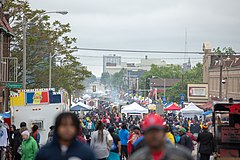
Juneteenth festival in Milwaukee, 2019.jpg

     This is why remembering Juneteenth is so important.  It is good to remember, it is good to reflect.  It is good to recall George Santanya's prescient words that, "Those who can't remember the past are doomed to repeat it."

     It is also good to realize where we are from.  We're all from dust, dust made into the image of God, dust made to enjoy, to be, to love.  I pray that we will always live in profound awareness of our place, a place of humility and grace, a place from which we have absolutely no reason to oppress other human beings.