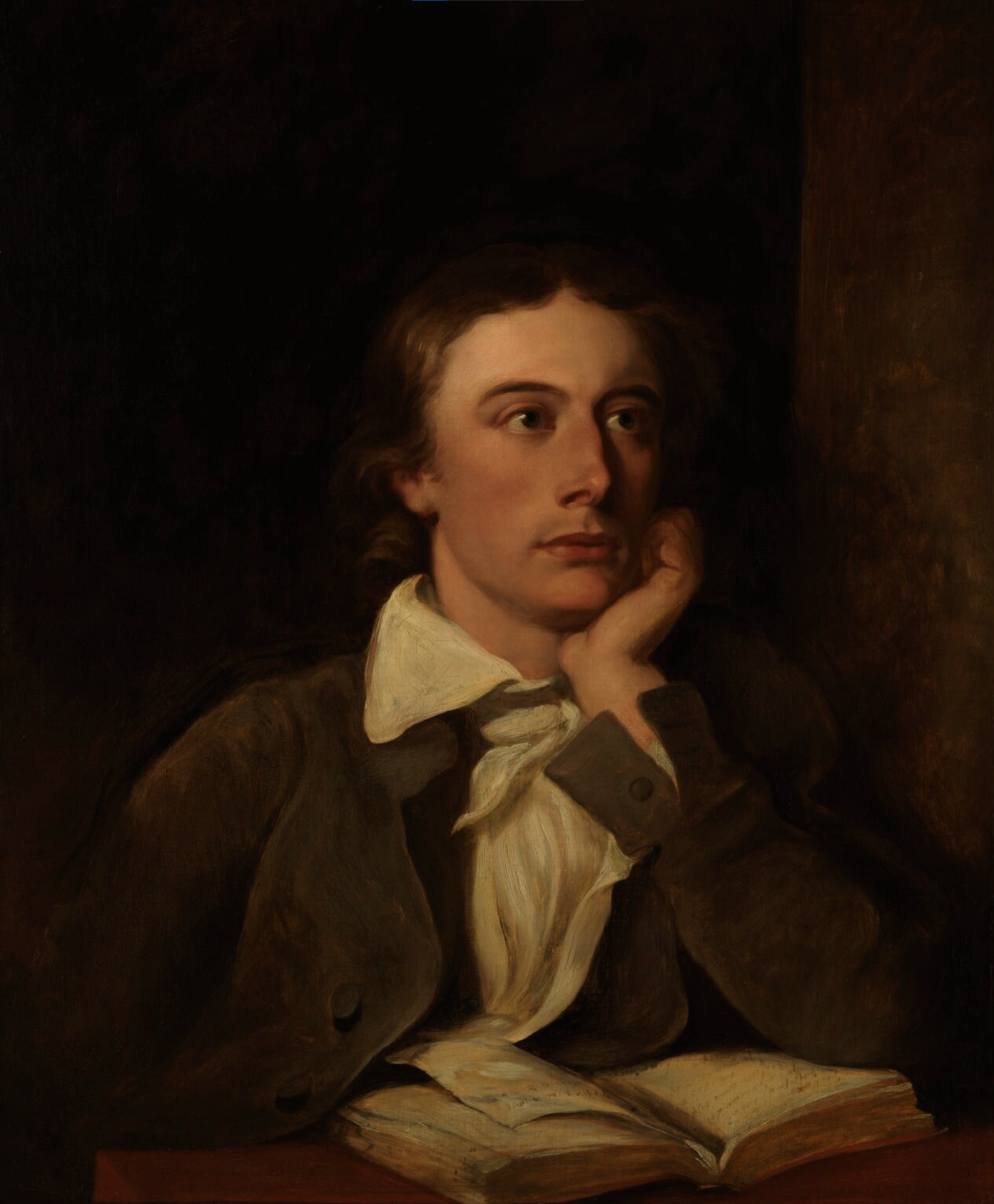
"I am certain of nothing but the holiness of the heart's affections and the truth of imagination--what the imagination seizes as beauty and truth--whether it existed before or not."
So said the British Romantic poet John Keats, who died in 1821 in Rome at the too tender age of 25. When I reflect on his poetry of which, considering his short life, he wrote a great deal, I confront, once again, the mystery of the human imagination. Many poets describe poetry as the grand window of humanity, that through which people may obtain a glimpse of what life really is about, the creative expression in which we see the
heart of the meaning of existence. For these poets, poetry is something akin to God.
From where does our imagination come? Why do we possess the capacity to imagine? Why are we, seemingly alone among all the animals, able to dream and fantasize of things invisible, unknown, and unseen? How is it that, if all things were once material and impersonal, we are now spiritual and personal--and capable of lifting ourselves beyond them?
Although the ready theological answer is that we are created in the image of an imaginative God--a fact I do not deny--I also like to look at the presence of imagination in the light of what it tells us about the universe. Without imagination, the universe is hollow, painfully hollow, an amalgam of materiality incapable of rising above itself, bereft of the ability to think about what it is.
We really can't have it both ways. If imagination is, as Keats insists, a truth, we will not find it in an impersonal and solely material universe.
A couple of weeks ago, on a frigid winter afternoon, I went hiking through a forest preserve near my home. Although very little snow was present, all of the lakes were locked in ice, trapped, it seemed, by the weight of the season. Nothing moved in them, nothing spoke from them. The silence was total.
Aponia, I thought, aphonia. Stillness and silence. How good, I thought, how good that in a crowded and noisy world I can experience silence, that I can touch stillness and vapidity. That I can know the absence of sound. It's a personal world, yes, but it's good to step aside from its immediate cacaphony and consider why that is. To ponder the looming and essential loquaciousness of the beyond. To confront the person of God.
It's easy to talk, it's easy to speak. It's not as simple to do neither one. Yet this is the only way we will know what to say.
Listen to the universe, hear its God: the Word became flesh, full of grace and truth.
What if you firmly believed in the truth of one religion, but had opportunity to advise another person, a person who had been raised apart from his family's religion, yet was seeking deeply to find his life's way, which way to choose?
This is precisely the question a Catholic priest faced in Saul Friedlander's powerful memoir, When Memory Comes. Not raised as an observant Jew and having participated heavily in the Catholic Church (to the point of entertaining the notion of becoming a priest), Friedlander had now begun to reconsider his Jewish heritage.
What is a priest, a person thoroughly committed to Christianity, to do?
Saul, the aging cleric told him, consider where you feel most comfortable. Consider what spiritual experience resonates with you most profoundly. Meditate on the real person of God. And consider that from which you have come.
What did Friedlander do? He left the Catholic Church. He rediscovered his Judaism. He moved to Israel and advocated much for the cause of the nation (the eretz, the land). As he saw it, he came home.
Did the priest do the right thing? As many a person has observed, all truth is God's truth. God is everywhere, and his truth is, too. And this truth meets people where they are at. It speaks to them in the day, it talks to them in the night. And it satisfies all their longings.
I do not know Friedlander's heart. But I do know that if a person is genuinely seeking God, in Jesus Christ, God will not let him down. He's always listening. And he always speaks.
And hope ever remains.
Well, it's over: Super Bowl 51. Although I didn't watch it all the way through (except for Lady Gaga's spectacular halftime show), I must say that it certainly provided some excitment for those watching it (unless he or she is an Atlanta Falcons' fan!).
 Evidence continues to grow, of course, for the prevalence of CTE in professional football players. To the avid football fan, however, this doesn't matter too much. The game exceeds all of its shortcomings and flaws.

Although I'm happy for those who enjoyed watching the game and the entertainment it brings, I always stop and think: here we are, fat and happy, focusing our time and money watching a spectacle about which too many of our brethren in the developing world could care less. They are more concerned with where they will find their next meal. Or where they will spend the night.
In his second letter to the church at Corinth,, Paul observes that, God is able to make all grace abound to you, so that having all sufficiency in all things at all times, you may abound in every good work."
While we can certainly enjoy, appreciate, and be thankful for what we have, we must also realize that, when we give generously from it, God will ensure that we will always have enough. We will meet our needs.
And maybe we will have what we want.
It's been a big week for musician birthdays. Friday of last week was Mozart's; Tuesday of this week was Schubert's; and today, February 3, is Felix Mendelssohn. Though born in Germany into a ostensibly Jewish family, he eventually was baptized as a Christian. Sadly, like Mozart and Schubert, Mendelssohn died before he was forty. A musician of Romanticism--like Schubert--he wrote music that, when we listen to it today, sounds like poetry, its melodies lithely carrying us along, transporting us to new levels of emotional experience, pushing us into thoughts of the ethereal and divine. We walk away enraptured, enraptured with time, space, and destiny: life seems newly wonderful, wonderful beyond belief.
 What more is there to say? We rejoice in such music; we delight that it speaks to us; we love that it lets us soar beyond the immediate and touch the eternal that encompasses us all.
Thanks, Felix Mendelssohn. Thanks for reminding us that if we open our eyes, if we really open our eyes, we see that life exceeds our wildest imaginations.
As one writer put it, it's an adventure with God.
What more is there to say? We rejoice in such music; we delight that it speaks to us; we love that it lets us soar beyond the immediate and touch the eternal that encompasses us all.
Thanks, Felix Mendelssohn. Thanks for reminding us that if we open our eyes, if we really open our eyes, we see that life exceeds our wildest imaginations.
As one writer put it, it's an adventure with God.
As I have continued to reflect on the inevitability of transcendence in our experience, yesterday mentioning it in relation to the Cult of the Supreme Being in the French Revolution, I thought of an experience my brother had many years ago.
At one point during his time attending university in Santa Barbara, California, my brother learned of a group of people who believed in what I will call "triangular" energy. They believed that by attaching a sort of a triangle onto their heads they could access special energy from the universe. Being an engineering student and ever the skeptic, Bob one afternoon dropped in on one of the group's gatherings.
The fervor of the group's adherents was no joke. There they were, standing around and chatting with various polygon shapes on the top of the heads. He couldn't believe what he was seeing.
 Looking back on this and thinking also of the Western culture's more recent obsession with using crystals as a means to communicate with or receive input from the transcendent/divine/universe, I realize once more how much people wish to believe that a truth bigger than them exists. And that they should and can know it.
Whatever our epistemological starting point, we rarely wish to stop there. We almost always want to think there's something more. For some of us, it's more of the same; for most of us, however, it's something qualitatively different, something that somehow gives a larger meaning to the present, regular, and mundane.
And it's difficult to believe that this something is found in polygons or crystals. If God is there--and I believe he is--we ought to be able to find him with rationality and reason. After all, we're reasonable people. And he's a reasonable God.
Just ask Jesus.
Looking back on this and thinking also of the Western culture's more recent obsession with using crystals as a means to communicate with or receive input from the transcendent/divine/universe, I realize once more how much people wish to believe that a truth bigger than them exists. And that they should and can know it.
Whatever our epistemological starting point, we rarely wish to stop there. We almost always want to think there's something more. For some of us, it's more of the same; for most of us, however, it's something qualitatively different, something that somehow gives a larger meaning to the present, regular, and mundane.
And it's difficult to believe that this something is found in polygons or crystals. If God is there--and I believe he is--we ought to be able to find him with rationality and reason. After all, we're reasonable people. And he's a reasonable God.
Just ask Jesus.
It changed the world in remarkable ways. I speak of the French Revolution, that epochal late eighteenth century upheaval of, literally the very foundations of the French culture. When it was over, France no longer had a king, nor did it any longer have religion. Although I am aware that many nuances attend the latter, the Revolution did in fact eviscerate the existing religious order. French religion would never be the same. Going forward, liberty, liberty from intellectual and spiritual boundary, would be prime.
Ironically, as the Revolution burrowed its way more deeply into the French imagination, its leaders came to create religion anew. They called it the Cult of the Supreme Being. Although their intentions were thoroughly secular, the face of what they established affirmed the ineradicability of the human quest for meaning, for some type of transcendent meaning. Despite the contentions of many a materialist to the contrary, we can never completely step away from the necessity of transcendence.
We observe this in the Russian Revolution, too. Although the Soviet government did everything it could to suppress and eliminate religious belief, its actions only served to further center it in the hearts of a countless number of Russians. Transcendence remained.
As it does today. Looming everywhere yet often seemingly nowhere, transcendence nonetheless is more than present. It is woven into the very fabric of creation.
Revolt, yes, stand up for what is right and true, but remember the inescapability of transcendence.
We cannot ignore God.