Although he died in an asylum at the end of the nineteenth century, the German philosopher Friedrich Nietzsche continues to speak to us today. I recently came across a rarely published addendum to his work, Will to Power, and share it here.
So does Nietzsche write, "All these bold birds who fly out into the wide, widest open--it is true! At some point the will not be able to fly any farther and . . . But who would want to conclude from this that there was no longer a vast and prodigious trajectory ahead of them. All our great mentors and precursors have finally come to a stop . . . and it will also happen to you and me! Of what concern, however, is that to you and me! Other birds will fly farther!"
Although divining the precise intentions of Nietzsche's mind is difficult, it seems that what he is saying here is that even though we one day will "fly" no longer, others will. The human adventure will continue. It's a reassuring thought. By the time he penned these words, Nietzsche, though he was the son of a Lutheran pastor, had come to reject everything about Christianity and its promise of eternal life. It was a religion for weaklings, he averred. Better to live bravely and die!
Maybe so. Our humanity is indeed wondrous and grand and, to this point, seemingly capable of sustaining progeny, seemingly capable of birthing even more "birds" to extend its experience of existence beyond the present.
And then what? Absent an eternal, when humanity is over, it will be as if it had never existed at all.
Wednesday, November 6, 2019
Monday, November 4, 2019
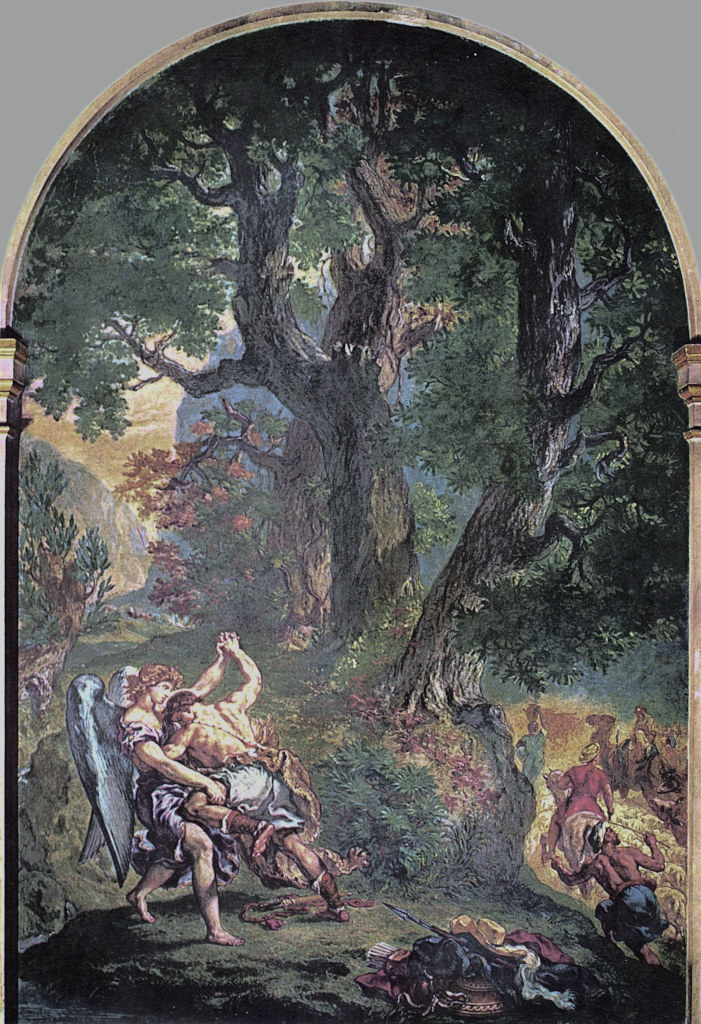
It's an ancient story. After he fled from his brother Esau, the one from whom he had stolen his father's birthright blessing, Jacob, as the Genesis account tells us, spent the night at the Jabbok River. There he wrestled with a man until daybreak. As morning dawned, the man, who was in fact an angel, perhaps even God himself, left Jacob. Before he did, however, he gave him a new name: Israel. That is, "the one who struggles with God."
![]() |
| Eugene Delacroix, "Jacob wrestling with the Angel" |
But that's the angel's point: to be human is to struggle. It is to struggle with capacity, it is to struggle with choice. It is to struggle with the emptiness of contingency and the darkness of finitude. And to realize that, over and above it all, contingency's emptiness and finitude's frustrations only exist because infinitude surrounds and defines them.
Otherwise, there would be no point to anything.
Friday, November 1, 2019
Earthly memory tells us who we were. Eternal memory tells us where we will one day be. Remember those who have preceded you in passing; think about the many memories you and they share, the sundry times and encounters you have had. Then consider the full weight, the total import of what they mean, mean to you, mean to the world: the darkness of Samhain cannot be without the light of what it follows it. Apart from light, darkness cannot be.
Wednesday, October 30, 2019
"Yet each mystery explained, as the science-loving Pope Francis would say, builds the case for God. It's a case I came to understand, to feel it and see it, only after I'd allowed myself to be amazed."
So said columnist and writer Timothy Egan in his newest book, A Pilgrimage to Eternity: From Canterbury to Rome in Search of a Faith. Have you ever been amazed? To be amazed is to experience that which you did not expect, to bump into something you did not think you would see. It is to be pushed outside the boundaries of what you thought possible: to be thrust into a new way of thinking about the possibilities of existence.
Although we strive mightily in this modern age to forswear any possibility of miracles or the supernatural, we nevertheless live as if we do: we love being amazed. We love being startled, enlightened, or overwhelmed with a new insight or experience. And I wonder what this says about us. Are we, as Enlightenment philosopher Immanuel Kant might say, creatures of the noumenal daily grappling with the phenomenal, beings of materiality wrestling with presences immaterial? Or we, as twentieth century philosopher A. J. Ayers averred, people who should ipso facto reject anything that we cannot with language understand?
To be amazed, it seems, is necessarily to assent to the possibility, perhaps the reality, of a mystifying but comprehensible unseen. It is to agree that life is more than what it, materially speaking, appears to be.
And to embrace the wonder of what this holds.
So said columnist and writer Timothy Egan in his newest book, A Pilgrimage to Eternity: From Canterbury to Rome in Search of a Faith. Have you ever been amazed? To be amazed is to experience that which you did not expect, to bump into something you did not think you would see. It is to be pushed outside the boundaries of what you thought possible: to be thrust into a new way of thinking about the possibilities of existence.
Although we strive mightily in this modern age to forswear any possibility of miracles or the supernatural, we nevertheless live as if we do: we love being amazed. We love being startled, enlightened, or overwhelmed with a new insight or experience. And I wonder what this says about us. Are we, as Enlightenment philosopher Immanuel Kant might say, creatures of the noumenal daily grappling with the phenomenal, beings of materiality wrestling with presences immaterial? Or we, as twentieth century philosopher A. J. Ayers averred, people who should ipso facto reject anything that we cannot with language understand?
To be amazed, it seems, is necessarily to assent to the possibility, perhaps the reality, of a mystifying but comprehensible unseen. It is to agree that life is more than what it, materially speaking, appears to be.
And to embrace the wonder of what this holds.
Thursday, October 24, 2019
Recently, I read an article by a person who had just undergone a gender transition, stepping into the fullness of the woman they had always thought they (to use this person preferred pronoun) were. They were very happy with their decision. No regrets.
Except for the reaction of their father. Their father could not adjust to the prospect of no longer having a male heir. He could not imagine life without a son. Though he loved them, he nonetheless experienced a profound grief.
Unless we have been in this person or their father's shoes, we cannot easily begin to relate. Be it theology, politics, or culture, all of these tend to falter and crumble when faced with the vicissitudes of human longing. It often has no earthly categories.
Maybe that's the point. Although I cannot fully divine the mind of God, I can say that, regardless of what a person does with his or her life, God continues to love him/her. He does not easily let go of those who are made in his image, those who are, in a very distant yet very real way, like him.
That's the wonder, yes, but it is also the challenge, the challenge of being a finite person in an infinitely designed world.
Our humanness is often beyond our knowing, yet it is, in a world in which natural and supernatural intersect constantly, the lens through which God, in a signal point in time, has made himself definitively known.
Except for the reaction of their father. Their father could not adjust to the prospect of no longer having a male heir. He could not imagine life without a son. Though he loved them, he nonetheless experienced a profound grief.Unless we have been in this person or their father's shoes, we cannot easily begin to relate. Be it theology, politics, or culture, all of these tend to falter and crumble when faced with the vicissitudes of human longing. It often has no earthly categories.
Maybe that's the point. Although I cannot fully divine the mind of God, I can say that, regardless of what a person does with his or her life, God continues to love him/her. He does not easily let go of those who are made in his image, those who are, in a very distant yet very real way, like him.
That's the wonder, yes, but it is also the challenge, the challenge of being a finite person in an infinitely designed world.
Our humanness is often beyond our knowing, yet it is, in a world in which natural and supernatural intersect constantly, the lens through which God, in a signal point in time, has made himself definitively known.
Wednesday, October 23, 2019
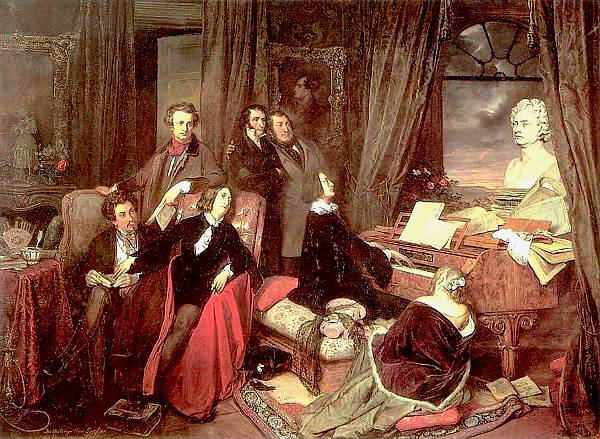
An imagination, I add, powered in turn by humanity's creation in the image of God. We may frown upon Liszt's personal transgressions, we may wonder what he really wanted, but we cannot dismiss the immensely present vision of God that his work represents to us. While Liszt may not have always been aware of his connection with God, there is no doubt that in his remarkable ability to create melody and song, he tells us about him.
Yes, we may not see God visibly, and yes, we may at times have no empirical evidence of him, but in the weight of the world's power and mystery we cannot dismiss the possibility of his factuality.
Play on, Franz Liszt.
Monday, October 21, 2019
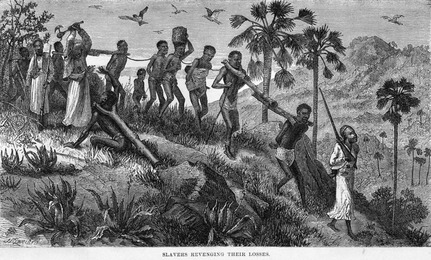
Last week, I talked about the year 1492. The year I cite today, 1619, is equally pivotal--and flowed out of 1492. 1619 is the year that the first African slaves arrived in the "New" World. It was the year that marked the beginning of the lengthy and singularly horrendous white American practice of enslaving their fellow human beings, beings who, like they, were made in the image of God, for, and only for, economic gain. Some historians have noted that the Americans who enslaved Africans did so because they were "lazy." They didn't want to toil in the cotton fields, they didn't want to labor in the humidity and heat. They didn't want to work.

Oddly enough, however, they at the same time passed laws mandating jail terms for people who failed to attend church twice on Sunday! One wonders at the theological disconnect: what were they thinking? How can one insist that a person must attend church twice on Sunday while at the same time forcing millions of people into lives of slavery?
Such hypocrisy makes one quiver; it makes one weep. Imagine,however, what it does to the heart of God.

Oddly enough, however, they at the same time passed laws mandating jail terms for people who failed to attend church twice on Sunday! One wonders at the theological disconnect: what were they thinking? How can one insist that a person must attend church twice on Sunday while at the same time forcing millions of people into lives of slavery?
Such hypocrisy makes one quiver; it makes one weep. Imagine,however, what it does to the heart of God.
Subscribe to:
Posts (Atom)