Monday, April 6, 2020

     It's Holy Week.  Holy Week is about suffering, helplessness, and pain.  It's also about joy, pure and holy joy.  Holy Week takes us into the deepest of darknesses, yes, but it also  takes us into the most profound of all light.
     As our planet continues to reel from Covid-19, pain and disaster seem, more than ever, integral, inextricably integral to our lives.  Holy Week tells us that, yes, suffering is a part, an essential and unavoidable part of human existence.  Yet it also tells us that this is only the beginning of the story.  There's much more to the narrative, much more to the tale.
     Holy Week tells us that the end of the story is that on which we must focus most.  Indeed, pain is part and parcel of our lives.  But only part.  In Jesus' suffering, we see ourselves.  And he us.  But it is in Jesus' resurrection that we ought to see ourselves even more.  It is in that pivotal moment, that epochal moment in which God conquered death that we must look.  For it is in it that we see our future.
     For some, Holy Week is silly and parochial, a foolish invocation of presences and forces that do not exist.  Perhaps.  More broadly speaking, however, definitely not.  Consider the 
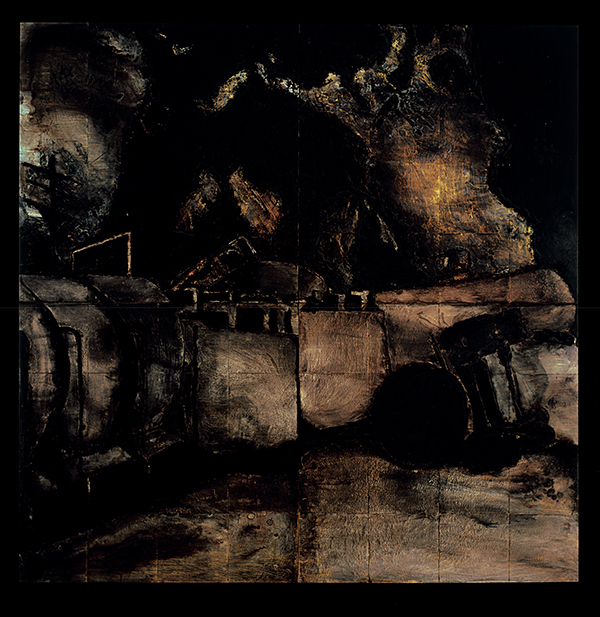
Image result for donald sutherland disaster paintings
Modern Museum of Art's description of this painting:  "The Disaster Paintings eternalize the real-life modern events we are faced with daily in contemporary society yet quickly forget when the next catastrophe occurs."
     We crave security; we crave control.  We weep when we see our fellow humans in pain. We weep over the suffering, we weep over the events that led to it.  We weep over our fallen world.
     Yet in Holy Week we see that death is but the prelude to life.  It's not the end.  God is here, God is there.  Jesus' death presents a God who is bigger than disaster, a God who is bigger than the very darkest of pain.  Jesus died, yes, the Messiah slain, but God lives.  And Jesus rose.
     And God is God.  Though disaster fills this world, God's power fills it even more.

Wednesday, April 1, 2020

     Of course today is April 1:  April Fools Day.  It's also the the birthday of one of the greatest of the Romantic pianists:  Sergei Rachmaninoff.  Born in Russia, eventually emigrating to America and, shortly before his death in 1943, becoming an American citizen, Rachmaninoff (my wife's favorite musician) composed some of the richest music ever written for the piano. His work blends intense and mournful melody with powerful and intricate chords and keyboard movements, beautifully capturing the deepest spirit of the Romantics.  Rachmaninoff's musician gives us a window, a poignant window into our perennial struggle with the vast and unyielding import of sentient existence.  It shows us that however intellectual we may suppose ourselves to be, we are, in the end, creatures of heart and imagination.  We live as sensual beings.
     Rachmaninoff helps us realize that although reason is an essential part of who we are, we make our biggest decisions with our heart.  To put this in theological terms, although we may believe, as a matter of intellectual assent, that Jesus died and rose again (or any other religious tenet), we can only trust its truth for our lives with our heart.  Trust is the wellspring of rational belief.
     As much of Rachmaninoff's music tells us, though we live for the moment, we flourish in the eternal, however we conceive it to be.  We trust our spiritual visions with our heart.

Tuesday, March 31, 2020

     In this terribly broken world, a world currently wracked with tremendous uncertainty and great pain, a world in which things do not always go as we wish them to, a world marked by tremendous joy as well as profound tragedy, we humans seem to cultivate an innate longing for control.  Why can we not control the affairs of our lives? Why can we not ensure that we are not surprised by darkness?


Image result     As we continue our Lenten journey through our present existential abyss, we have opportunity to rethink our longing for control.  We recognize afresh that we live in a world beyond our control.  We acknowledge that we are ultimately a collection of atoms spinning madly in a nexus of space and time, avoiding everything but ourselves.
     Nonetheless, we see, again, that though we are remarkable creatures, entirely capable of directing the course of our lives, we will never understand and control it all.  We remember that we are finite, that we have limits, that our marvelous attributes can only take us so far.  Sooner or later, we encounter a bump:  we realize that we are not so remarkable that we in ourselves can decide what we can be or what existence means. How could we?  We are only us.
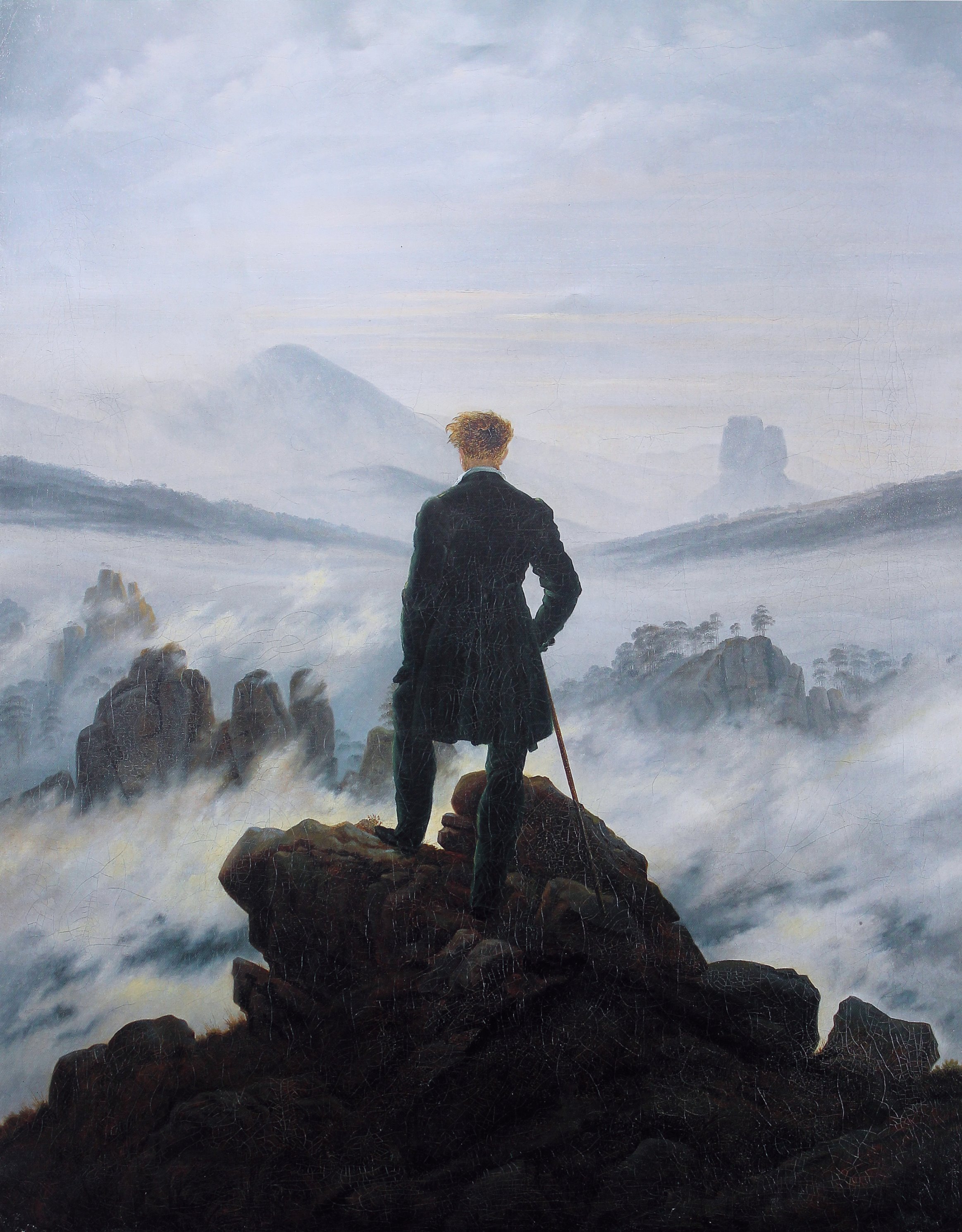
     Consider the "Wanderer above the Sea of Fog," standing before the world, watching, planning, waiting, yet lacking a way to make absolute sense of or control it
     And that's precisely God's point:  in order to gain control, we must give it up.  We must give up who we are now to find who we are destined to be.  That's all God's asking us to do.
     Stay well.

Monday, March 30, 2020

     As March draws to a close and the planet continues to reel from the effects of SARS-CoV-5 (its now official epidemiological name), I mention that March is, in fact, Women's History Month.  Why?  For too long, historians tended to overlook women and the role they played in moving humanity forward.  Conditioned by the social nuances of their times, and driven, perhaps, by various levels of male chauvinism, most historians, traditionally male, dismissed the contributions that women have made to the human adventure.
     Happily, this is changing.  If we are to hold that men and women are both made in the image of God and are therefore of equal worth, we err, err seriously, when we ignore, reject, or pass over the many ways that women have shaped human history for its good.  To overlook, deliberately or otherwise, the achievements of women is tragic, really:  we are in truth forgetting the meaning of the framework, physical as well as metaphysical, in which the universe functions.  It's no accident that when the writer of Proverbs 8 described wisdom, he personified it as a woman.  He knew.  He knew that even if we hold that the world has been created by God, we render it existentially meaningless if we fail to acknowledge the full measure of our fundamental humanness.
     Whether you believe in God or not, believe in the worth of every human being.  Celebrate who we are!
     

Wednesday, March 25, 2020

     In this time of global crisis, I share this excerpt from a book, Thinking about God, which I published in 2007:

     "Materially speaking, we all learn different things from the darknesses of our lives.  The one who loses a spouse learns things that one who loses a home does not, and the person who suffers paralysis comes away with something that someone gripped by aimlessness may not.  Yet each of us who finds himself enmeshed in the throes of darkness, if we treat our experience rightly, finds a greater vision for understanding our life and understanding what is most trustworthy in it.  We are forever changed and, if we approach our experience intelligently, for the better.  Bottom line, we grow in holiness.
            If we approach darkness with respect, we will enter into the larger meaning and perspective and wisdom it bequeaths.  We learn that in the panic of helplessness and the agony of uncertainty we find genuine power, a power rooted not in us, our abilities, or our wealth, but in our willingness and capacity to trust God.  We then find that in letting go of what we cannot know we find new ways to hang on to that which we irretrievably do:  the fact and presence of God.  We lose control of our circumstances but realize a deeper insight into our souls, our souls in which we bond, not with the travails of space and time, but with the perspective of eternity.  And we treat life with greater care, acutely understanding what it really it.
            We may never know why tragedy befalls us.  We may never know why the world is full of suffering.  We may never know why God seems silent in the face of destruction and pain.  Nor, despite all the ink that has been spilled attempting to answer these questions, we ever will (at least not in this life).  
All we know is that these things happen, that despair and tragedy visit every human being.  This is a fundamental fact of human existence.
For this reason, we know that we need to make a choice.  Do we want to believe that such things are absolutely random in a totally random universe?  Or do we want to believe that, below and beyond our world, God lives, granting purpose to all things?  How we choose will determine how we live.  Will we live with a sense of lingering uncertainty and despair, always wondering why, or will we live with a sense of abiding hope and purpose, always wondering not why, but how:  how will God make final sense of our situation?  It’s our choice.
Either way we choose, we recognize that like the eye of a hurricane, darkness nurtures wisdom in the midst of chaos, depth in the face of the shallowness and flimsiness of this material existence.  Its lessons are many and manifold.  Yet the darkness that is laid in the hands of God, the one who made us and the farthest stretches of the universe, offers the richest path of all.  
            Darkness transforms us by forcing us to trust in what we otherwise would not."

Tuesday, March 24, 2020

As COVID-19 continues to ripple through the world and people around the globe enter into ever deepening social isolation, I share this poem that was sent to me:

"Yes there is fear.
Yes there is isolation.
Yes there is panic buying.
Yes there is sickness.
Yes there is even death.
But, they say that in Wuhan after so many years of noise, you can hear the birds again.
They say that after just a few weeks of quiet, the sky is no longer thick with fumes, but blue and grey and clear.
They say that in the streets of Assisi, people are singing to each other across the empty squares, keeping their windows open so that those who are alone may hear the sounds of family around them.
They say that a hotel in the West of Ireland is offering free meals and delivery to the housebound.
Today, a young woman I know is busy spreading fliers with her number through the neighborhood so that the elders may have someone to call on.
Today Churches, Synagogues, Mosques and Temples are preparing to welcome and shelter the homeless, the sick, the weary.
All over the world people are slowing down and reflecting.
All over the world people are looking at their neighbors in a new way.
All over the world people are waking up to a new reality:
To how big we really are.
To how little control we really have.
To what really matters.
To love.
So we pray and we remember that, yes there is fear, but there does not have to be hate.
Yes there is isolation, but there does not have to be loneliness.
Yes there is panic buying, but there does not have to be meanness.
Yes there is sickness, but there does not have to be disease of the soul.
Yes there is even death, but there can always be a rebirth of love.
Wake to the choices you make as to how to live now.
Today...breathe.
Listen, behind the factory noises of your panic, the birds are singing again, the sky is clearing, Spring is coming, and we are always encompassed by Love.
Open the windows of your soul and though you may not be able to touch across the empty square...Sing."

Friday, March 20, 2020

     With the advent of Spring, we also remember the birthday of Johannes Sebastian Bach.  Wrapped in the rhythms of vernality and spring, Bach's birthday comes replete with the sounds of singing birds, greening forests, and deeper skies.  And his music fits the season.  Fresh, bright, and resonant with joy, Bach's music echoes the wonder of the newly born creation.
     We thank Bach for what he has shown us about life, wonder, and Spring.  We also thank Bach for giving us a glimpse of the unfolding mystery, and the mystery behind it, of this vast, vast--and loved--universe in which we revel.
     So did Bach write on every piece of music he composed, "Soli Deo Gloria" (All Glory to God Alone).  Bach knew very well from whence all things come, that we are not accidents.

     In this time of great uncertainty we can be grateful indeed that the world has a point.