Tuesday, December 15, 2020

     A few summers ago, I was backpacking through a portion of the Sierra Nevada, the massive mountain range that cuts through heart of California south of San Francisco.  The morning of the first full day, I rose extra early to prepare for what I expected to be a lengthy hike to the base of a pass which I intended to surmount the following day.  When I got out of my tent, the sun had not yet risen over the peaks below which I was camped.  The air was still cold, the lake basin still shrouded in shadow.  So I waited.
     I waited for the sunrise, the sun, that brilliant and life giving orb of light to rise over the peaks and bathe my camp in warmth and radiance.  As I waited, I packed up my camp, prepared breakfast, and got ready to go.
      Then it came.  Exploding atop the ridge, the sun burst, popping with rays of brilliance and wonder, its multiple filaments of splendor spreading over and across the waiting land.  I rejoiced:  the light had come.
     "For the people who walk in darkness," wrote the prophet Isaiah, "will see a great light (Isaiah 9:1)."  Isaiah speaks of Messiah, the one who would come to illuminate an Israel darkened by disappointment, abandonment, and sin.  He speaks of the Messiah (the Christ) who would enlighten and save all those who longed for him.  He speaks of the light that would come.
     As we journey ever deeper into this season, we remember this fact of light, how, like the sun exploding over a frigid mountain ridge, Messiah--Jesus--has brought us light, the light of enlightenment, the light of hope and meaning that shines through the cold of a terminal existence.  It is the light of purpose, the light of meaning, the light that, if we embrace it, embrace it as fervently as we do the warmth of the sunrise, mountain or not, of our lives, will change our lives forever.
     Once we touch this light, we'll never be the same.

Monday, December 14, 2020

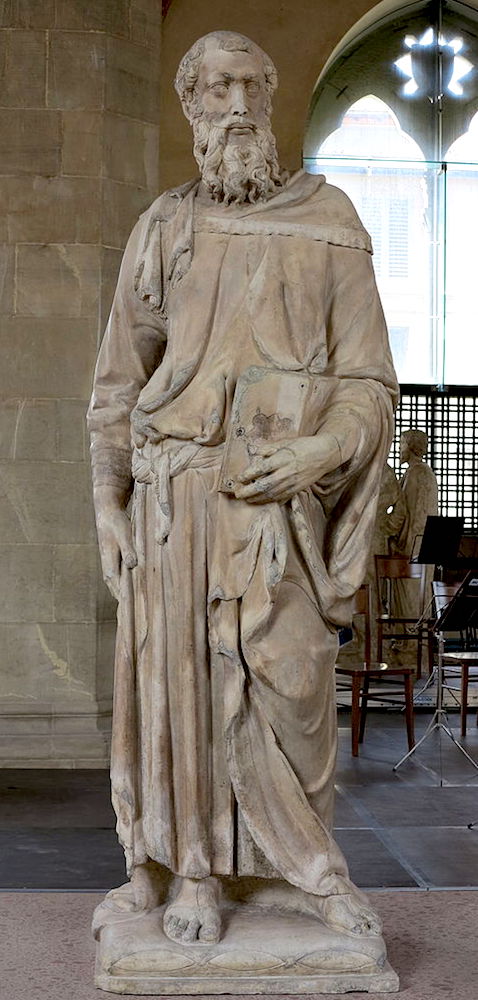
     Yesterday marked the birthday of the Italian artist Donatello.  Working in an entirely different milieu than Edvard Munch, whose birthday we remembered last week, Donatello was a person of the Renaissance, an integral part of one of the most glorious period of human achievement.  The Renaissance was a time, a very brief time, when, amazingly enough, spiritual fealty and artistic inspiration fused, fused in a way that produced some of the most magnificent works of art in history.

Image result for donatello
     A sculptor, Donatello was known for his highly realistic depictions of the human being, for extraordinary sculptural detail:  his works are remarkable studies in the immensely complex nature, external and internal, of the human being.  Like most of his contemporaries, Donatello grasped that humanity is more than material and yet more than spiritual, too:  it's both.  He understood that a person cannot be material without being spiritual, and spiritual without being material:  the two are inseparable.
      Although as Western Europe moved beyond the Renaissance, the influence of this perspective diminished, and many people concluded that, in truth, they are products of materiality alone, Donatello's work reminds us of who we really are.  We are indeed immensely amazing in our material abilities, yet we shortchange ourselves if we insist that we should not be in turn equally amazed that we are creatures of spirit, a spirit without which we could not be meaningful material beings in a material world.

Friday, December 11, 2020

       Have you seen Edward Munch's The Scream?  A piece that has puzzled and cajoled people for decades, The Scream seems to exemplify the alienation that so often characterizes the inhabitants of the West.  Overwhelmed by a world that offers them everything but meaning, countless people in the developing world cry out for help, some help in making sense of what seems to be a pointless reality.       Affluence reigns, yes, but without any foundation other than the assumption that life is worth it, and this only because those who decide this have nowhere else to go.  If the world is a closed system and we are therefore born only to die, then life, however wonderful it may be, ends before it begins.  So we scream:  why must this be?
     As we remember Munch's birthday tomorrow, as we look toward Christmas and the New Year, as we continue to do what we can to live a good life, we realize that the world is not closed, that it is in fact entirely transparent and open, open and streaming into a web of reality vastly larger than we can imagine, a web grounded in a transcendence that has spoken, a transcendence that has made itself known.  Life is more than itself.  And we are more than who we are.  Love is present, ascendant and true.
     Hence, in contrast to Munch's bleak perspective, we scream not why must this be, but rather how can such wonder be?

Thursday, December 10, 2020

 wind river range | North Western Images - photos by Andy ...

     "For the people who walk in darkness," wrote the prophet Isaiah, "will see a great light (Isaiah 9:1)."  Isaiah speaks of Messiah, the one who would come to illuminate an Israel darkened by disappointment, abandonment, and sin.  He speaks of the light that would come.
     In this second week of Advent, we remember this fact of Messiah's light.  We remember how, like the sun exploding over a frigid mountain ridge, Messiah--Jesus--the Word become flesh--has brought us light, the light of enlightenment, the light of hope and meaning that shines through the cold of an often Munchian existence.  It is a light that, if we embrace its rising, embrace it as fervently and without reservation, will change our lives forever.
     Though we may struggle with the idea of eternality, though we may question the presence of God, we all long for light. We all long for hope and meaning.  We all long for a window into a richer existence.
     In an accidental universe, however, richness is impossible, for value and morality cannot be.  Only in the light of transcendence, a transcendence wrought in personal presence, can meaning be.
     The light of the world.

Wednesday, December 9, 2020

 Image result for john lennon photos

     I heard the other day the poet/songwriter Leonard Cohen’s “Hallelujah.”  It reminded me of Canadian (and now American) singer Neil Young’s song, “When God Made Me.”  In it, Young questions God, asking him why he made people a certain way, why he made people when he knew they wouldn’t believe, and more.  Both pieces ask a very good question:  how can I believe in a God if I do not understand him?  Why must I wander in the darkness when I’m standing in the light?
     Yesterday, many across the planet remembered the fortieth anniversary of the death of John lennon.  In one of Lennon's most famous songs, "God," he says, "I just believe in me; Yoko and me.  That’s reality.”
            Granted, transcendence and religion do not lend themselves well to our perceptions.  And that’s the problem.  Ironically, it’s also the solution.  If we could explain everything with chemicals, if we never developed questions like Cohen and Young pose, if we subsumed all experience into a plastic (or computerized) box, then, yes, we would need nothing else.  But we can’t.  So we wonder.
     And we mourn those whom we've lost.
     As we therefore remember John Lennon, we also ponder the ultimate challenge:  how do we know who we are if all we know is ourselves?

Monday, December 7, 2020

      "It is a day that will live in infamy," said Franklin Roosevelt after the attack on Pearl Harbor.  For those who were alive when it happened, the attack on the naval base at Pearl Harbor, whose 79th anniversary is today, changed their world forever.  Never before had America been attacked, never before had such devastation been visited upon its shores.  Life was turned upside down.


Attack on Pearl Harbor (58 pics)     But isn't that the nature of existence?  It's capricious, random, and unpredictable, a series of unexpected waves in an unfathomable sea, an illusory skein on an abyss whose bottom we will never see.
     
     Yet we go on.  We grieve for those who lost their lives in this attack.  And we grieve for the thousand and thousands of additional lives that were lost redressing what happened.  The pain and carnage defy all form and sensibility. 
     
     And we continue to believe in meaning.  As we should.  No one should die unremembered, no one should die alone. No one should leave this life lost and abandoned, a forgotten and abandoned image of God, an entity without a point.
     Advent is upon us, reminding us that the horrors of existence are never the end.

Friday, December 4, 2020

      In his celebrated novel Frannie and Zooey, author J. D. Salinger at one point has Franny complain about the meaninglessness of existence.  For her, it is the ego that underscores life's futility:  hers and everyone else's she meets.
Frannyzoey.jpg     
     Ah, the ego:  we can't live with it, we can't live without it.  For some, including Sigmund Freud, the ego is the seat of all neuroses.  For others, say, Friedrich Nietzsche, it is the path to greatness:  to rise above the herd.  For a contemplative like John of the Cross, it is something to be erased so as to allow God to flourish more fully.
     Maybe all three are right.  Our ego is our drive and center as well as a source of stumbling and imperfection.  But we need it to be who we are.  We are creatures of ego.
     Yet it is in humility that our ego finds its truest home.  We revel in our achievements even as we acknowledge we are dependent on our cultural systems to accomplish them.  We rejoice in our spiritual insights and wisdom even as we recognize that apart from present transcendence we would be not be able to inhabit them.
     And we laud the fact of existence, the existence without which any of these, even the meaning of existence itself, would happen.
      Because we cannot possibly deem ourselves alone in a personal universe.