Tuesday, May 31, 2022

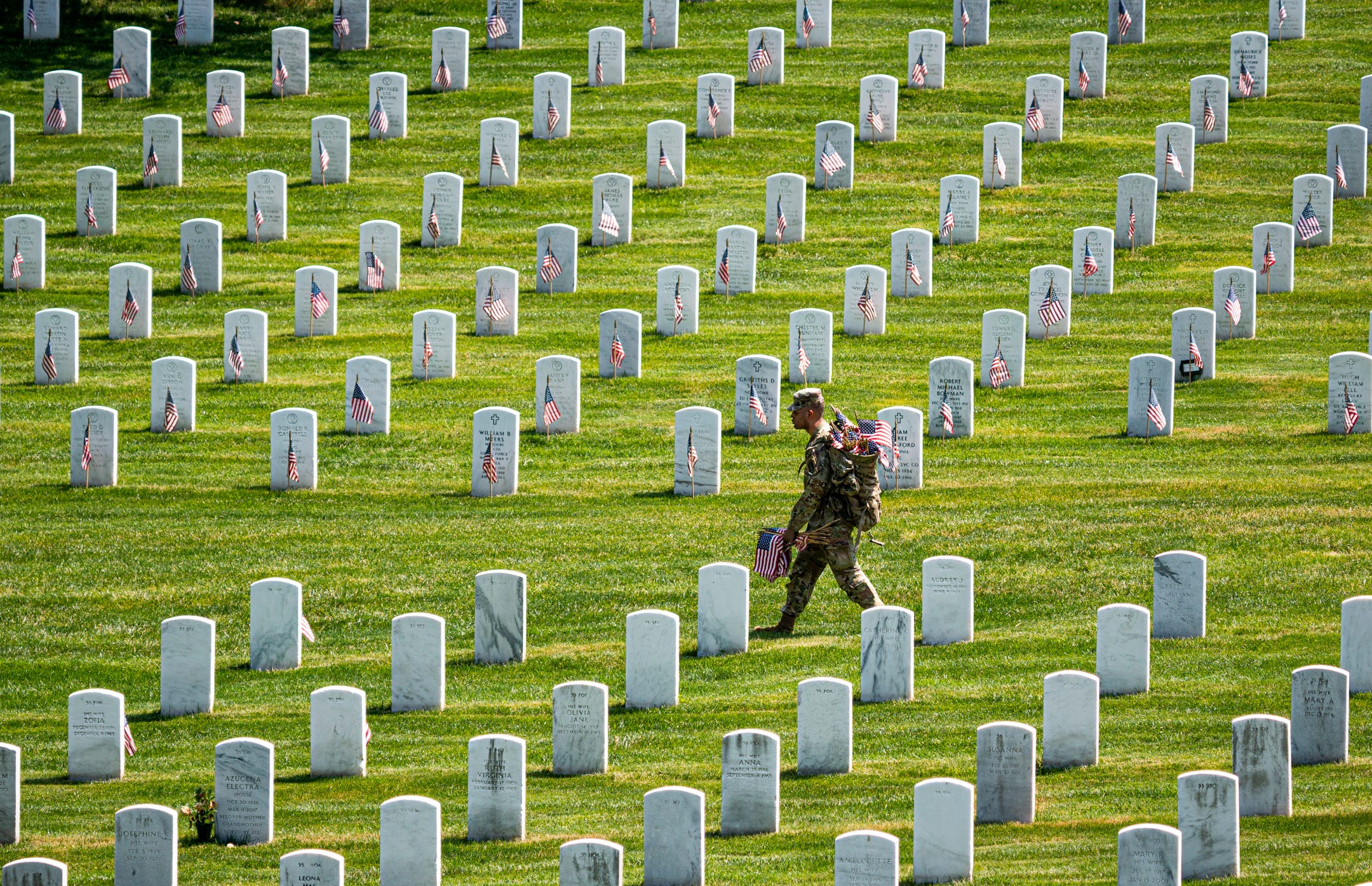
Photos: Arlington National Cemetery 'Flags In' for Memorial Day
Yesterday, in America anyway, was Memorial Day.  In addition to the many barbecues and gatherings this holiday spawns, it also births numerous displays of patriotism, even, dare I say, jingoism, among the American populace.  Lots of flags, lots of parades, lots of honoring of veterans.

    Although we may differ on what justifies sending troops into combat, and though we may debate how a war should be fought, we can agree, I think, to be grateful for those who, whether through conscription or voluntarism, put themselves on the line for people, people like you and me, people they may never meet or know, for causes both clear and ambiguous.

    The price, however, is high.  Military cemeteries around the world testify to this amply.  It's tragic and unspeakably sad.  So many lost and broken lives.  And this does not include the even more numerous civilians who, through no fault of their own, are trapped and die in the middle of military conflict.

    Hence, memory.  It is important to remember.  To remember who has been, to remember what they did.  To remember what we have lost.

    Most of us want peace.  Peace in our families, peace in our nation, peace in the world, and peace in our hearts.  Although some wars might seem necessary, they are never absolutely good.

    As countless religions attest, we do not grow by seeking our own welfare and safety only.  Over and above it all, we are called to seek the common good and not solely our own.

    And to remember those who have enabled us to do so.


Friday, May 27, 2022

 The Disintegration of the Persistence of Memory - Wikipedia

      Universally known for his highly innovative art, Salvador Dali, whose birthday falls in the month of May, has left a fascinating legacy for us to contemplate.  You may like his work, you may not.  Either way, however, Dali's work makes us think.  What if the world is as fungible as his art makes it to be?  What if our thoughts are as slippery as his work makes them appear to be?

     In short, what if existence is as surreal as Dali's art renders it?  Although we could discuss for some time the concept of reality, and although most of us realize that we determine our vision of reality through our individual perception, we can nonetheless see the wisdom of Dali's vision.  How much do we really know about what we feel and see?

     As Dali tells us, it is the fact of life's mystery that makes it singularly alluring:  it is as much darkness as it is light.  And that's the point:  we err when we suppose we can fit existence into a box.  Even if we believe in a greater presence, and even if we hold to the notion of an afterlife, we are still knocking at the door of what we don't know.

     After all, we are only human.  In the same way, however, God is only God, which is the central issue:  the fact of God's factuality ensures that while life's mystery endures, it is a mystery lived in a meaningful universe.

     And with this we find hope.

Thursday, May 26, 2022

      Does evil exist?  A friend of mine does not think so.  People do bad things, yes, but they are not evil.  Moreover, she says, a cognitive and active "evil" is not roaming through the world.

     Millennia ago, Augustine observed that evil is the privation of good.  That is, when good diminishes, evil is born.  But, the prelate added, evil does not exist in palpable form.  It is simply the result of a decrease in good.
     On this, in addition to the horrific school shooting in the U.S. earlier this week, I draw your attention to the case of Ian Brady, a forthrightly unrepentant torturer and killer of several young children in Great Britain in the 1960s. 
     Brady died some years ago at the age of 79.  (His love, Myra Hindley, who assisted in some of his deeds, lives on.) Some would say that Brady was evil, through and through, that there was no good in him. Furthermore, the acts he committed, many people feel, were entirely evil as well; there was absolutely nothing good about them.
     If people are made in the image of God, though a highly tarnished image at that, however, we cannot say that Brady was entirely evil.  Above and beyond all else, he is a human in the image of his creator.  Nonetheless, he did what most of us consider to be bad and evil things.
     And that's the point.  If we determine evil on the basis of our situation--and we definitely do--how do we ultimately know what really is evil?
     The short answer is that we don't.
     Is my friend right?  Only if we are all alone in the universe.  Only if there is no God. If there is no God, however, we'll never really know, absolutely, what is evil.
     Or even that it exists at all.

Wednesday, May 25, 2022

     It happened again.  Another mass shooting in the United States.  At least nineteenth children are dead.  Why?  Does not anyone realize that the more guns people have, the more apt they are to use them?  Americans are the most heavily armed people on the planet.  It has more guns than people.  Yet are Americans really safer?

    Hardly.  Talk of gun control notwithstanding, I believe that America needs to look deeply at itself.  What is it about American culture, a culture that, in various manifestations, has penetrated to almost every corner of the globe, that breeds the level of fear and angst that leads to these shootings?  It's not because America has, according to many commentators, allegedly rejected God.  America is one of the most religious nations of the globe.  Besides, religious people own guns, too.  And they are more than willing to use them to defend themselves and their property.

    No, this shooting is one more expression of the continuing fracturing and misinterpretation of the fine balance between freedom and order.  Americans treasure their freedom, treasure it more, it seems, than life, each other, or even God.  And that's the problem.  Americans need to learn to trust each other with their freedom.  We cannot separate freedom from integrity and community.

    Having freedom will not set us free from ourselves.

Monday, May 23, 2022

Image result for photo of opening scene in chariots of fire

     Have you seen "Chariots of Fire"?  Winner of the 1982 Academy Award for Best Picture, "Chariots of Fire" tells the story of two runners, Eric Liddell, a Scottish Presbyterian, preparing to join his family's Christian mission in China, and Harold Abrahams, a British Jew, son of a wealthy family who is attending the University of Oxford.  As the movie unfolds, it follows the running careers of both men, their successes and plaudits received and, eventually, how their paths converged at the 1924 Olympics.

    At the Olympics, Abrahams ran and won the 100 meter run, and Liddell, after refusing to participate in a qualifying heat for the same race because it was held on Sunday, his sabbath, later raced in and won, in world record time, the 400 meter run.  Before the race, Abrahams admitted that winning the 100 meter race would be his ultimate defining experience.  His life's point depending on him winning that race.  As he watched Liddell's joy as he ran the 400 meter, however, he was shaken:  though he had found no essential joy in his success, Liddell seemed to be experiencing precisely the opposite.  Why?

    The movie leads the audience to answer the question for itself.  I mention "Chariots" because Vangelis, as he is commonly known, the Greek born writer of its memorable soundtrack, passed away last week at the age of 79.  We all wonder about the point of our lives.  Do we live our life in quest of an ultimate experience or do we live it by acknowledging our place in a larger framework of ultimacy and meaning?


Thursday, May 19, 2022

     Perhaps you have heard of or have seen the recently released photograph of the massive black hole at the center of the Milky Way.  It's quite amazing, and not just for the photographic effect.  It's amazing because it tells us that at the heart of the massive Milky Way, the star formation which has been the fodder of countless stories, legends, and speculations, lies a point at which all tale and light ends.  Though on this planet, safely ensconced in its gravity and gravitational pull, we are free to dream and vision about what is beyond us, we dare not think of a place where this can no longer happen.  A place exceeding normal sensibility, a place not subject to form or definition.

    A point of overwhelmingness.  Maybe this black hole has done us a favor.  It demonstrates to us that for all our human ability, we may never fathom what such a place means.  We may never be able to comprehend such beyondness.

    Maybe, however, that's the point:  we're frightfully, and wonderfully, human.

Wednesday, May 18, 2022

Eight Patriarchs of the Shingon Sect of Buddhism Nagarjuna Cropped.jpg

     Reality is unknowable and constantly changing, the second century Indian Buddhist Nagarjuna once remarked, and to therefore try to define it, he added, is to misunderstand  it.

    Nagarjuna has a point.  How do we really know what we experience?  Though we can veer between affirming the fact of a God who enables and validates reality and the idea that because reality is entirely accidental, answering such a question is hardly worth our time, either way we may miss the larger issue.

    God or not, we move through a world and cosmos which, despite us using the best instruments of detection and analysis we have, ultimately evade any attempt to really define it.  In the end, we are using what we know to learn what we do not, using the tools we use to define to define what these tools are not equipped to understand.  We are captives of our moment, victims of our humanness.

    In a good way.  At least we know that we are looking.