Friday, July 25, 2025

       "Do not rejoice at your enemy's misfortunes," a Hebrew proverb says, "but want the best for him."  Or God will bless him anyway.

painting

    In this era of highly polarized political dialogue and disputation, avoiding what we might call Schadenfreude (taking pleasure in the misfortunes of those with whom we may disagree) is difficult.  However, it seems to be the only way forward.  We demean ourselves if we suppose our integrity to be ours, and ours alone.  There is always a bigger picture. 

    And we do not paint it.  Although it may be easy enough to say that, well, one day God will judge all things and hold everyone accountable for his or her deeds, I'm not sure this resolves the issue.  We do not live in the "later;" we live in the here and now.

    Yet unless there is a bigger picture--and a larger vision of newness--we have no business judging anyway.

Wednesday, July 23, 2025


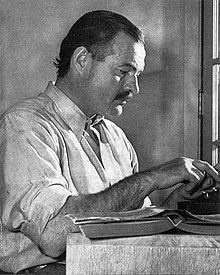
Dark-haired man in light colored short-sleeved shirt working on a typewriter at a table on which sits an open book
Ernest Hemingway

      Isn't truth a funny word?  Most of us appreciate it, most of us desire it. Very few of us, however, can define it.  Philosophers tell us there are essentially two ways of looking at truth.  The correspondence theory suggests that truth is simply that which corresponds to reality.  While this seems logical enough, it raises other questions:  how do we know what is real and how do we therefore know what corresponds to it? 

    Taking a different tack, the coherence theory holds that truth is the sum total of what seems apparent, logical, and right.  Truth is not fixed but is rather what appears to be most correct based on the prevailing evidence.  Yet how do we decide what is most correct and right?

     Though I see virtue in both perspectives, I won't try to reconcile them now.  I merely wish to make an observation about the necessity of truth.  When we insist that truth is relative or a creation of the moment, we are essentially saying that truth does not exist.  If so, we have no good reason to hold that even we exist.  If nothing holds, if nothing is sure, then neither are we.

     We need truth to be truth.  Otherwise, we became like the protagonist of Ernest Hemingway's Farewell to Arms, who, in the final scene of the novel, when he has just watched his wife die giving birth to his child, and then stood by as the child died, too, "put on his hat and walked into the rain."

    The end.

Monday, July 21, 2025

     He's most famous for his painting "The Scream," his portrayal of, as his biographer Sue Prideaux puts it, "the loss of meaning inflicted by the death of God."  But the Norwegian painter Edvard Munch had some insightful things to say about suffering.  

    "I must retain my physical weaknesses; they are an integral part of me.  I don't want to get rid of illness, however unsympathetically I may depict it in my art . . . My fear of life is necessary to me, as is my illness.  Without anxiety and illness, I am a ship without a rudder.  My art is grounded in reflections over being different to others.  My sufferings are part of my self and my art.  They are indistinguishable from me, and their destruction would destroy my art.  I want to keep those sufferings."

    And, "What is art, really?  The outcome of dissatisfaction with life, the point of impact for the creative force, the continual movement of life . . . in my area I attempt to explain life and its meaning to myself."

    However tragic we may consider "The Scream" to be, we can certainly thank Munch for his erudite perception of the importance of malaise and hardship in the formation of a wise human being.

    God is working even when we may not believe he's there.

Wednesday, June 18, 2025

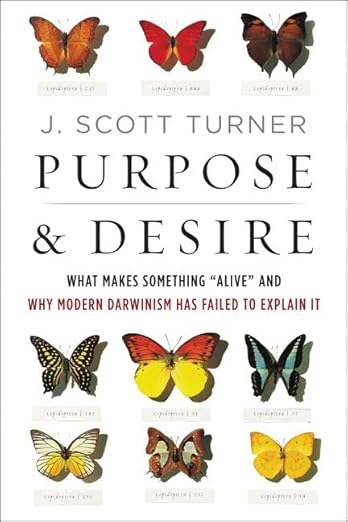
Purpose and Desire: What Makes Something "Alive" and Why Modern Darwinism Has Failed to Explain It

      I've always wondered about the penchant of those who ascribe a totally material origin to the universe and yet insist that purpose is to be found in it.  Somehow, it doesn't add up.

     Making some of the same arguments that atheist philospher Thomas Nagel made in his 2012 Mind and Cosmos:  Why the Materialist Neo-Darwinian Conception of Nature is Almost Certainly False, physiologist and biologist J. Scott Turner, in Purpose and Desire, a book he published about ten years ago, wonders why, too.  Why do we believe we have purpose if we live in what Darwinian evolution decrees to be a meaningless world?

     It's tough.  Clearly, every living thing behaves as if it has purpose, be it a purpose to eat, to seek safety, to reproduce, even to consider the nature of existence.  Yet why would wholly material beings come to think of such things?  Can chemicals desire?  Can chemicals think?

     A thoroughgoing Darwinian evolutionist, Turner does not see how.  He does not see how mentally inert matter can exercise purpose.  Yet he believes in the Darwinian picture of existence.  And while, yes, he believes in God, he is careful in the course of the book not to use such belief as the way to answer his question.

     And maybe that's his point.  Unless a bigger purpose is afoot, unless a larger vision is working through the cosmos, we strive in vain to prove it has purpose.  How can we?  As essentially inert matter, we have no reason to wonder.

     But we do.  Everyday.  We can therefore choose to live with the puzzle of God or we can choose to live without ever being able to explain why we really want to live in the first place.

     It's the choice of a lifetime.

    By the way, I'll be traveling for a few weeks and will not be posting.  Thanks for reading:  we'll talk soon!

Tuesday, June 17, 2025

    Arlington Cemetery, which at 624 acres is one of America’s largest, is a study in valor and pain, a portrait of bravery, solace, and privation, the nation’s most revered place for the final earthly repose of those who have served in the five branches of America’s military.  For many, it is sacred ground, a hallowed site, one on which those who visit it tread with enormous respect and care.

    Why do widows and widowers bring their children here?  They want them to remember.  To remember from whom they came.  To remember what had been.  To remember to keep going.

    We need to remember.  We need to remember our lost loved ones; we need to remember those we lose in wars; we need to remember those billions of people we will likely never meet.
     
    But think about this.  We remember because we believe we and life have a point.  Yet if we have no real reason to suppose this universe should be here, what point is there to make?
 
    Memory is wonderful, yes, but memory only has significance in a remembered universe.

Monday, June 16, 2025

    Because we have been created with speech, the meaningful speech of a meaningful creator who freely chose to speak us and the cosmos into being, we have more meaning than we can possibly imagine.  Moreover, we know that because the creator is meaningful from afar, it is far more so when set before us.

    And it has.  This means that we will see and grasp everything--not all things--we need to know. To understand that one day, life will no longer be a frustratingly finite and heartbreakingly terminal mystery.  We will know.

    Yet it all begins, as does everything else, with speech.  So, speak.  Speak and experience who you are, speak and experience who you can be, speak and experience the truth about the way the world is made.

                                                    Speak, and find the meaning that is your true life and home.

Thursday, June 12, 2025

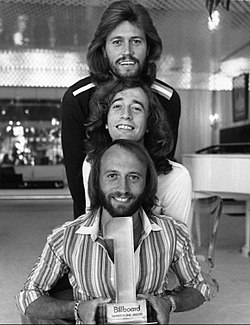
The Bee Gees in 1977 (top to bottom): Barry, Robin and Maurice Gibb

    Do you remember the Bee Gees?  Although they perhaps achieved their greatest fame during the run of disco music in the Eighties, they had been making (and continued to make) music for many other years as well.  Yet for all their success, their lives have been marked by immense tragedy.  I was reminded of this anew as I read a profile about Barry Gibbs, the only remaining Bee Gee.  He tells a sad story of losing not one, not two, but three brothers.  First to go was Andy, dead at age 30 of heart inflammation.  Next was Maurice, gone at 53 from a heart attack.  Finally, there was Robin, who died in London, somewhat older at 63, from cancer in 2012.

    Although many observers have cited bodily abuse—alcohol and drugs—as the principal cause of these premature deaths, this doesn’t take away the pain.  Who wants to lose three brothers?  Life can be supernally wonderful, but it can also be insuperably tragic.  Yes, the writers of Job and Ecclesiastes make clear that people are born to die, that humanity is destined to suffer, and that life has a futility which nothing about or in it cannot fully undo.  But both books also celebrate the marvelous and amazing gift that life is.  "Enjoy life!" says Ecclesiastes 9.  Indeed: who thought of life?

    Not us!

    But here we are.  What do you think?