Thursday, June 30, 2022

     Perhaps you've seen photos, perhaps you've seen his actual art.  Either way, I doubt you have forgotten it.  I speak of the Bulgarian born artist Christo (his full name was Christo Vladimirov Javacheff), most famous for the gargantuan sized art projects which he and his wife Jeanne Claude staged around the world.

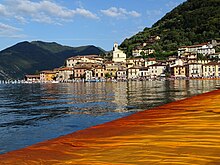
    Christo and Jeanne Claude focused on covering buildings, bridges, parks, even islands with enormous swathes of brightly colored cloth.  Buildings include the Reichstag in Berlin, bridges the Point Neuf in Paris, parks Central Park in New York City, and islands Monte Isola in Italy.  Some of his projects cost nearly thirty million dollars.  Christo and Jeanne Claude financed every one of them with their own money.
    Curiously, both said that, on balance, their projects contained no deeper meaning or transcendent truth.  They viewed their work as pure aesthetic expression, gifts to those who enjoy beauty and new ways of framing the obvious and familiar.  Steps beyond that are rooted in what is already there.

A large field with oversized blue umbrellas at regular intervals. Mountains are barely visible in the background as the fog descends.

    Some laughed at Christo; others lauded him.  But that, I think, bears out the point:  art is made to provoke, to provoke imagination, controversy, longing, and dream.  Be it covering islands in massive sheets of cloth or producing a wood carving of a dog that looks like Santa Claus, art expresses, expresses profoundly, the marvel of the human being.  Born to stay, born to roam:  born to always create a new home.

Friday, June 17, 2022

     Probably many more people are aware of the meaning of June 19 than were a year ago (particularly as last year it was made a national holiday).  It is the date, in 1865, on which slavery officially ended in the United States.  As some of us know, President Abraham Lincoln issued, in September 1862, the Emancipation Proclamation, making it effective July 1, 1863.  In this document he stated that this time forward all slaves were to be set free.  Unfortunately it was not until the end of the Civil War that this goal was actually accomplished.  Those who took up arms against the Union were not willing to manumit their slaves without a struggle.

 
     And what a bloody struggle it was.  So much suffering, so much pain.  So much blood spilled to defend and, alternately, vanquish a lifestyle built upon the forced labor of others.  It was one of the greatest tragedies in American history, one whose effects are still with us today. Prejudice and oppression die very, very hard.
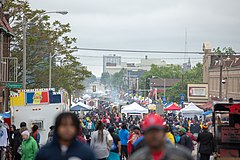
Juneteenth festival in Milwaukee, 2019.jpg

     This is why remembering Juneteenth, as June 19 is often called, is so important.  It is good to remember, it is good to reflect.  It is good to recall George Santanya's prescient words that, "Those who can't remember the past are doomed to repeat it."

     It is also good to realize where we are from.  We're all from dust, dust made into the image of God, dust made to enjoy, to be, to love.  And one day to die.  I pray that we will always live in profound awareness of our place, a place of humility and grace, a place from which we have absolutely no reason to oppress other human beings.  Ever.

    By the way, I'll be traveling for a week or so and will not be posting.  Enjoy the Summer Solstice and thanks for reading!


Thursday, June 16, 2022

Hunting with Eagles

    Falconry.  One of the most ancient expressions of humans connecting with other animals, falconry is still practiced in many parts of the world today.  Falconry presents a striking picture of human beings bonding with another animal to the benefit of both.  Not exploitative but an art that allows the falcon to be itself even while it grows alongside a human being, falconry reminds us of the incredible possibilities of human and animal exchange.

    I think of a person named Hidetoshi Matsubara, highlighted in a blog recently published by the clothing company Patagonia.  For many decades, Matsubara has made falconry his calling, raising, tending, and enabling them through countless seasons of summer, winter, spring, and autumn, making them the near essence of his life's calling.

    Some might call Matsubara's pursuit folly, others misplaced; still others a quest for the wrong thing.  Ours, however, is not to judge, but rather wonder:  what does Matsubara's affinity with falcons say about our potential as human beings?

Image result for Hidetoshi Matsubara

    Maybe we really are, as Genesis 1 points out, made to love and steward the earth and all that is in it, to make it our life mission to care for and nurture the earth even while we care for and nurture ourselves.

    Maybe we are not the only ones who matter to this planet.


Wednesday, June 15, 2022


     Written by Allen Ginsburg, whose birthday we remember this month, one of the so-called Beats of the American Fifties, Howl is a singularly memorable slice of literature, a titanic coming out of the American culture, an honesty about feelings and viewpoints that had rarely heretofore been expressed.

Allen Ginsberg 1979 - cropped.jpg

    While some have rued the day Ginsburg broke into the cultural scene, in truth, America, and the world, may well be better off that he did.  Yes, Ginsburg penned some rather bizarre, even, by some standards, obscene literature, yet there is no doubt that he and his Beat compatriots shook up the staid world of the lily white American Fifties.  Though they probably didn't intend to do so, they reminded any who looked   between the lines that, although God indeed exists, a personal and pervasive presence of love and purpose, humanity must always strive to interpret, and re-interpret, this love and purpose for changing and particular moments of passage and time.  While God does not change, humanity does.

    The challenge is understanding the balance:  the infinite in a finite world or the finite in a finite world.  Whatever else of which Ginsburg may be accused, he and his fellow Beats created a path for, in the long run, profound cultural and religious renewal.

Monday, June 13, 2022

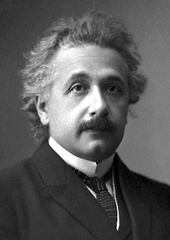
    Writing to the family of his good friend Michele Besso upon his death, Albert Einstein remarks, "Now he [Michele] has departed from this strange world a little ahead of me . . . "

    Ironically, Einstein died a little over a year later.  I share this very brief and frequently used quote of Einstein's to ponder, briefly, the way he described the world:  strange.  Why would the person who established General Relativity call this world strange?

    In another often cited observation Einstein said, "God doesn't play dice with the universe."  Not that Einstein believed in a personal God; he did not.  But he believed that the universe does not function randomly and without any rhyme or reason.

    Is this why he found it strange?  That even given the extraordinarily perplexing, and entirely provable, processes of quantum physics, processes that, from Einstein's viewpoint, appear to render the world wholly unpredictable, the cosmos continues to function, well, on predictable lines.  An unpredictable yet predictable world.  The ultimate paradox.  But a paradox in which people live and die every moment of every day.  Where else would they go?

    On the other hand, such discrepancy, with all its possibility, leaves the universe open, open to greater puzzles still, even the puzzle, I dare say, of God.  

    It is the unpredictable cosmos that underscores the predictability of personal transcendence,

Friday, June 10, 2022

      It was my dear aunt Jeanne who introduced me to the art of Paul Gaugin.  Over twenty years ago, she and my mother traveled to Chicago to take in an exhibit of his work at the Art Institute.  I'm so happy she did.  Today, Gaugin is most well known for his depictions of the people of Tahiti, the island on which he spent his later years.  These paintings depict another world, a world very different from the frenetic world of the West, a world of rest and leisure, openness and unconstructed possibility, a world which people do not try to shape for their own ends, but a world they allow to speak to them.  And from which they learn.

Image result for day of the god gauguin

     
    To let the world be as it should be.
     
    The freneticism of the West often blinds it to what life really is:  a gift from God.  A gift not to be taken lightly.
     Thanks, Monsieur Gaugin, for helping us see beyond our cultural ken.  Happy trails.

Thursday, June 9, 2022

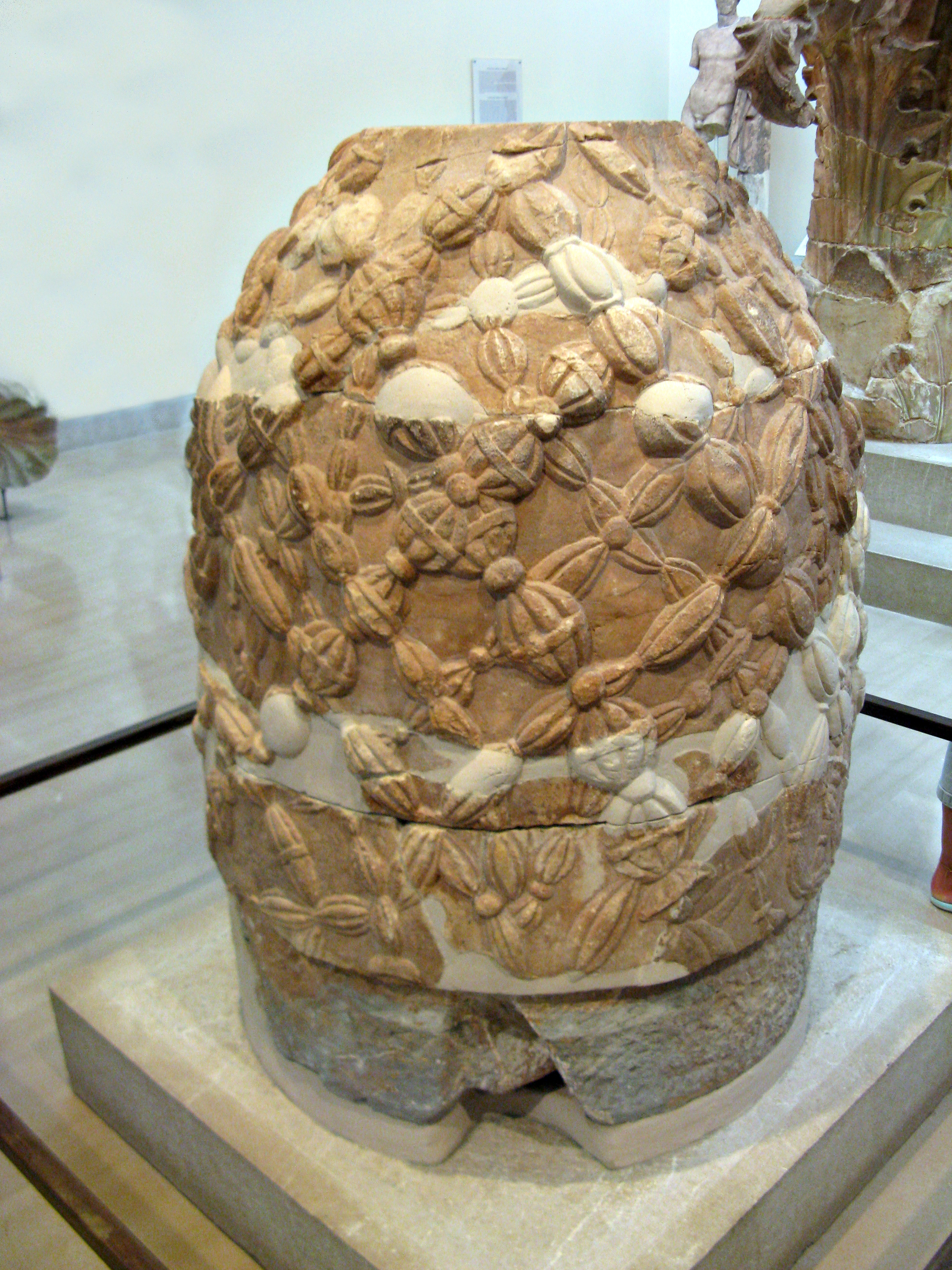
    Omphalos?  What is an omphalos?  A Latin term that appeared often in the annals of ancient Rome, omphalos is best translated as "the center of the world" or the "navel of the universe."  As the proud Romans saw it, their empire was an omphalos, the center, hub, the undisputed lord of the known world.  For them, Rome was the zenith, the highest, the beginning and end of civilization.  Nothing could match Rome, nothing dared challenge it. Why would anyone question the center of the universe?

    Let's now look at omphalos as a center, yes, but center as a home, home as the beginning of our life journey, home, in some way, the end of our existence.  A home as that which runs through the entirety of our lives, shaping, influencing, building and, sometimes, tearing apart.  A home that is always there, home that though it may at times not seem present at all, steadfastly ripples across the currents of our days.  Home as the center of our world.

Omphalos of Delphi - Wikipedia
     
    Long ago, poet William Yeats asked, "Will the center hold?"  One day, our home, our center, will be gone, as will we.  Shorn of its cohering life force, the center itself will vanish, too. Our omphalos will be no more.  
    
    Yet omphalos cannot be the center unless centering is possible.  And in an ordered yet allegedly meaningless world (an oxymoron for sure), how can centering, a centering of thought, meaning, and belief, be?
    
    It almost makes one want to say there is a God.