March 15: the Ides of March. On this day in 44 B.C., Julius Caesar, a general and would-be dictator of the Roman republic was assassinated, set upon by a group of nearly sixty people, including his supposedly best friend and associate Brutus, and stabbed to death on the floor of the Roman Senate. It was an ugly demise.
As the historian Plutarch tells it, some time prior to that day, Caesar was warned by a seer that he would die before the day, March 15, ended. In a movie made about Caesar a decade ago, he was pictured seeing a crow fly overhead as he traveled to the Senate that day. In much ancient lore, including that of Rome, a crow was considered to be a bad omen.
In his piece "Crossroads" (popularized by the long gone band Cream), the legendary blues singer Robert Johnson paints a picture of a decision to be made, a barrier to be bridged and, to borrow from Caesar once again, a Rubicon to be crossed. Though the story is that the song describes a pact that Johnson supposedly made with the Devil, we cannot be sure.
The point is this: we all have our Ides of March, we all have our crossroads. We all face, whether we sense it beforehand or not, potentially transforming moments. How these moments will transform us we usually do not know. But we understand that each of our moments lingers on the cusp of change.
But why? We do so because we believe that the world speaks. We believe that we are creatures of sense living in a sensory world. Yet we only experience our Ides of March, and we only face our crossroads because we and the world are personal. We think, we feel, we love.
In a solely material world, a world absent of transcendent presence, however, such experiences cannot exist. From where would they come?
Chemicals alone will not give us an Ides of March.
Wednesday, March 15, 2017

Tuesday, March 14, 2017
Now that I've resolved some technical issues with my blogging, I blog once more. this time to think about, again, the place of women in the world. Last week, I mentioned that March 8th is International Women's Day. Today I add that the next day, March 9th, is my mother's birthday. She would have been 95 years old. When I think of women, I invariably think of, along with my wife, my mother. A housewife her entire married life, Mom steadfastly pursued and supported, particularly in her later years, the women around the world who were advocating for increased attention to the needs of her fellow females. Though she was a comfortable white suburbanite--a fact of which she was acutely aware--Mom devoted much time, resources, and energy to looking after her kin who had not been so fortunate. Her daughters, my two sisters, did so--and continue to--as well.
What, beyond lauding my mother, is my point? All of us have mothers, all of us came from a woman, somewhere in the world. Perhaps your mother loved you dearly, perhaps she failed to show her affection for you. Perhaps you never knew your mother. Whatever the case may be, we all came from a mother. We all came from a woman who, as I shared a few days ago, had been uniquely gifted by God to gestate and give birth. And although the sin and brokenness of this planet has often fractured the bond of mother and child, its essential truth remains: the enduring truth of a personal God.
What, beyond lauding my mother, is my point? All of us have mothers, all of us came from a woman, somewhere in the world. Perhaps your mother loved you dearly, perhaps she failed to show her affection for you. Perhaps you never knew your mother. Whatever the case may be, we all came from a mother. We all came from a woman who, as I shared a few days ago, had been uniquely gifted by God to gestate and give birth. And although the sin and brokenness of this planet has often fractured the bond of mother and child, its essential truth remains: the enduring truth of a personal God.
Friday, March 10, 2017
Amidst my travels last week, I noticed that March 8th, two days ago, was International Women's Day. It's definitely an occasion to celebrate. After all, it's no secret that, historically, women have frequently been relegated to second place status in almost every area of human existence and that, moreover, this continues to happen, too much, today.
It's time, indeed, way past time to remedy this malady.
 And God would agree. If we examine the verbs the writer of Genesis uses to describe the creation of man and woman, we see why.
The verb used to describe God's creation of Adam is a fairly common one. It connotes a general act of making or creating. It presents the creative act as a rather casual one, as if God put together Adam from various parts he found as he wandered to and fro through the universe (although he really did not).
The verb used to describe the creation of Eve is very different. Used far less frequently, it is a verb that presents creation as a very systematic, thoughtful, and carefully constructed act, as if the creator--God--is working from a blueprint, a very complex activity.
What does this tell us? That although God created man and woman, he did so in different ways. While the man is infinitely important, the woman is the most complex creature in all of creation. Why? Out of the two beings that comprise the human species, only she is able to give birth to human offspring, living, viable beings made in the image of God. Only woman can sustain the human race.
And this is more than enough reason to laud and celebrate women. Clearly, if not for our mothers, none of us would be here today. If not for women, not one person would be able to enjoy this existence.
Most importantly, if not for women, none of us would have opportunity to find God.
It's time, indeed, way past time to remedy this malady.
The verb used to describe God's creation of Adam is a fairly common one. It connotes a general act of making or creating. It presents the creative act as a rather casual one, as if God put together Adam from various parts he found as he wandered to and fro through the universe (although he really did not).
The verb used to describe the creation of Eve is very different. Used far less frequently, it is a verb that presents creation as a very systematic, thoughtful, and carefully constructed act, as if the creator--God--is working from a blueprint, a very complex activity.
What does this tell us? That although God created man and woman, he did so in different ways. While the man is infinitely important, the woman is the most complex creature in all of creation. Why? Out of the two beings that comprise the human species, only she is able to give birth to human offspring, living, viable beings made in the image of God. Only woman can sustain the human race.
And this is more than enough reason to laud and celebrate women. Clearly, if not for our mothers, none of us would be here today. If not for women, not one person would be able to enjoy this existence.
Most importantly, if not for women, none of us would have opportunity to find God.
Thursday, March 2, 2017
H In addition to marking the solemnity of Ash Wednesday yesterday, March 1 is also the birthday of another famous composer: Frederic Chopin. One of the most dazzling musicians of the Romantic Era, Chopin in his too short life (he died at the age of 39) composed a host of memorable pieces for the piano. His works are full of life yet resonate with the sound of memory and contemplation. We listen to them today and think about how his Polish origins blended with his relatively cosmopolitan lifestyle (he was well acquainted with Hungarian composer Franz Liszt and the novelist George Sand) to produce melodies that dig into our soul.
And in the wake of Ash Wednesday, a day on which we take time to meditate on our fragility and mortality, a day also on which we find space to ponder the meaning of our curious conglomeration of physicality and spirit, we remember Chopin. We remember his creativity, we remember his vision. We remember his angst. And we realize, again, that we live in a beautiful yet tragic world, that we dance on a very narrow line between being here and not, and that we, human beings, we magnificent creators, find our humanness most profoundly when we submit to the mystery of whom we may not believe we really are.
 In addition to marking the solemnity of Ash Wednesday yesterday, March 1 is also the birthday of another famous composer: Frederic Chopin. One of the most dazzling musicians of the Romantic Era, Chopin in his too short life (he died at the age of 39) composed a host of memorable pieces for the piano. His works are full of life yet resonate with the sound of memory and contemplation. We listen to them today and think about how his Polish origins blended with his relatively cosmopolitan lifestyle (he was well acquainted with Hungarian composer Franz Liszt and the novelist George Sand) to produce melodies that dig into our soul.
And in the wake of Ash Wednesday, a day on which we take time to meditate on our fragility and mortality, a day also on which we find space to ponder the meaning of our curious conglomeration of physicality and spirit, we remember Chopin. We remember his creativity, we remember his vision. We remember his angst. And we realize, again, that we live in a beautiful yet tragic world, that we dance on a very narrow line between being here and not, and that we, human beings, we magnificent creators, find our humanness most profoundly when we submit to the mystery of whom we may not believe we really are.
By the way, I'll be traveling for about a week, so will not be posting. Thanks for reading. Talk to you next week!
Wednesday, March 1, 2017
Today is Ash Wednesday, the first day of Lent. Ash Wednesday reminds us that, whether we believe in an afterlife or not, we are ultimately no more than dust. When we die and pass out of this life, what remains of us will soon be no more, too, returned to the earth from which it has come. Before my siblings and I scattered my mother's ashes atop her favorite mountain in the San Gabriel Mountains of California in October of 2011, we opened the box that contained "her." All that Mom ever was had been reduced to a small pile of ashes. All her years, all her love, all her joy, all her meaning, all her hopes and dreams now no more than a bag of ashes. It was sobering.
 Even more sobering is that one day, every one of us will be exactly the same. Happily, however, even as it reminds us of our mortality, Ash Wednesday also reminds us to realize that we are not dust and ashes only. We are spiritual beings, physical creatures with spiritual form and vision, created by a transcendent God.
Our death is not the end.
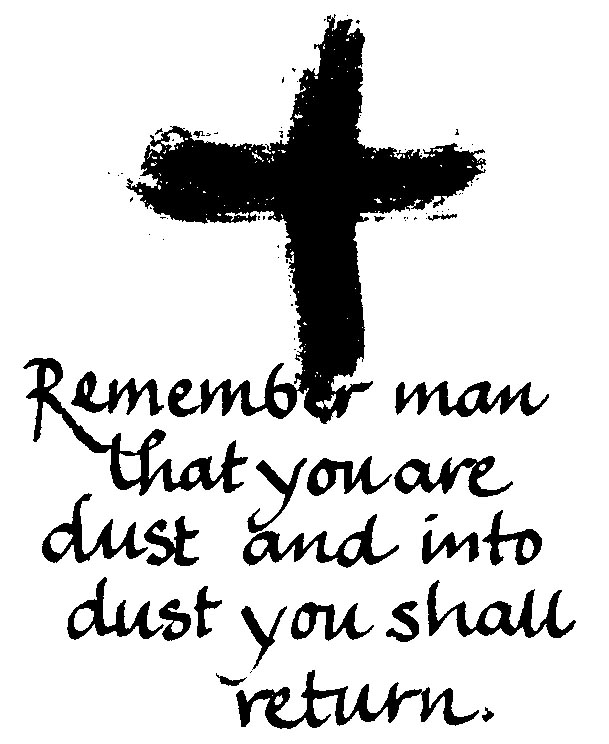 Even more sobering is that one day, every one of us will be exactly the same. Happily, however, even as it reminds us of our mortality, Ash Wednesday also reminds us to realize that we are not dust and ashes only. We are spiritual beings, physical creatures with spiritual form and vision, created by a transcendent God.
Our death is not the end.
Monday, February 27, 2017
Are you privileged? Many of us who live in the West are. Born into affluence, largely white, having access to good educational opportunities, bred to seek greater and greater success (whatever that is), we occupy positions of power, broadly speaking, which few other people on the planet share.
Yesterday, as I was mingling with the congregants of an Unitarian Universalist church which I attend occasionally, primarily to dialogue with fellow members of the atheist discussion group in which I participate, I came across this observation:
Yesterday, as I was mingling with the congregants of an Unitarian Universalist church which I attend occasionally, primarily to dialogue with fellow members of the atheist discussion group in which I participate, I came across this observation:
"When you're accustomed to privilege, equality feels like oppression"
How true, I thought, how true: privilege tends to color how we see everything else. On the other hand, consider the radical counterintuitivity of the imperative, rooted deeply in the pages of the Hebrew and Christian Bibles, that for those to whom much has been given, much is required. Sharing out of our abundance, particularly in a way that results in increased equality of opportunity for all people, is in no way oppression. Quite the opposite. It simply affirms the fact of God's love for every human being.
Friday, February 24, 2017
James Baldwin? Most famous for his memoirs articulating the African-American experience in the Sixties, Baldwin's unfinished memoir was recently made the basis for a movie, I Am Not Your Negro. For those of us who lived through the civil rights movement of the Sixties, Baldwin's recollections and observations ring frightfully true. It was a highly tense and volatile time in America. Too many people died, too many people were hurt, too many people lost everything. And regrettably, way too many people emerged unchanged, racists still, even today.
Although the whites who participated in the movement were thoroughly committed to its goals, they--and they readily admitted to this--would never be able to fully understand what it felt to be a black person in America. Nor do they today. People who are born into what I will call white privilege, though they may do their best to expunge it from their psyche and worldview, will never be able to shake it off completely. Like it or not, its legacy endures.
 When we therefore consider Baldwin's points about the African-American experience, we do well to view them not through the prism of our often mishapen perspective, but through the lens of a God who loves all people in equal measure, a God who enabled and encourages genetic and cultural diversity, a God who dearly wishes for all people to come together in loving community. Would it be that we, all of us human beings, all of us who find outselves living together on this often bewildering planet, look beyond ourselves to the transcendence that defines, undergirds, and frames the rhythms of the cosmos. That we set our hope in something bigger than ourselves.
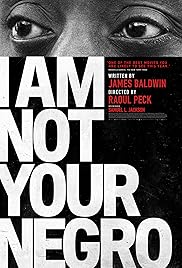 And see the movie: you will not soon forget it.
Although the whites who participated in the movement were thoroughly committed to its goals, they--and they readily admitted to this--would never be able to fully understand what it felt to be a black person in America. Nor do they today. People who are born into what I will call white privilege, though they may do their best to expunge it from their psyche and worldview, will never be able to shake it off completely. Like it or not, its legacy endures.
 When we therefore consider Baldwin's points about the African-American experience, we do well to view them not through the prism of our often mishapen perspective, but through the lens of a God who loves all people in equal measure, a God who enabled and encourages genetic and cultural diversity, a God who dearly wishes for all people to come together in loving community. Would it be that we, all of us human beings, all of us who find outselves living together on this often bewildering planet, look beyond ourselves to the transcendence that defines, undergirds, and frames the rhythms of the cosmos. That we set our hope in something bigger than ourselves.
Subscribe to:
Posts (Atom)